
Mechanical Analysis and Movement Questions & Verified
Answers 100%
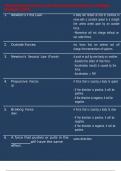
1. Newton's First Law: A body will remain at rest or continue to
move with a constant speed in a straight
line unless acted upon by an outside
force.
-Momentum will not change without an
out- side force.
2. Outside Forces: Any forces that are external and will
change the momentum of system.
3. Newton's Second Law (Force): A push or pull by one body on another.
-Explains the ettect of that force.
-Acceleration (result) is caused by the
force.
-Acceleration = F/M
4. Propulsive Force: A force that is causing a body to speed
up.
-If the direction is positive, it will be
positive.
-If the direction is negative, it will be
negative.
5. Braking Force: A force that is causing a body to slow
down.
-If the direction is positive, it will be
negative.
-If the direction is negative, it will be
positive.
6. A force that pushes or pulls in the same direction
will have the same
effect.
1/
33
,Mechanical Analysis and Movement Questions & Verified
Answers 100%
7. Weight: The force on a body due to a gravity.
-Gravity = -9.81 m/s2
8. Effective (Net) Force: The vector sum of all external forces will
cause an acceleration of the center of
mass.
-A force does not cause an acceleration; a
net (ettective) force does.
2/
33
,Mechanical Analysis and Movement Questions & Verified
Answers 100%
9. If your body is not accelerating, then there must be an equal and
opposite
force to F(g).
10. Newton's Third Law: For every force, there is an equal and
opposite force.
-Occurs when two bodies are in
contact and exert a contact force.
11. Constant Force: the force created when two bodies are
touch- ing each other.
12. Reaction Force: As a consequence of Newton's third
law, for every force created by body A on
body B, there is a force of equal
magnitude and opposite in direction
created by body B acting on body A.
13. Ground Reaction Force: the equal and opposite force the
ground ap- plies back on the person.
14. The force and reaction forces are always: acting on ditterent bodies.
15. Friction: Opposes motion between two objects in
con- tact.
-Will always be parallel to the contact
area.
-Caused by irregularities in the
surfaces be- tween 2 objects.
16. Momentum: L = (m)(v)
17. Impulse: The product of average force and the time
that force is applied.
3/
33
, Mechanical Analysis and Movement Questions & Verified
Answers 100%
-Equal to the change in momentum.
18. To be effective,
4/
33
Answers 100%
1. Newton's First Law: A body will remain at rest or continue to
move with a constant speed in a straight
line unless acted upon by an outside
force.
-Momentum will not change without an
out- side force.
2. Outside Forces: Any forces that are external and will
change the momentum of system.
3. Newton's Second Law (Force): A push or pull by one body on another.
-Explains the ettect of that force.
-Acceleration (result) is caused by the
force.
-Acceleration = F/M
4. Propulsive Force: A force that is causing a body to speed
up.
-If the direction is positive, it will be
positive.
-If the direction is negative, it will be
negative.
5. Braking Force: A force that is causing a body to slow
down.
-If the direction is positive, it will be
negative.
-If the direction is negative, it will be
positive.
6. A force that pushes or pulls in the same direction
will have the same
effect.
1/
33
,Mechanical Analysis and Movement Questions & Verified
Answers 100%
7. Weight: The force on a body due to a gravity.
-Gravity = -9.81 m/s2
8. Effective (Net) Force: The vector sum of all external forces will
cause an acceleration of the center of
mass.
-A force does not cause an acceleration; a
net (ettective) force does.
2/
33
,Mechanical Analysis and Movement Questions & Verified
Answers 100%
9. If your body is not accelerating, then there must be an equal and
opposite
force to F(g).
10. Newton's Third Law: For every force, there is an equal and
opposite force.
-Occurs when two bodies are in
contact and exert a contact force.
11. Constant Force: the force created when two bodies are
touch- ing each other.
12. Reaction Force: As a consequence of Newton's third
law, for every force created by body A on
body B, there is a force of equal
magnitude and opposite in direction
created by body B acting on body A.
13. Ground Reaction Force: the equal and opposite force the
ground ap- plies back on the person.
14. The force and reaction forces are always: acting on ditterent bodies.
15. Friction: Opposes motion between two objects in
con- tact.
-Will always be parallel to the contact
area.
-Caused by irregularities in the
surfaces be- tween 2 objects.
16. Momentum: L = (m)(v)
17. Impulse: The product of average force and the time
that force is applied.
3/
33
, Mechanical Analysis and Movement Questions & Verified
Answers 100%
-Equal to the change in momentum.
18. To be effective,
4/
33


