

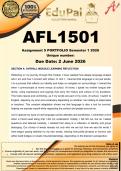
AFL1501
Assignment 5 PORTFOLIO Semester 1 2026
Unique number:
Due Date: 2 June 2026
SECTION A: OVERALL MODULE LEARNING REFLECTION
Reflecting on my journey through this module, I have realised how deeply language shapes
who I am and how I connect with others. In Unit 1, I learned that language is not just words;
it is a process that reflects our identity and helps us navigate our surroundings. I noticed this
when I communicate at home versus at school. At home, I speak my mother tongue with
family, using expressions and sayings that carry the history and culture of my ancestors.
This feels natural and comforting, as if my words are part of my roots. At school, I switch to
English, adjusting my tone and vocabulary depending on whether I am talking to classmates
or teachers. This constant adaptation shows me that language is also a tool for survival,
helping me express myself while respecting the context and people around me.
Unit 2 opened my eyes to how language carries attitudes and worldviews. I remember a time
when a friend used slang that I did not understand. Initially, I felt left out, but as I asked
questions and listened carefully, I realised that slang is a reflection of identity and group
belonging. Our choice of words reveals not only who we are but how we see the world. I
have begun paying attention to my own words, noticing how polite phrases or humour can
either build bridges or create misunderstandings, depending on the listener‘s perspective.
Terms of use
By making use of this document you agree to:
Use this document as a guide for learning, comparison and reference purpose,
Terms of use
Not to duplicate, reproduce and/or misrepresent the contents of this document as your own work,
By making use of this document you agree to:
Use this document
Fully accept the consequences
solely as a guide forshould you plagiarise
learning, reference,or and
misuse this document.
comparison purposes,
Ensure originality of your own work, and fully accept the consequences should you plagiarise or misuse this document.
Comply with all relevant standards, guidelines, regulations, and legislation governing academic and written work.
Disclaimer
Great care has been taken in the preparation of this document; however, the contents are provided "as is" without any express or
implied representations or warranties. The author accepts no responsibility or liability for any actions taken based on the
information contained within this document. This document is intended solely for comparison, research, and reference purposes.
Reproduction, resale, or transmission of any part of this document, in any form or by any means, is strictly prohibited.
, +27 81 278 3372
SECTION A: OVERALL MODULE LEARNING REFLECTION
Reflecting on my journey through this module, I have realised how deeply language
shapes who I am and how I connect with others. In Unit 1, I learned that language is
not just words; it is a process that reflects our identity and helps us navigate our
surroundings. I noticed this when I communicate at home versus at school. At home,
I speak my mother tongue with family, using expressions and sayings that carry the
history and culture of my ancestors. This feels natural and comforting, as if my words
are part of my roots. At school, I switch to English, adjusting my tone and vocabulary
depending on whether I am talking to classmates or teachers. This constant
adaptation shows me that language is also a tool for survival, helping me express
myself while respecting the context and people around me.
Unit 2 opened my eyes to how language carries attitudes and worldviews. I
remember a time when a friend used slang that I did not understand. Initially, I felt
left out, but as I asked questions and listened carefully, I realised that slang is a
reflection of identity and group belonging. Our choice of words reveals not only who
we are but how we see the world. I have begun paying attention to my own words,
noticing how polite phrases or humour can either build bridges or create
misunderstandings, depending on the listener‘s perspective.
Unit 3 focused on language and identity, which made me reflect on my name and
family background. Sharing stories about my family in class showed me how names,
kinship terms, and everyday speech shape relationships. For example, calling my
grandmother ―Gogo‖ in our language carries respect, warmth, and connection, while
simply saying ―grandmother‖ in English lacks the same intimacy. This taught me that
language is a powerful way of showing who we are in our cultural context and how
we connect to others.
Unit 4 explored interpersonal communication, and I saw this in my own friendships.
Misunderstandings often arise not because of disagreement but because people
interpret words differently. I recall a group project where I misunderstood a
classmate‘s instructions due to differences in phrasing. Clarifying and listening
attentively allowed us to work together effectively. This reinforced that
communication is not only about speaking but also about understanding and
adapting to others.
Disclaimer
Great care has been taken in the preparation of this document; however, the contents are provided "as is"
without any express or implied representations or warranties. The author accepts no responsibility or
liability for any actions taken based on the information contained within this document. This document is
intended solely for comparison, research, and reference purposes. Reproduction, resale, or transmission
of any part of this document, in any form or by any means, is strictly prohibited.
Assignment 5 PORTFOLIO Semester 1 2026
Unique number:
Due Date: 2 June 2026
SECTION A: OVERALL MODULE LEARNING REFLECTION
Reflecting on my journey through this module, I have realised how deeply language shapes
who I am and how I connect with others. In Unit 1, I learned that language is not just words;
it is a process that reflects our identity and helps us navigate our surroundings. I noticed this
when I communicate at home versus at school. At home, I speak my mother tongue with
family, using expressions and sayings that carry the history and culture of my ancestors.
This feels natural and comforting, as if my words are part of my roots. At school, I switch to
English, adjusting my tone and vocabulary depending on whether I am talking to classmates
or teachers. This constant adaptation shows me that language is also a tool for survival,
helping me express myself while respecting the context and people around me.
Unit 2 opened my eyes to how language carries attitudes and worldviews. I remember a time
when a friend used slang that I did not understand. Initially, I felt left out, but as I asked
questions and listened carefully, I realised that slang is a reflection of identity and group
belonging. Our choice of words reveals not only who we are but how we see the world. I
have begun paying attention to my own words, noticing how polite phrases or humour can
either build bridges or create misunderstandings, depending on the listener‘s perspective.
Terms of use
By making use of this document you agree to:
Use this document as a guide for learning, comparison and reference purpose,
Terms of use
Not to duplicate, reproduce and/or misrepresent the contents of this document as your own work,
By making use of this document you agree to:
Use this document
Fully accept the consequences
solely as a guide forshould you plagiarise
learning, reference,or and
misuse this document.
comparison purposes,
Ensure originality of your own work, and fully accept the consequences should you plagiarise or misuse this document.
Comply with all relevant standards, guidelines, regulations, and legislation governing academic and written work.
Disclaimer
Great care has been taken in the preparation of this document; however, the contents are provided "as is" without any express or
implied representations or warranties. The author accepts no responsibility or liability for any actions taken based on the
information contained within this document. This document is intended solely for comparison, research, and reference purposes.
Reproduction, resale, or transmission of any part of this document, in any form or by any means, is strictly prohibited.
, +27 81 278 3372
SECTION A: OVERALL MODULE LEARNING REFLECTION
Reflecting on my journey through this module, I have realised how deeply language
shapes who I am and how I connect with others. In Unit 1, I learned that language is
not just words; it is a process that reflects our identity and helps us navigate our
surroundings. I noticed this when I communicate at home versus at school. At home,
I speak my mother tongue with family, using expressions and sayings that carry the
history and culture of my ancestors. This feels natural and comforting, as if my words
are part of my roots. At school, I switch to English, adjusting my tone and vocabulary
depending on whether I am talking to classmates or teachers. This constant
adaptation shows me that language is also a tool for survival, helping me express
myself while respecting the context and people around me.
Unit 2 opened my eyes to how language carries attitudes and worldviews. I
remember a time when a friend used slang that I did not understand. Initially, I felt
left out, but as I asked questions and listened carefully, I realised that slang is a
reflection of identity and group belonging. Our choice of words reveals not only who
we are but how we see the world. I have begun paying attention to my own words,
noticing how polite phrases or humour can either build bridges or create
misunderstandings, depending on the listener‘s perspective.
Unit 3 focused on language and identity, which made me reflect on my name and
family background. Sharing stories about my family in class showed me how names,
kinship terms, and everyday speech shape relationships. For example, calling my
grandmother ―Gogo‖ in our language carries respect, warmth, and connection, while
simply saying ―grandmother‖ in English lacks the same intimacy. This taught me that
language is a powerful way of showing who we are in our cultural context and how
we connect to others.
Unit 4 explored interpersonal communication, and I saw this in my own friendships.
Misunderstandings often arise not because of disagreement but because people
interpret words differently. I recall a group project where I misunderstood a
classmate‘s instructions due to differences in phrasing. Clarifying and listening
attentively allowed us to work together effectively. This reinforced that
communication is not only about speaking but also about understanding and
adapting to others.
Disclaimer
Great care has been taken in the preparation of this document; however, the contents are provided "as is"
without any express or implied representations or warranties. The author accepts no responsibility or
liability for any actions taken based on the information contained within this document. This document is
intended solely for comparison, research, and reference purposes. Reproduction, resale, or transmission
of any part of this document, in any form or by any means, is strictly prohibited.




