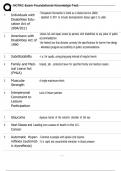
NCTRC Exam Foundational Knowledge Test.
-Therapeutic Recreation is listed as a related service (2004)
1. Individuals with
- Updated in 2011 to include developmental delays aged 2 & under
Disabilities Edu-
cation Act of
2004/2011
-Allows full and equal access by persons with disabilities to any place of public
2. Americans with
accommodation
Disabilities Act of
-the federal law that dictates currently the specifications for barrier free design
1990
- Mandates program accessibility in public accommodations
3. Substitutability -i.e. for quads, using ping pong instead of regular tennis
4. Family and Med- Unpaid, job - protected leave for specified family and medical reasons
ical Leave Act
(FMLA)
5. Muscular A single maximum ettort
Strength
6. Interpersonal Lack of leisure partners
Constraint to
Leisure
Participation
7. Glaucoma Aqueous humor of the anterior chamber of the eye
8. Heart Disease and Leading two causes of death in the U.S.
Cancer
9. Automatic Hyper- -Common in people with spinal cord injuries
reflexia (automat- -It is rapid and uncontrolled elevation in blood pressure
ic dysreflexia)
, NCTRC Exam Foundational Knowledge Test.
10. Times obstacle course
, NCTRC Exam Foundational Knowledge Test.
Best test for agili-
ty?
11. Aphasia Inability to comprehend and formulate words
12. Visual and Hear- Significantly reduced physical fitness
ing impaired
clients
13. T1&T2 Dividing vertebrae between being classified as a para and quad
14. Achieving an opti- The activity challenge and their skill level are nearly equal
mal experience
15. Medicare (Federal -Individual 65 and older
health insurance -Individuals under age 65 with certain disabilities
program) -Individuals with end-stage renal disease
16. Myasthenia Chronic autoimmune neuromuscular disease (droopy eyelid and mouth)
Gravis
17. Most difficult in- Lack of participant interest
terpersonal con-
straint for CTRS?
18. Goal: "To increase Intervention: Ballroom dancing (two people cooperating together)
clients dyad coop-
eration skills"
19. According to Na- Pain
tional Institutes of
Health what oc-
curs more fre-
quently than dia-