
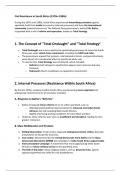
Civil Resistance in South Africa (1970s–1980s)
During the 1970s and 1980s, South Africa experienced intensifying resistance against
apartheid, both from inside the country (internal pressures) and from the international
community (external pressures). The National Party government, led by P.W. Botha,
responded with a mix of reform and repression, known as Total Strategy.
1. The Concept of "Total Onslaught" and "Total Strategy"
• Total Onslaught was a term used by the apartheid government to claim that South
Africa was under attack from communists, including the USSR and Cuba.
• The government argued that protests, international criticism, and guerrilla attacks
were all part of a coordinated effort to overthrow white rule.
• To counter this, Total Strategy was introduced, which included:
o Reforms (small changes to apartheid to appear more inclusive and ease
tensions).
o Repression (harsh crackdowns on opposition movements).
2. Internal Pressures (Resistance Within South Africa)
By the late 1970s, resistance within South Africa was becoming more organized and
widespread. Some key forms of resistance included:
A. Response to Botha's "Reforms"
• Botha introduced minor reforms to try to soften apartheid, such as:
o Allowing limited political representation for Coloured and Indian South
Africans, but still excluding Black South Africans.
o Slightly improving working conditions for some Black workers.
• However, these reforms were seen as insufficient and deceptive, leading to even
greater resistance.
B. Mass Mobilization and Protests
1. Rolling Mass Action: Trade unions organized widespread worker strikes, boycotts,
and protests to disrupt the economy.
2. Civic Action: Movements like the United Democratic Front (UDF) and the Mass
Democratic Movement (MDM) led campaigns to make South Africa ungovernable.
3. End Conscription Campaign: A movement that encouraged young white South
Africans to refuse military service in the apartheid army.
4. The Role of Churches: Many religious leaders, such as Desmond Tutu, openly
opposed apartheid and called for civil disobedience.
During the 1970s and 1980s, South Africa experienced intensifying resistance against
apartheid, both from inside the country (internal pressures) and from the international
community (external pressures). The National Party government, led by P.W. Botha,
responded with a mix of reform and repression, known as Total Strategy.
1. The Concept of "Total Onslaught" and "Total Strategy"
• Total Onslaught was a term used by the apartheid government to claim that South
Africa was under attack from communists, including the USSR and Cuba.
• The government argued that protests, international criticism, and guerrilla attacks
were all part of a coordinated effort to overthrow white rule.
• To counter this, Total Strategy was introduced, which included:
o Reforms (small changes to apartheid to appear more inclusive and ease
tensions).
o Repression (harsh crackdowns on opposition movements).
2. Internal Pressures (Resistance Within South Africa)
By the late 1970s, resistance within South Africa was becoming more organized and
widespread. Some key forms of resistance included:
A. Response to Botha's "Reforms"
• Botha introduced minor reforms to try to soften apartheid, such as:
o Allowing limited political representation for Coloured and Indian South
Africans, but still excluding Black South Africans.
o Slightly improving working conditions for some Black workers.
• However, these reforms were seen as insufficient and deceptive, leading to even
greater resistance.
B. Mass Mobilization and Protests
1. Rolling Mass Action: Trade unions organized widespread worker strikes, boycotts,
and protests to disrupt the economy.
2. Civic Action: Movements like the United Democratic Front (UDF) and the Mass
Democratic Movement (MDM) led campaigns to make South Africa ungovernable.
3. End Conscription Campaign: A movement that encouraged young white South
Africans to refuse military service in the apartheid army.
4. The Role of Churches: Many religious leaders, such as Desmond Tutu, openly
opposed apartheid and called for civil disobedience.


