

Exam 1: Psychiatric Mental Health Nursing Practice
Exam | 260 Questions with Verified Answers and
Rationale | 100% Correct | Latest 2025/2026.
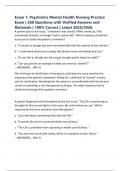
A patient says to the nurse, "I dreamed I was stoned. When I woke up, I felt
emotionally drained, as though I hadn't rested well." Which response should the
nurse use to clarify the patient's comment?
a. "It sounds as though you were uncomfortable with the content of your dream."
b. "I understand what you're saying. Bad dreams leave me feeling tired, too."
c. "So you feel as though you did not get enough quality sleep last night?"
d. "Can you give me an example of what you mean by 'stoned'?" -
...(ANSWERS)....ANS: D
The technique of clarification is therapeutic and helps the nurse examine the
meaning of the patient's statement. Asking for a definition of "stoned" directly
asks for clarification. Restating that the patient is uncomfortable with the dream's
content is parroting, a non-therapeutic technique. The other responses fail to
clarify the meaning of the patient's comment.
A patient diagnosed with schizophrenia tells the nurse, "The CIA is monitoring us
through the fluorescent lights in this room. Be careful what you say." Which
response by the nurse would be most therapeutic?
a. "Let's talk about something other than the CIA."
b. "It sounds like you're concerned about your privacy."
c. "The CIA is prohibited from operating in health care facilities."
d. "You have lost touch with reality, which is a symptom of your illness." -
...(ANSWERS)....ANS: B
,It is important not to challenge the patient's beliefs, even if they are unrealistic.
Challenging undermines the patient's trust in the nurse. The nurse should try to
understand the underlying feelings or thoughts the patient's message conveys.
The correct response uses the therapeutic technique of reflection. The other
comments are non-therapeutic. Asking to talk about something other than the
concern at hand is changing the subject. Saying that the CIA is prohibited from
operating in health care facilities gives false reassurance. Stating that the patient
has lost touch with reality is truthful, but uncompassionate.
The patient says, "My marriage is just great. My spouse and I always agree." The
nurse observes the patient's foot moving continuously as the patient twirls a shirt
button. The conclusion the nurse can draw is that the patient's communication is:
a. clear.
b. mixed.
c. precise.
d. inadequate. - ...(ANSWERS)....ANS: B
Mixed messages involve the transmission of conflicting or incongruent messages
by the speaker. The patient's verbal message that all was well in the relationship
was modified by the nonverbal behaviors denoting anxiety. Data are not present
to support the choice of the verbal message being clear, explicit, or inadequate.
A nurse interacts with a newly hospitalized patient. Select the nurse's comment
that applies the communication technique of "offering self."
a. "I've also had traumatic life experiences. Maybe it would help if I told you about
them."
b. "Why do you think you had so much difficulty adjusting to this change in your
life?"
,c. "I hope you will feel better after getting accustomed to how this unit operates."
d. "I'd like to sit with you for a while to help you get comfortable talking to me." -
...(ANSWERS)....ANS: D
"Offering self" is a technique that should be used in the orientation phase of the
nurse-patient relationship. Sitting with the patient, an example of "offering self,"
helps to build trust and convey that the nurse cares about the patient. Two
incorrect responses are ineffective and non-therapeutic. The other incorrect
response is therapeutic but is an example of "offering hope."
Which technique will best communicate to a patient that the nurse is interested
in listening?
a. Restating a feeling or thought the patient has expressed.
b. Asking a direct question, such as "Did you feel angry?"
c. Making a judgment about the patient's problem.
d. Saying, "I understand what you're saying." - ...(ANSWERS)....ANS: A
Restating allows the patient to validate the nurse's understanding of what has
been communicated. Restating is an active listening technique. Judgments should
be suspended in a nurse-patient relationship. Close-ended questions such as "Did
you feel angry?" ask for specific information rather than showing understanding.
When the nurse simply states that he or she understands the patient's words, the
patient has no way of measuring the understanding.
A patient discloses several concerns and associated feelings. If the nurse wants to
seek clarification, which comment would be appropriate?
a. "What are the common elements here?"
b. "Tell me again about your experiences."
, c. "Am I correct in understanding that . . ."
d. "Tell me everything from the beginning." - ...(ANSWERS)....ANS: C
Asking, "Am I correct in understanding that..." permits clarification to ensure that
both the nurse and patient share mutual understanding of the communication.
Asking about common elements encourages comparison rather than clarification.
The remaining responses are implied questions that suggest the nurse was not
listening.
A patient tells the nurse, "I don't think I'll ever get out of here." Select the nurse's
most therapeutic response.
a. "Don't talk that way. Of course you will leave here!"
b. "Keep up the good work, and you certainly will."
c. "You don't think you're making progress?"
d. "Everyone feels that way sometimes." - ...(ANSWERS)....ANS: C
By asking if the patient does not believe that progress has been made, the nurse
is reflecting by putting into words what the patient is hinting. By making
communication more explicit, issues are easier to identify and resolve. The
remaining options are non-therapeutic techniques. Telling the patient not to "talk
that way" is disapproving. Saying that everyone feels that way at times minimizes
feelings. Telling the patient that good work will always result in success is falsely
reassuring.
Documentation in a patient's chart shows, "Throughout a 5-minute interaction,
patient fidgeted and tapped left foot, periodically covered face with hands, and
looked under chair while stating, 'I enjoy spending time with you.'" Which analysis
is most accurate?
Exam | 260 Questions with Verified Answers and
Rationale | 100% Correct | Latest 2025/2026.
A patient says to the nurse, "I dreamed I was stoned. When I woke up, I felt
emotionally drained, as though I hadn't rested well." Which response should the
nurse use to clarify the patient's comment?
a. "It sounds as though you were uncomfortable with the content of your dream."
b. "I understand what you're saying. Bad dreams leave me feeling tired, too."
c. "So you feel as though you did not get enough quality sleep last night?"
d. "Can you give me an example of what you mean by 'stoned'?" -
...(ANSWERS)....ANS: D
The technique of clarification is therapeutic and helps the nurse examine the
meaning of the patient's statement. Asking for a definition of "stoned" directly
asks for clarification. Restating that the patient is uncomfortable with the dream's
content is parroting, a non-therapeutic technique. The other responses fail to
clarify the meaning of the patient's comment.
A patient diagnosed with schizophrenia tells the nurse, "The CIA is monitoring us
through the fluorescent lights in this room. Be careful what you say." Which
response by the nurse would be most therapeutic?
a. "Let's talk about something other than the CIA."
b. "It sounds like you're concerned about your privacy."
c. "The CIA is prohibited from operating in health care facilities."
d. "You have lost touch with reality, which is a symptom of your illness." -
...(ANSWERS)....ANS: B
,It is important not to challenge the patient's beliefs, even if they are unrealistic.
Challenging undermines the patient's trust in the nurse. The nurse should try to
understand the underlying feelings or thoughts the patient's message conveys.
The correct response uses the therapeutic technique of reflection. The other
comments are non-therapeutic. Asking to talk about something other than the
concern at hand is changing the subject. Saying that the CIA is prohibited from
operating in health care facilities gives false reassurance. Stating that the patient
has lost touch with reality is truthful, but uncompassionate.
The patient says, "My marriage is just great. My spouse and I always agree." The
nurse observes the patient's foot moving continuously as the patient twirls a shirt
button. The conclusion the nurse can draw is that the patient's communication is:
a. clear.
b. mixed.
c. precise.
d. inadequate. - ...(ANSWERS)....ANS: B
Mixed messages involve the transmission of conflicting or incongruent messages
by the speaker. The patient's verbal message that all was well in the relationship
was modified by the nonverbal behaviors denoting anxiety. Data are not present
to support the choice of the verbal message being clear, explicit, or inadequate.
A nurse interacts with a newly hospitalized patient. Select the nurse's comment
that applies the communication technique of "offering self."
a. "I've also had traumatic life experiences. Maybe it would help if I told you about
them."
b. "Why do you think you had so much difficulty adjusting to this change in your
life?"
,c. "I hope you will feel better after getting accustomed to how this unit operates."
d. "I'd like to sit with you for a while to help you get comfortable talking to me." -
...(ANSWERS)....ANS: D
"Offering self" is a technique that should be used in the orientation phase of the
nurse-patient relationship. Sitting with the patient, an example of "offering self,"
helps to build trust and convey that the nurse cares about the patient. Two
incorrect responses are ineffective and non-therapeutic. The other incorrect
response is therapeutic but is an example of "offering hope."
Which technique will best communicate to a patient that the nurse is interested
in listening?
a. Restating a feeling or thought the patient has expressed.
b. Asking a direct question, such as "Did you feel angry?"
c. Making a judgment about the patient's problem.
d. Saying, "I understand what you're saying." - ...(ANSWERS)....ANS: A
Restating allows the patient to validate the nurse's understanding of what has
been communicated. Restating is an active listening technique. Judgments should
be suspended in a nurse-patient relationship. Close-ended questions such as "Did
you feel angry?" ask for specific information rather than showing understanding.
When the nurse simply states that he or she understands the patient's words, the
patient has no way of measuring the understanding.
A patient discloses several concerns and associated feelings. If the nurse wants to
seek clarification, which comment would be appropriate?
a. "What are the common elements here?"
b. "Tell me again about your experiences."
, c. "Am I correct in understanding that . . ."
d. "Tell me everything from the beginning." - ...(ANSWERS)....ANS: C
Asking, "Am I correct in understanding that..." permits clarification to ensure that
both the nurse and patient share mutual understanding of the communication.
Asking about common elements encourages comparison rather than clarification.
The remaining responses are implied questions that suggest the nurse was not
listening.
A patient tells the nurse, "I don't think I'll ever get out of here." Select the nurse's
most therapeutic response.
a. "Don't talk that way. Of course you will leave here!"
b. "Keep up the good work, and you certainly will."
c. "You don't think you're making progress?"
d. "Everyone feels that way sometimes." - ...(ANSWERS)....ANS: C
By asking if the patient does not believe that progress has been made, the nurse
is reflecting by putting into words what the patient is hinting. By making
communication more explicit, issues are easier to identify and resolve. The
remaining options are non-therapeutic techniques. Telling the patient not to "talk
that way" is disapproving. Saying that everyone feels that way at times minimizes
feelings. Telling the patient that good work will always result in success is falsely
reassuring.
Documentation in a patient's chart shows, "Throughout a 5-minute interaction,
patient fidgeted and tapped left foot, periodically covered face with hands, and
looked under chair while stating, 'I enjoy spending time with you.'" Which analysis
is most accurate?


