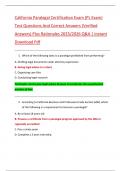
California Paralegal Certification Exam (PL Exam)
Test Questions And Correct Answers (Verified
Answers) Plus Rationales 2025/2026 Q&A | Instant
Download Pdf
1. Which of the following tasks is a paralegal prohibited from performing?
A. Drafting legal documents under attorney supervision
B. Giving legal advice to a client
C. Organizing case files
D. Conducting legal research
Paralegals cannot give legal advice because it constitutes the unauthorized
practice of law.
2. According to California Business and Professions Code Section 6450, which
of the following is a requirement to become a paralegal?
A. Be at least 18 years old
B. Possess a certificate from a paralegal program approved by the ABA or
regionally accredited
C. Pass a state exam
D. Complete a 2-year internship
,A paralegal must have completed education from an ABA-approved or
regionally accredited program.
3. Under California law, how many hours of continuing legal education (CLE)
are required for paralegals every two years?
A. 4
B. 8
C. 12
D. 8 hours (4 in legal ethics and 4 in general law)
California requires 8 hours of CLE every two years: 4 in legal ethics and 4 in
general legal studies.
4. What is the term for protecting client communications under attorney-
client privilege?
A. Legal immunity
B. Confidentiality
C. Pro bono protection
D. Privacy
Confidentiality ensures that privileged communication between a client and
attorney is protected.
5. Which of the following may a paralegal do legally?
, A. Represent a client in court
B. Prepare legal documents under attorney supervision
C. Set legal fees for a law firm
D. Provide legal advice in immigration cases
Paralegals may prepare documents as long as it’s under attorney supervision.
6. Which legal document starts a civil lawsuit?
A. Motion
B. Complaint
C. Answer
D. Writ
The complaint initiates a civil lawsuit by stating the claims against the
defendant.
7. What does "pro bono" mean?
A. For the public good
B. Without discovery
C. Filed after judgment
D. A type of jurisdiction
“Pro bono” refers to legal services provided for free or for the public good.
8. What is a deposition?
Test Questions And Correct Answers (Verified
Answers) Plus Rationales 2025/2026 Q&A | Instant
Download Pdf
1. Which of the following tasks is a paralegal prohibited from performing?
A. Drafting legal documents under attorney supervision
B. Giving legal advice to a client
C. Organizing case files
D. Conducting legal research
Paralegals cannot give legal advice because it constitutes the unauthorized
practice of law.
2. According to California Business and Professions Code Section 6450, which
of the following is a requirement to become a paralegal?
A. Be at least 18 years old
B. Possess a certificate from a paralegal program approved by the ABA or
regionally accredited
C. Pass a state exam
D. Complete a 2-year internship
,A paralegal must have completed education from an ABA-approved or
regionally accredited program.
3. Under California law, how many hours of continuing legal education (CLE)
are required for paralegals every two years?
A. 4
B. 8
C. 12
D. 8 hours (4 in legal ethics and 4 in general law)
California requires 8 hours of CLE every two years: 4 in legal ethics and 4 in
general legal studies.
4. What is the term for protecting client communications under attorney-
client privilege?
A. Legal immunity
B. Confidentiality
C. Pro bono protection
D. Privacy
Confidentiality ensures that privileged communication between a client and
attorney is protected.
5. Which of the following may a paralegal do legally?
, A. Represent a client in court
B. Prepare legal documents under attorney supervision
C. Set legal fees for a law firm
D. Provide legal advice in immigration cases
Paralegals may prepare documents as long as it’s under attorney supervision.
6. Which legal document starts a civil lawsuit?
A. Motion
B. Complaint
C. Answer
D. Writ
The complaint initiates a civil lawsuit by stating the claims against the
defendant.
7. What does "pro bono" mean?
A. For the public good
B. Without discovery
C. Filed after judgment
D. A type of jurisdiction
“Pro bono” refers to legal services provided for free or for the public good.
8. What is a deposition?