

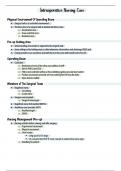
Intraoperative Nursing Care
Physical Environment Of Operating Room
• Surgical suite is a controlled environment
• The floor plan of a surgical suite is divided into three zones:
o Unrestricted area
o Semi restricted area
o Restricted area
Pre-op Holding Area
• Special waiting area inside or adjacent to the surgical suite
• Some seings in the holding area is called admission, observation, and discharge (AOD) unit
• Family members can sometimes wait with the pt in this area until transferred to the OR
Operating Room
• Controlled
o Restricted in terms of the inflow and outflow of staff
o Next to PACU and SICU
o Filters and controlled airflow in the ventilating systems provide dust control
o Positive air pressure prevents air from entering the OR from the halls
o Open shelves omied
Members of The Surgical Team
• Registered nurse:
o Circulating
o Scrub nurse
• Surgeon and assistant:
o Surgical technologist
• Registered nurse first assistant (RNFA)
• Anesthesia care provider (ACP)
o Anesthesiologist
o CRNA
Nursing Management (Pre-op)
• Nursing activities before, during, and after surgery
o Psychosocial assessment
o Physical assessment
o Chart review
§ Only good for 30 days
§ No consent= find POAà need 2 people to witness then nurse signs
o Admiing the patient
, Nursing Management (Intra-op)
• Room preparationà circulating and scrub nurse
• Transferring patientà circulating nurse
• Scrubbing, gowning, and glovingà scrub nurse
o Surgical hand antiseptics
• Basic aseptic technique
• Assisting the ACPà nurse helps maintain airway
• Safety considerations:
o Surgical care improvement project:
§ A national quality partnership of organization focused on improving surgical care by significantly
reducing the number of complications from surgery
§ SCIP measure: a prophylactic antibiotic started within 30 to 60 min before the surgical incision to decrease
risk of infection
• Delay if surgery is rescheduled
• Give heated blanketà prevents hypothermia
• Compression devicesà prevent DVT
o Universal protocol:
§ Part of a global patient safety initiative launched by the WHO
§ Preventing wrong pt, wrong site, wrong procedure, and wrong surgery
o Surgical time-out:
§ Verify pt ID, surgical procedure, and surgical site
• ID pt by asking name, DOB, and operative procedure and location
• Compare hospital ID number with pts own ID band and chart
• Prepping the surgical site:
o Clean site to prevent infection
o Clean in bullseye fashion then drape
• Positioning the pt:
o Bad alignment could cause nerve damage
Anesthesia
• The limited or total loss of feeling with or without loss of consciousness
• Classification:
o Moderate to deep sedation
§ Used for procedures outside of the OR
• Could be in ER
§ Sedative, anxiolytic (anxiety agent), and/or analgesic drugs used
§ No inhalation agents
§ Patients responsive and breathe w/o assistance
§ Used for minor procedures (ex. realign fracture)
• Formerly known as conscious sedation
§ Do not need ACP, nurse can administer w/ MD and RT
o Monitored anesthesia care (MAC)
§ Used for procedures performed in or outside the OR
• Could be for endoscopy
Physical Environment Of Operating Room
• Surgical suite is a controlled environment
• The floor plan of a surgical suite is divided into three zones:
o Unrestricted area
o Semi restricted area
o Restricted area
Pre-op Holding Area
• Special waiting area inside or adjacent to the surgical suite
• Some seings in the holding area is called admission, observation, and discharge (AOD) unit
• Family members can sometimes wait with the pt in this area until transferred to the OR
Operating Room
• Controlled
o Restricted in terms of the inflow and outflow of staff
o Next to PACU and SICU
o Filters and controlled airflow in the ventilating systems provide dust control
o Positive air pressure prevents air from entering the OR from the halls
o Open shelves omied
Members of The Surgical Team
• Registered nurse:
o Circulating
o Scrub nurse
• Surgeon and assistant:
o Surgical technologist
• Registered nurse first assistant (RNFA)
• Anesthesia care provider (ACP)
o Anesthesiologist
o CRNA
Nursing Management (Pre-op)
• Nursing activities before, during, and after surgery
o Psychosocial assessment
o Physical assessment
o Chart review
§ Only good for 30 days
§ No consent= find POAà need 2 people to witness then nurse signs
o Admiing the patient
, Nursing Management (Intra-op)
• Room preparationà circulating and scrub nurse
• Transferring patientà circulating nurse
• Scrubbing, gowning, and glovingà scrub nurse
o Surgical hand antiseptics
• Basic aseptic technique
• Assisting the ACPà nurse helps maintain airway
• Safety considerations:
o Surgical care improvement project:
§ A national quality partnership of organization focused on improving surgical care by significantly
reducing the number of complications from surgery
§ SCIP measure: a prophylactic antibiotic started within 30 to 60 min before the surgical incision to decrease
risk of infection
• Delay if surgery is rescheduled
• Give heated blanketà prevents hypothermia
• Compression devicesà prevent DVT
o Universal protocol:
§ Part of a global patient safety initiative launched by the WHO
§ Preventing wrong pt, wrong site, wrong procedure, and wrong surgery
o Surgical time-out:
§ Verify pt ID, surgical procedure, and surgical site
• ID pt by asking name, DOB, and operative procedure and location
• Compare hospital ID number with pts own ID band and chart
• Prepping the surgical site:
o Clean site to prevent infection
o Clean in bullseye fashion then drape
• Positioning the pt:
o Bad alignment could cause nerve damage
Anesthesia
• The limited or total loss of feeling with or without loss of consciousness
• Classification:
o Moderate to deep sedation
§ Used for procedures outside of the OR
• Could be in ER
§ Sedative, anxiolytic (anxiety agent), and/or analgesic drugs used
§ No inhalation agents
§ Patients responsive and breathe w/o assistance
§ Used for minor procedures (ex. realign fracture)
• Formerly known as conscious sedation
§ Do not need ACP, nurse can administer w/ MD and RT
o Monitored anesthesia care (MAC)
§ Used for procedures performed in or outside the OR
• Could be for endoscopy


