

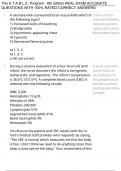
The S.T.A.B.L.E. Program - 6th edition REAL EXAM ACCURATE
The S.T.A.B.L.E. Program - 6th edition
QUESTIONS WITH 100% RATED CORRECT ANSWERS
Study online at https://quizlet.com/_68az0k
1. A neonate with a pneumothorax may exhibit which of c) All are correct (In-
the following signs? creased work of breathing,
1) Increased work of breathing bradycardia, asymmetric
2) Bradycardia appearing chest, cyanosis,
3) Asymmetric appearing chest decreased femoral pulses)
4) Cyanosis
5) Decreased femoral pulses
a) 1, 2, 4
b) 1, 3, 5
c) All are correct
2. During a routine evaluation of a four-hour-old term b) You are concerned be-
infant, the nurse discovers the infant is tachypneic, cause the infant's clin-
tachycardic, and hypotonic. The infant's temperature ical presentation is not
is 38.6ºC (101.5ºF). A complete blood count (CBC) is being adequately consid-
ordered with the following results: ered; work-up and treat-
ment for possible infection
WBC 9,200 is indicated.
Hemoglobin 15 g/dL
Hematocrit 46%
Platelets 290,000
Lymphocytes 51%
Segmented neutrophils 41%
Band neutrophils 5%
Monocytes 3%
You discuss the patient and CBC results with the in-
fant's medical staff provider who responds by saying,
"The CBC is normal which reassures me that the baby
is fine. I don't think we need to do anything more than
keep a close eye on the baby." Your assessment of this
, The S.T.A.B.L.E. Program - 6th edition
Study online at https://quizlet.com/_68az0k
response is:
a) You agree that close observation is all that is neces-
sary at this time because the CBC and CRP are normal,
which reassures you that the infant is well.
b) You are concerned because the infant's clinical pre-
sentation is not being adequately considered; work-up
and treatment for possible infection is indicated.
c) You are concerned because you think a CBC and CRP
should also be re-evaluated in 8 to 12 hours.
3. A term infant is breastfeeding when his mother asks c) An upper gastrointesti-
you to come and assess him because he vomited. You nal (UGI) exam to evaluate
notice the color of the emesis is lime green. The moth- for malrotation
er reveals that this is the third time the infant vomit-
ed green-colored emesis. The infant's abdomen is not
distended, and he is irritable and crying. Which one of
the following should be performed emergently?
a) A barium enema to evaluate for colonic obstruction
b) A swallow study with contrast to evaluate for tra-
chea-esophageal fistula
c) An upper gastrointestinal (UGI) exam to evaluate for
malrotation
4. A term infant weighing 1400 grams (3 pounds, 1.5 b) Insert an IV then give a
ounces) is born to an underweight mother. A bedside 2.8 mL bolus of D10W, fol-
glucose test at 30 minutes of life is 10 mg/dL (0.6 lowed by an IV infusion of
mmol/L). The infant does not have any apparent signs D10W at 80 mLs per kilo-
of hypoglycemia at the time the lab test was drawn. gram per day; recheck the
Which of the following orders is the most appropriate glucose 15 to 30 minutes
therapy for this infant? after the bolus.
, The S.T.A.B.L.E. Program - 6th edition
Study online at https://quizlet.com/_68az0k
a) Gavage feed 7 mLs (equals 5 mLs per kg) of breast
milk or formula; recheck the glucose 30 to 60 minutes
after the feeding is given.
b) Insert an IV then give a 2.8 mL bolus of D10W,
followed by an IV infusion of D10W at 80 mLs per
kilogram per day; recheck the glucose 15 to 30 minutes
after the bolus.
c) Send a confirmatory plasma glucose to the lab and
if low, insert an IV and give a 2.8 mL bolus of D10W
followed by an IV infusion of D10W at 80 mLs per
kilogram per day; recheck the glucose 15 to 30 minutes
after the bolus.
5. The function of brown fat is to: a) Generate heat when it is
metabolized.
a) Generate heat when it is metabolized.
b) Provide a rapidly available source of glucose in the
first day of life.
c) Provide an insulating layer of fat in the first month
of life.
6. An infant is delivered to a healthy woman with good c) Tracheoesophageal fis-
prenatal care. Within minutes of birth, the infant de- tula
veloped respiratory distress (retractions and nasal flar-
ing). Blow-by oxygen, then CPAP was initiated. The
infant further deteriorated so bag/mask positive pres-
sure ventilation was given. You observe a shift in the
point of maximal impulse (PMI) to the right, a barrel
chest, and a sunken abdomen. Which of the follow-
ing respiratory illnesses is most likely causing these
signs?
The S.T.A.B.L.E. Program - 6th edition
QUESTIONS WITH 100% RATED CORRECT ANSWERS
Study online at https://quizlet.com/_68az0k
1. A neonate with a pneumothorax may exhibit which of c) All are correct (In-
the following signs? creased work of breathing,
1) Increased work of breathing bradycardia, asymmetric
2) Bradycardia appearing chest, cyanosis,
3) Asymmetric appearing chest decreased femoral pulses)
4) Cyanosis
5) Decreased femoral pulses
a) 1, 2, 4
b) 1, 3, 5
c) All are correct
2. During a routine evaluation of a four-hour-old term b) You are concerned be-
infant, the nurse discovers the infant is tachypneic, cause the infant's clin-
tachycardic, and hypotonic. The infant's temperature ical presentation is not
is 38.6ºC (101.5ºF). A complete blood count (CBC) is being adequately consid-
ordered with the following results: ered; work-up and treat-
ment for possible infection
WBC 9,200 is indicated.
Hemoglobin 15 g/dL
Hematocrit 46%
Platelets 290,000
Lymphocytes 51%
Segmented neutrophils 41%
Band neutrophils 5%
Monocytes 3%
You discuss the patient and CBC results with the in-
fant's medical staff provider who responds by saying,
"The CBC is normal which reassures me that the baby
is fine. I don't think we need to do anything more than
keep a close eye on the baby." Your assessment of this
, The S.T.A.B.L.E. Program - 6th edition
Study online at https://quizlet.com/_68az0k
response is:
a) You agree that close observation is all that is neces-
sary at this time because the CBC and CRP are normal,
which reassures you that the infant is well.
b) You are concerned because the infant's clinical pre-
sentation is not being adequately considered; work-up
and treatment for possible infection is indicated.
c) You are concerned because you think a CBC and CRP
should also be re-evaluated in 8 to 12 hours.
3. A term infant is breastfeeding when his mother asks c) An upper gastrointesti-
you to come and assess him because he vomited. You nal (UGI) exam to evaluate
notice the color of the emesis is lime green. The moth- for malrotation
er reveals that this is the third time the infant vomit-
ed green-colored emesis. The infant's abdomen is not
distended, and he is irritable and crying. Which one of
the following should be performed emergently?
a) A barium enema to evaluate for colonic obstruction
b) A swallow study with contrast to evaluate for tra-
chea-esophageal fistula
c) An upper gastrointestinal (UGI) exam to evaluate for
malrotation
4. A term infant weighing 1400 grams (3 pounds, 1.5 b) Insert an IV then give a
ounces) is born to an underweight mother. A bedside 2.8 mL bolus of D10W, fol-
glucose test at 30 minutes of life is 10 mg/dL (0.6 lowed by an IV infusion of
mmol/L). The infant does not have any apparent signs D10W at 80 mLs per kilo-
of hypoglycemia at the time the lab test was drawn. gram per day; recheck the
Which of the following orders is the most appropriate glucose 15 to 30 minutes
therapy for this infant? after the bolus.
, The S.T.A.B.L.E. Program - 6th edition
Study online at https://quizlet.com/_68az0k
a) Gavage feed 7 mLs (equals 5 mLs per kg) of breast
milk or formula; recheck the glucose 30 to 60 minutes
after the feeding is given.
b) Insert an IV then give a 2.8 mL bolus of D10W,
followed by an IV infusion of D10W at 80 mLs per
kilogram per day; recheck the glucose 15 to 30 minutes
after the bolus.
c) Send a confirmatory plasma glucose to the lab and
if low, insert an IV and give a 2.8 mL bolus of D10W
followed by an IV infusion of D10W at 80 mLs per
kilogram per day; recheck the glucose 15 to 30 minutes
after the bolus.
5. The function of brown fat is to: a) Generate heat when it is
metabolized.
a) Generate heat when it is metabolized.
b) Provide a rapidly available source of glucose in the
first day of life.
c) Provide an insulating layer of fat in the first month
of life.
6. An infant is delivered to a healthy woman with good c) Tracheoesophageal fis-
prenatal care. Within minutes of birth, the infant de- tula
veloped respiratory distress (retractions and nasal flar-
ing). Blow-by oxygen, then CPAP was initiated. The
infant further deteriorated so bag/mask positive pres-
sure ventilation was given. You observe a shift in the
point of maximal impulse (PMI) to the right, a barrel
chest, and a sunken abdomen. Which of the follow-
ing respiratory illnesses is most likely causing these
signs?


