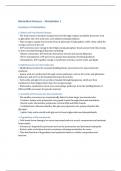
Biomedical Sciences – Metabolism 1
Functions of Metabolism
1. Obtain and Trap Chemical Energy
• The body extracts chemical energy from food through complex metabolic processes such
as glycolysis, the citric acid cycle, and oxidative phosphorylation.
• This energy is mainly stored in the form of Adenosine Triphosphate (ATP), often called the
energy currency of the cell.
• ATP molecules store energy in their high-energy phosphate bonds and provide this energy
to drive essential biological functions including:
- Muscle contraction: ATP fuels the interaction of actin and myosin filaments.
- Nerve transmission: ATP powers ion pumps that maintain electrical gradients.
- Biosynthesis: ATP supplies energy to synthesize proteins, nucleic acids, and lipids.
2. Build Precursors to Macromolecules
• Metabolism provides the essential building blocks (precursors) for macromolecule
synthesis.
• Amino acids are synthesized through various pathways, such as the serine and glutamate
pathways, and serve as the fundamental units of proteins.
• Fatty acids and glycerol are produced mainly through lipogenesis, which are then
combined to form triglycerides (fats) for energy storage.
• Nucleotides, synthesized via de novo and salvage pathways, form the building blocks of
DNA and RNA necessary for genetic material.
3. Assembly of Precursors into Macromolecules
• The smaller precursors are enzymatically linked to form larger macromolecules:
- Proteins: Amino acids polymerize via peptide bonds through ribosomal translation.
- Nucleic acids: Nucleotides polymerize to form DNA and RNA strands.
- Carbohydrates: Monosaccharides like glucose polymerize into polysaccharides like
glycogen.
- Lipids: Fatty acids esterify with glycerol to form triglycerides and phospholipids.
4. Degradation of Macromolecules
• Cells break down damaged or excess macromolecules to recycle components and maintain
homeostasis.
• Proteins are degraded by proteases such as the proteasome and lysosomal cathepsins.
• Nucleic acids are broken down by nucleases releasing nucleotides for reuse.
• This dual function of degradation and synthesis balances cellular composition and
function.
Functions of Metabolism
1. Obtain and Trap Chemical Energy
• The body extracts chemical energy from food through complex metabolic processes such
as glycolysis, the citric acid cycle, and oxidative phosphorylation.
• This energy is mainly stored in the form of Adenosine Triphosphate (ATP), often called the
energy currency of the cell.
• ATP molecules store energy in their high-energy phosphate bonds and provide this energy
to drive essential biological functions including:
- Muscle contraction: ATP fuels the interaction of actin and myosin filaments.
- Nerve transmission: ATP powers ion pumps that maintain electrical gradients.
- Biosynthesis: ATP supplies energy to synthesize proteins, nucleic acids, and lipids.
2. Build Precursors to Macromolecules
• Metabolism provides the essential building blocks (precursors) for macromolecule
synthesis.
• Amino acids are synthesized through various pathways, such as the serine and glutamate
pathways, and serve as the fundamental units of proteins.
• Fatty acids and glycerol are produced mainly through lipogenesis, which are then
combined to form triglycerides (fats) for energy storage.
• Nucleotides, synthesized via de novo and salvage pathways, form the building blocks of
DNA and RNA necessary for genetic material.
3. Assembly of Precursors into Macromolecules
• The smaller precursors are enzymatically linked to form larger macromolecules:
- Proteins: Amino acids polymerize via peptide bonds through ribosomal translation.
- Nucleic acids: Nucleotides polymerize to form DNA and RNA strands.
- Carbohydrates: Monosaccharides like glucose polymerize into polysaccharides like
glycogen.
- Lipids: Fatty acids esterify with glycerol to form triglycerides and phospholipids.
4. Degradation of Macromolecules
• Cells break down damaged or excess macromolecules to recycle components and maintain
homeostasis.
• Proteins are degraded by proteases such as the proteasome and lysosomal cathepsins.
• Nucleic acids are broken down by nucleases releasing nucleotides for reuse.
• This dual function of degradation and synthesis balances cellular composition and
function.