

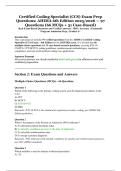
Certified Coding Specialist (CCS) Exam Prep
Questions: AHIMA 6th Edition 2025/2026 — 97
Questions (66 MCQs + 31 Case-Based)
Real Exam-Based Questions and Verified Answers | 100% Accuracy | Paramedic
Program Admission Prep | Graded A+
Introduction
This exam prep set includes 97 verified questions from the AHIMA Certified Coding
Specialist (CCS) Exam – 6th Edition for the 2025/2026 cycle. It is divided into 66
multiple-choice questions and 31 case-based scenario questions, covering ICD-10-
CM/PCS, CPT/HCPCS, coding guidelines, reimbursement methodologies, regulatory
compliance, and real-world medical coding case applications.
Answer Format
All correct answers are clearly marked in bold and green for efficient review and
confident preparation.
Section 2: Exam Questions and Answers
Multiple-Choice Questions (MCQs) - 66 Questions
Question 1
Which of the following is the primary coding system used for inpatient procedures in the
U.S.?
A) CPT
B) HCPCS
C) ICD-10-PCS
D) DRG
Rationale: ICD-10-PCS is the standard for inpatient procedure coding, per AHIMA 6th
Edition guidelines.
Question 2
What is the purpose of the Present on Admission (POA) indicator?
A) To determine patient discharge status
B) To identify conditions present at the time of admission
C) To calculate reimbursement rates
D) To assign a primary diagnosis
Rationale: POA indicators help identify conditions for quality and reimbursement purposes,
per 2025 AHIMA standards.
Question 3
Which modifier is used to indicate a bilateral procedure?
A) -25
,B) -50
C) -59
D) -51
Rationale: Modifier -50 indicates a procedure performed on both sides of the body, per CPT
guidelines.
Question 4
What is the correct code for a patient diagnosed with acute myocardial infarction?
A) I21.9
B) I21.4
C) I25.10
D) I50.9
Rationale: I21.4 specifies an acute myocardial infarction, per ICD-10-CM 2025 updates.
Question 5
Which of the following is a component of the MS-DRG system?
A) Patient age
B) Principal diagnosis
C) Physician specialty
D) Pharmacy costs
Rationale: The principal diagnosis drives MS-DRG assignment, per AHIMA reimbursement
methodologies.
Question 6
What is the primary purpose of the ICD-10-CM coding system?
A) To track outpatient procedures
B) To classify diseases and conditions
C) To determine reimbursement rates
D) To document surgical techniques
Rationale: ICD-10-CM is designed to classify diagnoses, per AHIMA standards.
Question 7
Which code set is used for outpatient physician services?
A) ICD-10-PCS
B) CPT
C) HCPCS Level I
D) DRG
Rationale: CPT codes are used for outpatient physician services, per 2025 AHIMA
guidelines.
Question 8
What does the term "upcoding" refer to in medical coding?
A) Assigning a lower code to reduce costs
B) Assigning a higher code to increase reimbursement
, C) Correcting a coding error
D) Using multiple codes for a single procedure
Rationale: Upcoding is a fraudulent practice to inflate reimbursement, per AHIMA
compliance rules.
Question 9
Which modifier indicates a distinct procedural service?
A) -50
B) -51
C) -59
D) -25
Rationale: Modifier -59 indicates a distinct procedure, per CPT guidelines.
Question 10
What is the correct code for chronic obstructive pulmonary disease with acute exacerbation?
A) J44.0
B) J44.1
C) J43.9
D) J45.909
Rationale: J44.1 specifies COPD with acute exacerbation, per ICD-10-CM 2025.
Question 11
Which organization maintains the ICD-10-CM code set?
A) AMA
B) CDC
C) CMS
D) WHO
Rationale: The CDC maintains ICD-10-CM in collaboration with WHO, per AHIMA
standards.
Question 12
What is the purpose of the National Correct Coding Initiative (NCCI)?
A) To standardize hospital billing
B) To prevent improper coding and billing
C) To train coding specialists
D) To develop new CPT codes
Rationale: NCCI reduces errors and fraud in coding, per 2025 AHIMA guidelines.
Question 13
Which code is used for a simple repair of a 3 cm laceration on the scalp?
A) 12001
B) 12002
C) 13120
Questions: AHIMA 6th Edition 2025/2026 — 97
Questions (66 MCQs + 31 Case-Based)
Real Exam-Based Questions and Verified Answers | 100% Accuracy | Paramedic
Program Admission Prep | Graded A+
Introduction
This exam prep set includes 97 verified questions from the AHIMA Certified Coding
Specialist (CCS) Exam – 6th Edition for the 2025/2026 cycle. It is divided into 66
multiple-choice questions and 31 case-based scenario questions, covering ICD-10-
CM/PCS, CPT/HCPCS, coding guidelines, reimbursement methodologies, regulatory
compliance, and real-world medical coding case applications.
Answer Format
All correct answers are clearly marked in bold and green for efficient review and
confident preparation.
Section 2: Exam Questions and Answers
Multiple-Choice Questions (MCQs) - 66 Questions
Question 1
Which of the following is the primary coding system used for inpatient procedures in the
U.S.?
A) CPT
B) HCPCS
C) ICD-10-PCS
D) DRG
Rationale: ICD-10-PCS is the standard for inpatient procedure coding, per AHIMA 6th
Edition guidelines.
Question 2
What is the purpose of the Present on Admission (POA) indicator?
A) To determine patient discharge status
B) To identify conditions present at the time of admission
C) To calculate reimbursement rates
D) To assign a primary diagnosis
Rationale: POA indicators help identify conditions for quality and reimbursement purposes,
per 2025 AHIMA standards.
Question 3
Which modifier is used to indicate a bilateral procedure?
A) -25
,B) -50
C) -59
D) -51
Rationale: Modifier -50 indicates a procedure performed on both sides of the body, per CPT
guidelines.
Question 4
What is the correct code for a patient diagnosed with acute myocardial infarction?
A) I21.9
B) I21.4
C) I25.10
D) I50.9
Rationale: I21.4 specifies an acute myocardial infarction, per ICD-10-CM 2025 updates.
Question 5
Which of the following is a component of the MS-DRG system?
A) Patient age
B) Principal diagnosis
C) Physician specialty
D) Pharmacy costs
Rationale: The principal diagnosis drives MS-DRG assignment, per AHIMA reimbursement
methodologies.
Question 6
What is the primary purpose of the ICD-10-CM coding system?
A) To track outpatient procedures
B) To classify diseases and conditions
C) To determine reimbursement rates
D) To document surgical techniques
Rationale: ICD-10-CM is designed to classify diagnoses, per AHIMA standards.
Question 7
Which code set is used for outpatient physician services?
A) ICD-10-PCS
B) CPT
C) HCPCS Level I
D) DRG
Rationale: CPT codes are used for outpatient physician services, per 2025 AHIMA
guidelines.
Question 8
What does the term "upcoding" refer to in medical coding?
A) Assigning a lower code to reduce costs
B) Assigning a higher code to increase reimbursement
, C) Correcting a coding error
D) Using multiple codes for a single procedure
Rationale: Upcoding is a fraudulent practice to inflate reimbursement, per AHIMA
compliance rules.
Question 9
Which modifier indicates a distinct procedural service?
A) -50
B) -51
C) -59
D) -25
Rationale: Modifier -59 indicates a distinct procedure, per CPT guidelines.
Question 10
What is the correct code for chronic obstructive pulmonary disease with acute exacerbation?
A) J44.0
B) J44.1
C) J43.9
D) J45.909
Rationale: J44.1 specifies COPD with acute exacerbation, per ICD-10-CM 2025.
Question 11
Which organization maintains the ICD-10-CM code set?
A) AMA
B) CDC
C) CMS
D) WHO
Rationale: The CDC maintains ICD-10-CM in collaboration with WHO, per AHIMA
standards.
Question 12
What is the purpose of the National Correct Coding Initiative (NCCI)?
A) To standardize hospital billing
B) To prevent improper coding and billing
C) To train coding specialists
D) To develop new CPT codes
Rationale: NCCI reduces errors and fraud in coding, per 2025 AHIMA guidelines.
Question 13
Which code is used for a simple repair of a 3 cm laceration on the scalp?
A) 12001
B) 12002
C) 13120


