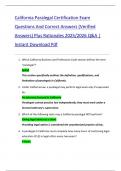
California Paralegal Certification Exam
Questions And Correct Answers
(Verified Answers) Plus Rationales 2025
Q&A | Instant Download Pdf
1. What is the minimum educational requirement to qualify as a
paralegal in California under Business and Professions Code §6450?
A. High school diploma
B. Associate’s degree in any field
C. Certificate from an ABA-approved program or equivalent education and
work experience
D. Two years of clerical legal work
A paralegal in California must have completed a certificate program from
an ABA-approved school, or possess a bachelor's degree with at least one
year of law-related experience, or have other comparable qualifications
under BPC §6450.
2. Which of the following tasks is a California paralegal not permitted to
perform?
A. Drafting legal documents under attorney supervision
B. Conducting legal research
,C. Giving legal advice to a client
D. Organizing trial exhibits
Paralegals are strictly prohibited from providing legal advice or
representing clients in legal proceedings under BPC §6450.
3. California law requires paralegals to complete how many hours of
continuing legal education (CLE) every two years?
A. 2 hours
B. 6 hours
C. 8 hours
D. 10 hours
Paralegals must complete 8 hours of CLE every two years: 4 in legal ethics
and 4 in general law or specialized areas.
4. Under California law, paralegals may be disciplined for:
A. Clerical errors
B. Unauthorized practice of law
C. Working under multiple attorneys
D. Billing too few hours
Engaging in the unauthorized practice of law is a serious offense and can
result in criminal or civil penalties.
5. A paralegal in California must disclose their job title:
A. Only to the court
B. Only to clients who ask
,C. On all legal documents and communications
D. Only when billing
The paralegal must disclose their title (e.g., “paralegal” or “legal
assistant”) on all documents and communications as per BPC §6450(b)(2).
6. What is the primary purpose of the California Business and Professions
Code §6450?
A. To regulate lawyers
B. To provide job descriptions for legal clerks
C. To define and regulate paralegals
D. To eliminate unauthorized legal work
The BPC §6450 et seq. defines who may use the title “paralegal” and sets
forth educational, ethical, and professional standards.
7. Who is responsible for ensuring a paralegal complies with ethical
rules?
A. The client
B. The court
C. The supervising attorney
D. The paralegal board
Although paralegals are responsible for their conduct, the supervising
attorney is ultimately responsible for the legal work produced under their
supervision.
8. A paralegal preparing a will must:
, A. File it with the court
B. Work under attorney supervision
C. Witness the will
D. Provide legal advice
Paralegals can assist in preparing legal documents like wills but only under
the supervision of a licensed attorney.
9. A paralegal is asked by a friend for help with their divorce papers. The
paralegal should:
A. Help as a friend
B. Offer to do it for free
C. Decline and refer them to an attorney
D. Prepare the documents anyway
Paralegals may not prepare legal documents or give advice outside the
supervision of an attorney.
10. What is the key ethical principle behind Rule 5.3 of the ABA
Model Rules of Professional Conduct?
A. Confidentiality
B. Attorney supervision of nonlawyer assistants
C. Duty of loyalty
D. Competence
Rule 5.3 emphasizes the attorney's responsibility to ensure that paralegals
and other nonlawyers act ethically and appropriately.
Questions And Correct Answers
(Verified Answers) Plus Rationales 2025
Q&A | Instant Download Pdf
1. What is the minimum educational requirement to qualify as a
paralegal in California under Business and Professions Code §6450?
A. High school diploma
B. Associate’s degree in any field
C. Certificate from an ABA-approved program or equivalent education and
work experience
D. Two years of clerical legal work
A paralegal in California must have completed a certificate program from
an ABA-approved school, or possess a bachelor's degree with at least one
year of law-related experience, or have other comparable qualifications
under BPC §6450.
2. Which of the following tasks is a California paralegal not permitted to
perform?
A. Drafting legal documents under attorney supervision
B. Conducting legal research
,C. Giving legal advice to a client
D. Organizing trial exhibits
Paralegals are strictly prohibited from providing legal advice or
representing clients in legal proceedings under BPC §6450.
3. California law requires paralegals to complete how many hours of
continuing legal education (CLE) every two years?
A. 2 hours
B. 6 hours
C. 8 hours
D. 10 hours
Paralegals must complete 8 hours of CLE every two years: 4 in legal ethics
and 4 in general law or specialized areas.
4. Under California law, paralegals may be disciplined for:
A. Clerical errors
B. Unauthorized practice of law
C. Working under multiple attorneys
D. Billing too few hours
Engaging in the unauthorized practice of law is a serious offense and can
result in criminal or civil penalties.
5. A paralegal in California must disclose their job title:
A. Only to the court
B. Only to clients who ask
,C. On all legal documents and communications
D. Only when billing
The paralegal must disclose their title (e.g., “paralegal” or “legal
assistant”) on all documents and communications as per BPC §6450(b)(2).
6. What is the primary purpose of the California Business and Professions
Code §6450?
A. To regulate lawyers
B. To provide job descriptions for legal clerks
C. To define and regulate paralegals
D. To eliminate unauthorized legal work
The BPC §6450 et seq. defines who may use the title “paralegal” and sets
forth educational, ethical, and professional standards.
7. Who is responsible for ensuring a paralegal complies with ethical
rules?
A. The client
B. The court
C. The supervising attorney
D. The paralegal board
Although paralegals are responsible for their conduct, the supervising
attorney is ultimately responsible for the legal work produced under their
supervision.
8. A paralegal preparing a will must:
, A. File it with the court
B. Work under attorney supervision
C. Witness the will
D. Provide legal advice
Paralegals can assist in preparing legal documents like wills but only under
the supervision of a licensed attorney.
9. A paralegal is asked by a friend for help with their divorce papers. The
paralegal should:
A. Help as a friend
B. Offer to do it for free
C. Decline and refer them to an attorney
D. Prepare the documents anyway
Paralegals may not prepare legal documents or give advice outside the
supervision of an attorney.
10. What is the key ethical principle behind Rule 5.3 of the ABA
Model Rules of Professional Conduct?
A. Confidentiality
B. Attorney supervision of nonlawyer assistants
C. Duty of loyalty
D. Competence
Rule 5.3 emphasizes the attorney's responsibility to ensure that paralegals
and other nonlawyers act ethically and appropriately.