Science Medicine Nursing
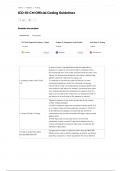
ICD-10-CM Official Coding Guidelines
Save
Students also studied
Flashcard sets Study guides
OST-248 Diagnostic Coding - Chapt... Chapter 5: Diagnostic Code Guideli... NHA Quiz 11: Testing
144 terms 50 terms 15 terms
dwhoke Preview kalliekbs Preview Aliciagunera
To select a code in the classification that corresponds to a
diagnosis or reason for visit documented in a medical record,
first located the term in the Index, and then verify the code in the
Tabular List. Read and be guided by instructional notations that
appear in both the Index and the Tabular List.
1. Locating a code in the ICD-10- It is essential to use both the Index and Tabular List when
CM locating and assigning a code. The Index does not always
provide the full code, including laterality and applicable 7th can
only be done in the Tabular list. A dash (-) at the end of an Index
entry indicate that additional characters are required. Even if a
dash is not included at the Index entry, it is necessary to refer to
the Tabular list to verify that no 7th character is required.
Diagnosis codes are to be used and reported at their highest
number of digits available.
ICD-10-CM diagnosis codes are composed of codes with 3, 4, 5,
6, or 7 digits. Codes with three digits are included in ICD-10-CM
as the heading of a category of codes that may be further
2. Levels of Detail in Coding subdivided by the use of fourth and/or fifth digits, which provide
greater detail.
A three-digit code is to be used only if it is not further
subdivided. A code is invalid if it has not be coded to the full
number of characters required for that code, including the 7th
character, if applicable.
The appropriate code or codes from A00.0 through T88.9, Z00-
3. Code or codes from A00.0
Z99.8 must be used to identify diagnoses, symptoms, conditions,
through T88.9, Z00-Z99.
problems, complaints or other reason(s) for the encounter/visit.
, Codes that describe symptoms and signs as opposed to
diagnoses, are acceptable for reporting purposes when a
related definitive diagnosis has not ben established (confirmed)
4. Signs and Symptoms by the provider. Chapter 18 of ICD-10-CM, Symptoms, Signs, and
Abnormal Clinical and Laboratory Findings, Not Elsewhere
Classified (codes R00.0-R99) contains many, but not all codes for
symptoms.
Signs and symptoms that are associated routinely with a disease
5. Conditions that are an integral
process should not be assigned as additional codes, unless
part of a disease process
otherwise instructed by the classification.
6. Conditions that are not an Additional signs and symptoms that may not be associated
integral part of a disease routinely with a disease process should be coded when present.
process
In addition to the etiology/manifestation convention that requires
two codes to fully describe a single condition that affects
multiple body systems, there are other single conditions that also
require more than one code. "Use additional code" notes are
found in the Tabular at codes that are not part of an
etiology/manifestation pair, where a secondary code is useful to
fully describe a condition. The sequencing rule is the same as the
etiology/manifestation pair, "use additional code" indicates that a
secondary code should be added.
For example, for bacterial infections that are not included in
chapter 1, a secondary code from category B95, Streptococcus,
and Enterococcus, as the cause of disease classified elsewhere,
or B96, Other bacterial agents as the cause of diseases classified
elsewhere, may be required to identify the bacterial organism
causing the infection. A "use additional code" note will normally
7. Multiple coding for a single
be found at the infectious disease code, indicating a need for the
condition
organism code to be added as a secondary code.
"Code first" notes are also under certain codes that are not
specifically manifestation codes but may be due to an underlying
cause. When there is a "code first" note and an underlying
condition present, the underlying condition should be
sequenced first.
"Code, if applicable, any casual condition first", notes indicate
that this code may be assigned as a principal diagnosis when the
casual condition is unknown or not applicable. If a casual
condition is known, then the code for that condition should be
sequenced as the principal or first-listed diagnosis.
Multiple codes may be needed for late effects, complication
codes and obstetric codes to more fully describe a condition.
See the specific guidelines for those conditions for further
instruction.
If the same condition is described as both acute (subacute) and
chronic, and separate subentries exist in the Alphabetic Index at
8. Acute and Chronic Conditions
the same indentation level, code both and sequence the acute
(subacute) code first.
ICD-10-CM Official Coding Guidelines
Save
Students also studied
Flashcard sets Study guides
OST-248 Diagnostic Coding - Chapt... Chapter 5: Diagnostic Code Guideli... NHA Quiz 11: Testing
144 terms 50 terms 15 terms
dwhoke Preview kalliekbs Preview Aliciagunera
To select a code in the classification that corresponds to a
diagnosis or reason for visit documented in a medical record,
first located the term in the Index, and then verify the code in the
Tabular List. Read and be guided by instructional notations that
appear in both the Index and the Tabular List.
1. Locating a code in the ICD-10- It is essential to use both the Index and Tabular List when
CM locating and assigning a code. The Index does not always
provide the full code, including laterality and applicable 7th can
only be done in the Tabular list. A dash (-) at the end of an Index
entry indicate that additional characters are required. Even if a
dash is not included at the Index entry, it is necessary to refer to
the Tabular list to verify that no 7th character is required.
Diagnosis codes are to be used and reported at their highest
number of digits available.
ICD-10-CM diagnosis codes are composed of codes with 3, 4, 5,
6, or 7 digits. Codes with three digits are included in ICD-10-CM
as the heading of a category of codes that may be further
2. Levels of Detail in Coding subdivided by the use of fourth and/or fifth digits, which provide
greater detail.
A three-digit code is to be used only if it is not further
subdivided. A code is invalid if it has not be coded to the full
number of characters required for that code, including the 7th
character, if applicable.
The appropriate code or codes from A00.0 through T88.9, Z00-
3. Code or codes from A00.0
Z99.8 must be used to identify diagnoses, symptoms, conditions,
through T88.9, Z00-Z99.
problems, complaints or other reason(s) for the encounter/visit.
, Codes that describe symptoms and signs as opposed to
diagnoses, are acceptable for reporting purposes when a
related definitive diagnosis has not ben established (confirmed)
4. Signs and Symptoms by the provider. Chapter 18 of ICD-10-CM, Symptoms, Signs, and
Abnormal Clinical and Laboratory Findings, Not Elsewhere
Classified (codes R00.0-R99) contains many, but not all codes for
symptoms.
Signs and symptoms that are associated routinely with a disease
5. Conditions that are an integral
process should not be assigned as additional codes, unless
part of a disease process
otherwise instructed by the classification.
6. Conditions that are not an Additional signs and symptoms that may not be associated
integral part of a disease routinely with a disease process should be coded when present.
process
In addition to the etiology/manifestation convention that requires
two codes to fully describe a single condition that affects
multiple body systems, there are other single conditions that also
require more than one code. "Use additional code" notes are
found in the Tabular at codes that are not part of an
etiology/manifestation pair, where a secondary code is useful to
fully describe a condition. The sequencing rule is the same as the
etiology/manifestation pair, "use additional code" indicates that a
secondary code should be added.
For example, for bacterial infections that are not included in
chapter 1, a secondary code from category B95, Streptococcus,
and Enterococcus, as the cause of disease classified elsewhere,
or B96, Other bacterial agents as the cause of diseases classified
elsewhere, may be required to identify the bacterial organism
causing the infection. A "use additional code" note will normally
7. Multiple coding for a single
be found at the infectious disease code, indicating a need for the
condition
organism code to be added as a secondary code.
"Code first" notes are also under certain codes that are not
specifically manifestation codes but may be due to an underlying
cause. When there is a "code first" note and an underlying
condition present, the underlying condition should be
sequenced first.
"Code, if applicable, any casual condition first", notes indicate
that this code may be assigned as a principal diagnosis when the
casual condition is unknown or not applicable. If a casual
condition is known, then the code for that condition should be
sequenced as the principal or first-listed diagnosis.
Multiple codes may be needed for late effects, complication
codes and obstetric codes to more fully describe a condition.
See the specific guidelines for those conditions for further
instruction.
If the same condition is described as both acute (subacute) and
chronic, and separate subentries exist in the Alphabetic Index at
8. Acute and Chronic Conditions
the same indentation level, code both and sequence the acute
(subacute) code first.