ATLS Study Cards Test.
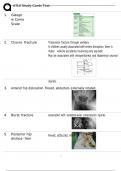
1. Glasgo
w Coma
Scale
2. Chance fracture Transverse fracture through vertebra.
In children usually associated with enterc disruption. Seen in
motor vehicle accidents involving only lap belt.
May be associated with retroperitoneal and Abdominal visceral
injuries.
3. Anterior hip dislocation Flexed, abducted, externally rotated.
4. Burst fracture Associated with vertebral-axial compression injuries
5. Posterior hip Flexed, aDDucted, internally rotated
disloca- tion
1/
67
, ATLS Study Cards Test.
6. Anterior shoulder Squared ott appearance
dislo- cation
7. Posterior shoulder Lock in internal rotation.
dis- location
8. Ankle dislocation Most are Externally rotated, with a prominent medial malleolus.
9. FULL thickness (3rd clude
de- gree) burn
10. Principle Life
saving measures
for patients with
burn injuries in-
2/
67
, ATLS Study Cards Test.
Dark or white and leathery.
Translucent white as well. Painless
and generally "dry" Does not blanch
with pressure. Very little swelling of
burned tissue.
-Establishing airway control
-Stopping the burning. process
-Intravenous access
3/
67
, ATLS study cards
Study online at
https://quizlet.com/_1vznd7
11. Factors that -Burns to the head and face
increase the risk -Burn size and depth
for upper AIR- WAY -Burns inside the mouth
OBSTRUCTION in
burns include:
12. Partial thickness burn Red remodeled appearance with associated swelling and blister
forma-
tion. May have weeping or wet appearance and is painfully
hypersen- sitive even to air current.
13. Signs and These patients should be intubated. Inhalation injury is an indication
symptoms and for transfer to a burn center.
history that sug-
gest INHALATION
IN-
JURY include:
14. Rule of nines - adult The palm represents 1% of the body total surface area.
1. Glasgo
w Coma
Scale
2. Chance fracture Transverse fracture through vertebra.
In children usually associated with enterc disruption. Seen in
motor vehicle accidents involving only lap belt.
May be associated with retroperitoneal and Abdominal visceral
injuries.
3. Anterior hip dislocation Flexed, abducted, externally rotated.
4. Burst fracture Associated with vertebral-axial compression injuries
5. Posterior hip Flexed, aDDucted, internally rotated
disloca- tion
1/
67
, ATLS Study Cards Test.
6. Anterior shoulder Squared ott appearance
dislo- cation
7. Posterior shoulder Lock in internal rotation.
dis- location
8. Ankle dislocation Most are Externally rotated, with a prominent medial malleolus.
9. FULL thickness (3rd clude
de- gree) burn
10. Principle Life
saving measures
for patients with
burn injuries in-
2/
67
, ATLS Study Cards Test.
Dark or white and leathery.
Translucent white as well. Painless
and generally "dry" Does not blanch
with pressure. Very little swelling of
burned tissue.
-Establishing airway control
-Stopping the burning. process
-Intravenous access
3/
67
, ATLS study cards
Study online at
https://quizlet.com/_1vznd7
11. Factors that -Burns to the head and face
increase the risk -Burn size and depth
for upper AIR- WAY -Burns inside the mouth
OBSTRUCTION in
burns include:
12. Partial thickness burn Red remodeled appearance with associated swelling and blister
forma-
tion. May have weeping or wet appearance and is painfully
hypersen- sitive even to air current.
13. Signs and These patients should be intubated. Inhalation injury is an indication
symptoms and for transfer to a burn center.
history that sug-
gest INHALATION
IN-
JURY include:
14. Rule of nines - adult The palm represents 1% of the body total surface area.