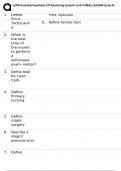
LPN Fundamentals Of Nursing Exam 1-6 FINAL EXAM Q & A.
\
1. Define Pres- byscusis
Sinus
Tachycardi 8. Define Ventila- tion
a
2. When is
the best
time of
the month
to perform
a
self-breast
exam- ination?
3. Define total
Pa- tient
Care
4. Define
Primary
nursing
5. Define
major
surgery
6. Describe a
stage II
pressure ulcer
7. Define
1/
36
, LPN Fundamentals Of Nursing Exam 1-6 FINAL EXAM Q & A.
\
Regular Rhythm, rate 100-180 directly with pt, family and health care team members.
beats/min (higher in infants)
1 primary RN assumes responsibility for a caseload of patients,
provides care for the same pts during their stay in health care facility. RN
4th to 7th day during menstrual assesses pt, develops plan of care and delivers appropriate nursing
cycle or days after cycle has intervention. Communication is lateral from nurse to nurse and
ended.
caregiver to caregiver.
Involves extensive reconstruction or alteration in body parts, poses great
risks to well being.
Partial thickness loss of dermis presenting a shallow ulcer red- pink
wound bed without slough. May present an intact or open. ruptured serum
Rn is responsible for all filled blister. Shiny dry shallow ulcer without slough or bruising.
aspects of care for one or
more pts during a shift of Hearing loss associated with aging. Usually involves both a loss of
care. Care is usually hearing sensi- tivity and a reduction in the clarity of speech.
consistent, comprehensive,
movement of air in and out of the lungs. Afterload ejection of blood from left
and holistic, care can be
ventricle
delegated. RN works
9.
2/
36
, LPN Fundamentals Of Nursing Exam 1-6 FINAL EXAM Q & A.
\
define contact complains of chills, dizzi- ness and feel-
precaution ing hot during
10. what sound
do rhonchi
make
11. describe
head lice
12. describe
diffu- sion
13. what is the fi-
nal step in a
complete
assess- ment?
14. S/S of
hypostatic
pneumonia
15. s/s of
respiratory
acidosis
16. what is the
primary
advan- tage
of hydrogel
dressing ?
17. A pt
3/
36
, LPN Fundamentals Of Nursing Exam 1-6 FINAL EXAM Q & A.
\
guards designed to reduce the inflammation of the lung from stasis or pooling of secretions. )
risk of transmission of
epidemiologically importantincreased PaCo2 and increased hydrogen ion concentration below 7.35. This
microorganisms by direct or re- flects the excess carbonic acid in the blood (hypoventilation produces
indirect contact. R. acidosis)
contains a high percentage of water for wounds that require moisture.
ous wheeze-coarse, low pitched:
may clear with cough. Main- taining a moist wound environment needed for healing.
Hydrogel facilitates debridement by softening dead tissue.
h their eggs to hair, eggs
look like oval particles ofStop transfusion immediately.
dandrutt. Lice are diflcult toRemove blood component and tubing containing and tubing contacting blood
see, observe for bites or products
pustule eruptions in thereplace with new primed tubing with 0.9% sodium chloride
follicles and area where
skin surfaces meet behind
the ears in the ears and in
the groin.
ement of gases between air
spaces and blood stream
mentation
eased lung expansion,
generalized respiratory
muscle weakness and
secre- tions occur without
immobility. (comes from
4/
36
\
1. Define Pres- byscusis
Sinus
Tachycardi 8. Define Ventila- tion
a
2. When is
the best
time of
the month
to perform
a
self-breast
exam- ination?
3. Define total
Pa- tient
Care
4. Define
Primary
nursing
5. Define
major
surgery
6. Describe a
stage II
pressure ulcer
7. Define
1/
36
, LPN Fundamentals Of Nursing Exam 1-6 FINAL EXAM Q & A.
\
Regular Rhythm, rate 100-180 directly with pt, family and health care team members.
beats/min (higher in infants)
1 primary RN assumes responsibility for a caseload of patients,
provides care for the same pts during their stay in health care facility. RN
4th to 7th day during menstrual assesses pt, develops plan of care and delivers appropriate nursing
cycle or days after cycle has intervention. Communication is lateral from nurse to nurse and
ended.
caregiver to caregiver.
Involves extensive reconstruction or alteration in body parts, poses great
risks to well being.
Partial thickness loss of dermis presenting a shallow ulcer red- pink
wound bed without slough. May present an intact or open. ruptured serum
Rn is responsible for all filled blister. Shiny dry shallow ulcer without slough or bruising.
aspects of care for one or
more pts during a shift of Hearing loss associated with aging. Usually involves both a loss of
care. Care is usually hearing sensi- tivity and a reduction in the clarity of speech.
consistent, comprehensive,
movement of air in and out of the lungs. Afterload ejection of blood from left
and holistic, care can be
ventricle
delegated. RN works
9.
2/
36
, LPN Fundamentals Of Nursing Exam 1-6 FINAL EXAM Q & A.
\
define contact complains of chills, dizzi- ness and feel-
precaution ing hot during
10. what sound
do rhonchi
make
11. describe
head lice
12. describe
diffu- sion
13. what is the fi-
nal step in a
complete
assess- ment?
14. S/S of
hypostatic
pneumonia
15. s/s of
respiratory
acidosis
16. what is the
primary
advan- tage
of hydrogel
dressing ?
17. A pt
3/
36
, LPN Fundamentals Of Nursing Exam 1-6 FINAL EXAM Q & A.
\
guards designed to reduce the inflammation of the lung from stasis or pooling of secretions. )
risk of transmission of
epidemiologically importantincreased PaCo2 and increased hydrogen ion concentration below 7.35. This
microorganisms by direct or re- flects the excess carbonic acid in the blood (hypoventilation produces
indirect contact. R. acidosis)
contains a high percentage of water for wounds that require moisture.
ous wheeze-coarse, low pitched:
may clear with cough. Main- taining a moist wound environment needed for healing.
Hydrogel facilitates debridement by softening dead tissue.
h their eggs to hair, eggs
look like oval particles ofStop transfusion immediately.
dandrutt. Lice are diflcult toRemove blood component and tubing containing and tubing contacting blood
see, observe for bites or products
pustule eruptions in thereplace with new primed tubing with 0.9% sodium chloride
follicles and area where
skin surfaces meet behind
the ears in the ears and in
the groin.
ement of gases between air
spaces and blood stream
mentation
eased lung expansion,
generalized respiratory
muscle weakness and
secre- tions occur without
immobility. (comes from
4/
36