Page |1
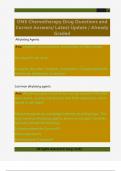
ONS Chemotherapy Drug Questions and
Correct Answers/ Latest Update / Already
Graded
Alkylating Agents
Ans: synthetic chemicals that cause breaks in DNA strands
Non-specific cell cycle
Examples: Busulfan, Cisplatin, Carboplatin, Cyclophosphamide,
Ifosfamide, Melphalan, Oxaliplatin
Common alkylating agents
Ans: Alkylating agents function by causing a break in the DNA
helix strand, causing interference with DNA replication, which
results in cell death.
Alkylating agents are subcategorized into several groups. The
most common alkylating agents, known as nitrogen mustards,
typically include the following:
Cyclophosphamide (Cytoxan®)
Ifosfamide (Ifex®)
Bendamustine (Treanda®)
All rights reserved © 2025/ 2026 |
, Page |2
Platinum-based chemotherapy agents act similarly to alkylating
agents, but they do not possess an alkyl group molecule to
attach to and destroy DNA. Despite this, they are often termed
alkylating agents, or alkylating-like agents. Common platinum-
based drugs include the following:
Cisplatin (Platinol®)
Carboplatin (Paraplatin®)
However, depending on the type of patients that you see, other
alkylating agents may be more common in your workplace. A
third subcategory of alkylating agents is known as the
nitrosoureas.
Alkylating Agents:
Dose limiting? Side effects?
Ans: These agents have many dose-limiting toxiciites that need
to be monitored closely, including the following:
Bone marrow suppression, which can put a patient at risk for
infection
Gastrointestinal (GI) toxicities, particularly nausea, vomiting,
and diarrhea
Renal toxicities
Hepatotoxicity
All rights reserved © 2025/ 2026 |
, Page |3
Pulmonary fibrosis
Hypersensitivities
Key points to remember about the alkylating agents and nitrosoureas:
Ans: - Hypersensitivity may occur with late doses of
carboplatin.
- Tumor lysis syndrome is possible in patients receiving
alkylating agents, particularly when there is a high tumor
burden.
- Preadministration blood tests should include blood urea
nitrogen, creatinine, and a complete blood count with
differential.
- These agents are typically highly emetogenic.
- When administering cyclophosphamide or ifosfamide, mesna
is typically used as a bladder protectant.
- When administering oxaliplatin, instruct patients to avoid
exposure to cold air and consuming cold fluids for 3 -4 days
following treatment.
- Streptozocin and semustine are the most nephrotoxic drugs,
affecting more than 75% of patients, which may lead to
treatment delays.
- Pruritus and itching can occur with patients receiving
alkylating agents and nitorsoureas. This may worsen with
dehydration, so patients are encouraged to drink at least 8 -10
All rights reserved © 2025/ 2026 |
ONS Chemotherapy Drug Questions and
Correct Answers/ Latest Update / Already
Graded
Alkylating Agents
Ans: synthetic chemicals that cause breaks in DNA strands
Non-specific cell cycle
Examples: Busulfan, Cisplatin, Carboplatin, Cyclophosphamide,
Ifosfamide, Melphalan, Oxaliplatin
Common alkylating agents
Ans: Alkylating agents function by causing a break in the DNA
helix strand, causing interference with DNA replication, which
results in cell death.
Alkylating agents are subcategorized into several groups. The
most common alkylating agents, known as nitrogen mustards,
typically include the following:
Cyclophosphamide (Cytoxan®)
Ifosfamide (Ifex®)
Bendamustine (Treanda®)
All rights reserved © 2025/ 2026 |
, Page |2
Platinum-based chemotherapy agents act similarly to alkylating
agents, but they do not possess an alkyl group molecule to
attach to and destroy DNA. Despite this, they are often termed
alkylating agents, or alkylating-like agents. Common platinum-
based drugs include the following:
Cisplatin (Platinol®)
Carboplatin (Paraplatin®)
However, depending on the type of patients that you see, other
alkylating agents may be more common in your workplace. A
third subcategory of alkylating agents is known as the
nitrosoureas.
Alkylating Agents:
Dose limiting? Side effects?
Ans: These agents have many dose-limiting toxiciites that need
to be monitored closely, including the following:
Bone marrow suppression, which can put a patient at risk for
infection
Gastrointestinal (GI) toxicities, particularly nausea, vomiting,
and diarrhea
Renal toxicities
Hepatotoxicity
All rights reserved © 2025/ 2026 |
, Page |3
Pulmonary fibrosis
Hypersensitivities
Key points to remember about the alkylating agents and nitrosoureas:
Ans: - Hypersensitivity may occur with late doses of
carboplatin.
- Tumor lysis syndrome is possible in patients receiving
alkylating agents, particularly when there is a high tumor
burden.
- Preadministration blood tests should include blood urea
nitrogen, creatinine, and a complete blood count with
differential.
- These agents are typically highly emetogenic.
- When administering cyclophosphamide or ifosfamide, mesna
is typically used as a bladder protectant.
- When administering oxaliplatin, instruct patients to avoid
exposure to cold air and consuming cold fluids for 3 -4 days
following treatment.
- Streptozocin and semustine are the most nephrotoxic drugs,
affecting more than 75% of patients, which may lead to
treatment delays.
- Pruritus and itching can occur with patients receiving
alkylating agents and nitorsoureas. This may worsen with
dehydration, so patients are encouraged to drink at least 8 -10
All rights reserved © 2025/ 2026 |