

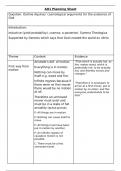
AO1 Planning Sheet
Question: Outline Aquinas’ cosmological arguments for the existence of
God
Introduction:
Inductive (yield probability), cosmos, a posteriori, Summa Theologica
Supported by Genesis which says that God created the world ex nihilo
Theme Content Evidence
Aristotle’s def. of motion “That which is actually hot, as
fire, makes wood, which is
First way from Everything is in motion. potentially hot, to be actually
motion hot, and thereby moves and
Nothing can move by
changes.”
itself e.g. wood and fire.
Infinite regress because if
“Therefore it is necessary to
there were no first mover arrive at a first mover, put in
there would be no motion motion by no other; and this
at all. everyone understands to be
God.”
Therefore an unmoved
mover must exist and
must be in a state of full
actuality (actus purus).
P: All things are in motion.
P: Nothing can cause itself to
move.
P: All things must have been
put in motion by another.
P: An infinite regress of
causative motion is not
possible.
C: There must be a first
unmoved mover.
, Aristotle’s influence – No being can be ‘efficient
Second way efficient cause, nothing cause of itself’ Aquinas
from efficient can cause itself, “There is no case known in
cause characteristics and which a thing is found to be
uncaused cause = eternal the efficient cause of itself.”
Leibniz’s principle = for
every state of affairs there “Therefore it is necessary to
is always an explanation admit a first efficient cause, to
for why it is. which everyone gives the
name of God.”
P: All things that exist have
been caused to exist by an
efficient cause.
P: Nothing can be the cause of
itself.
P: An infinite regress of causes
is not possible.
C: There must be a first
uncaused cause.
Define two types of “it Is possible that at
Third way from existence, explain what some point there would
necessity and would happen if be nothing” Aquinas
contingency everything were “If everything is possible not
contingent (nothingness) to be, then at one time there
therefore there must be a could have been nothing in
necessary being. existence.”
P: All contingent beings “Therefore we cannot but
depend on something else for postulate the existence of
their existence. some being having of itself its
, P: If there were never a own necessity, and not
necessary being to bring all receiving it from another, but
things into existence, there rather causing in others their
would be nothing. necessity.”
C: There must be a first
necessary being upon which
contingent beings depend for
their existence.
Specialist Terminology:
Synoptic Links: Aquinas inspired by Aristotle in most areas of his works
takes inspiration from Aristotle’s four causes. Just as Aquinas focuses on
the final cause in his theory of Natural law, he focuses he on the
efficient cause.
AO1 Planning Sheet
Question: Explain the Kalam cosmological argument with reference to William Lane
Craig.
Introduction:
The kalam argument was put forward by William Lane Craig who was
inspired by Al Ghazali
, Theme Content Evidence
P1: All things that begin to
exist has a cause which
we can see using the
empirical world around us.
The universe has
a beginning P2: The universe began to
exist because actual
infinites are impossible
exhibited by Hilbert’s
hotel. Therefore the
universe must be a
potential infinite which
means that it has a
beginning.
Cause of the P3: since the universe has
universe a beginning the universe
must therefore have a
cause.
P4: This first cause must
be a personal and eternal
creator because of the
Principle of determination.
This is where there are
two possible options and a
choice must be made and
God chose to create the
world out of love.
Therefore God must exist
as the first cause.
Question: Outline Aquinas’ cosmological arguments for the existence of
God
Introduction:
Inductive (yield probability), cosmos, a posteriori, Summa Theologica
Supported by Genesis which says that God created the world ex nihilo
Theme Content Evidence
Aristotle’s def. of motion “That which is actually hot, as
fire, makes wood, which is
First way from Everything is in motion. potentially hot, to be actually
motion hot, and thereby moves and
Nothing can move by
changes.”
itself e.g. wood and fire.
Infinite regress because if
“Therefore it is necessary to
there were no first mover arrive at a first mover, put in
there would be no motion motion by no other; and this
at all. everyone understands to be
God.”
Therefore an unmoved
mover must exist and
must be in a state of full
actuality (actus purus).
P: All things are in motion.
P: Nothing can cause itself to
move.
P: All things must have been
put in motion by another.
P: An infinite regress of
causative motion is not
possible.
C: There must be a first
unmoved mover.
, Aristotle’s influence – No being can be ‘efficient
Second way efficient cause, nothing cause of itself’ Aquinas
from efficient can cause itself, “There is no case known in
cause characteristics and which a thing is found to be
uncaused cause = eternal the efficient cause of itself.”
Leibniz’s principle = for
every state of affairs there “Therefore it is necessary to
is always an explanation admit a first efficient cause, to
for why it is. which everyone gives the
name of God.”
P: All things that exist have
been caused to exist by an
efficient cause.
P: Nothing can be the cause of
itself.
P: An infinite regress of causes
is not possible.
C: There must be a first
uncaused cause.
Define two types of “it Is possible that at
Third way from existence, explain what some point there would
necessity and would happen if be nothing” Aquinas
contingency everything were “If everything is possible not
contingent (nothingness) to be, then at one time there
therefore there must be a could have been nothing in
necessary being. existence.”
P: All contingent beings “Therefore we cannot but
depend on something else for postulate the existence of
their existence. some being having of itself its
, P: If there were never a own necessity, and not
necessary being to bring all receiving it from another, but
things into existence, there rather causing in others their
would be nothing. necessity.”
C: There must be a first
necessary being upon which
contingent beings depend for
their existence.
Specialist Terminology:
Synoptic Links: Aquinas inspired by Aristotle in most areas of his works
takes inspiration from Aristotle’s four causes. Just as Aquinas focuses on
the final cause in his theory of Natural law, he focuses he on the
efficient cause.
AO1 Planning Sheet
Question: Explain the Kalam cosmological argument with reference to William Lane
Craig.
Introduction:
The kalam argument was put forward by William Lane Craig who was
inspired by Al Ghazali
, Theme Content Evidence
P1: All things that begin to
exist has a cause which
we can see using the
empirical world around us.
The universe has
a beginning P2: The universe began to
exist because actual
infinites are impossible
exhibited by Hilbert’s
hotel. Therefore the
universe must be a
potential infinite which
means that it has a
beginning.
Cause of the P3: since the universe has
universe a beginning the universe
must therefore have a
cause.
P4: This first cause must
be a personal and eternal
creator because of the
Principle of determination.
This is where there are
two possible options and a
choice must be made and
God chose to create the
world out of love.
Therefore God must exist
as the first cause.


