CCS PREP EXAM SECTION 1
CONVENTIONS, GENERAL CODING
GUIDELINES AND CHAPT SPEC
GUIDELINES
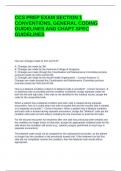
How are changes made to ICD-10-PCS?
A. Changes are made by 3M.
B. Changes are made by the American College of Surgeons.
C. Changes are made through the Coordination and Maintenance Committee process
overseen jointly by CMS and NCHS.
D. Changes are made by the World Health Organization. - Correct Answers -C.
Changes are made through the Coordination and Maintenance Committee process
overseen jointly by CMS and NCHS.
How is a bilateral condition coded if no bilateral code is provided? - Correct Answers -If
no bilateral code is provided and the condition is bilateral, assign separate codes for
both the left and right side. If the side is not identified in the medical record, assign the
code for the unspecified side.
When a patient has a bilateral condition and each side is treated during separate
encounters, how is it coded when one side is treated first and the second side is treated
on a separate encounter? - Correct Answers -When a patient has a bilateral condition
and each side is treated during separate encounters, assign the "bilateral" code (as the
condition still exists on both sides), including for the encounter to treat the first side.
For the second encounter for treatment after one side has previously been treated and
the condition no longer exists on that side, assign the appropriate unilateral code for the
side where the condition still exists (e.g., cataract surgery performed on each eye in
separate encounters).
The bilateral code would not be assigned for the subsequent encounter, as the patient
no longer has the condition in the previously treated site. If the treatment on the first
side did not completely resolve the condition, then the bilateral code would still be
appropriate.
,Which of the following organizations developed ICD-10-PCS?
A. World Health Organization
B. AHIMA
C. 3M under contract to the Centers for Medicare & Medicaid Services
D. National Center for Health Statistics - Correct Answers -3M under contract to the
Centers for Medicare & Medicaid Services
What does the second character represent in the ICD-10-PCS code structure in the
Medical and Surgical Section?
A. Section
B. Body system
C. Root operation
D. Body part - Correct Answers -Body system
Which of the following statements is NOT one of the conditions that must be met in
order for multiple procedures performed during the same operative episode to be coded
separately?
A. The same root operation is performed on different body parts as defined by distinct
values of the body part character.
B. The same root operation is repeated in multiple body parts, and those body parts are
separate and distinct body parts classified to a single ICD-10-PCS body part value.
C. Multiple root operations with the same objectives are performed on the same body
part.
D. The intended root operation is attempted using one approach but is converted to a
different approach. - Correct Answers -A. Multiple root operations with the same
objectives are performed on the same body part.
5. If a procedure is attempted by a surgeon but is not successful, what should the
coding professional do?
A. Not code the procedure.
B. Code to the root operation performed and if no root operation performed code to
inspection.
C. Query the surgeon for instructions
D. Code the procedure attempted with a qualifier for "attempted." - Correct Answers -
Code to the root operation performed and if no root operation performed code to
inspection.
Which of the following root operations is an example of a root operation "to take out
some or all of a body part"?
A. Extirpation
B. Fragmentation
,C. Division
D. Detachment - Correct Answers -Detachment
Which root operation would be used to indicate the performance of a total mastectomy?
A. Excision
B. Resection
C. Detachment
D. Extraction - Correct Answers -Resection
Which of the following root operations has as its objective "moving a body part to normal
or other suitable location"?
A. Reposition
B. Transfer
C. Reattachment
D. Transplantation - Correct Answers -Reposition
Which of the following is an example of a procedure that should be coded multiple times
according to the ICD-10-PCS guidelines for multiple procedures?
A. Resection of multiple uterine fibroids
B. Destruction of two sigmoid colon polyps
C. Extraction of multiple toenails
D. All of the above - Correct Answers -Extraction of multiple toenails
20. Which of the following statements is true regarding mastectomy followed by breast
reconstruction?
A. Both resection and replacement of the breast are coded separately.
B. Only replacement of the breast is coded
C. Only resection of the breast is coded
D. Whether to code resection or replacement of the breast is determined by hospital
internal policy - Correct Answers -Both resection and replacement of the breast are
coded separately.
Whats the difference between immunotherapy and chemotherapy - Correct Answers -
Cancer immunotherapy is a treatment that empowers a patient's own immune system to
fight cancer.
Chemotherapy, often called "chemo," is a treatment with drugs that kill cancer cells
directly
External cause codes should never be used as a principal or first listed diagnosis. True
or false - Correct Answers -TRUE
, Which of the following types of Z codes are used when the initial treatment of a disease
has been completed, but the patient requires continued care during the healing or
recovery phase?
Admission for follow-up examination
Admission or encounter for aftercare management
Admission for observation and evaluation
Screening examinations - Correct Answers -Admission or encounter for aftercare
management
The aftercare Z codes should be used to report aftercare for injuries. True or False. -
Correct Answers -False.
A patient is seen in the outpatient clinic for colonoscopy due to family history of colon
cancer. The patient has no personal history of gastrointestinal disease and is currently
without signs and symptoms. Colonoscopy was normal. Assign the appropriate code(s)
and sequence according to coding guidelines. - Correct Answers -Z12.11, Encounter for
screening for malignant neoplasm of colon
Z80.0, Family history of malignant neoplasm of digestive organs
0DJD8ZZ Inspection of lower intestinal tract, via natural or artificial opening endoscopic
A patient had carcinoma of the descending colon, which was resected one year prior to
this outpatient encounter. Patient is now seen for colonoscopy to evaluate anastomosis
and remaining colon. Colonoscopy showed a normal anastomosis and no evidence of
cancer recurrence. Assign the appropriate diagnosis and procedure code(s) and
sequence according to coding guidelines. - Correct Answers -Z08, Encounter for follow-
up examination after completed treatment for malignant neoplasm
Z85.038, Personal history of other malignant neoplasm of large intestine
Z90.49, Acquired absence of other specified parts of digestive tract
Procedure code: 0DJD8ZZ, Inspection of lower intestinal tract, via natural or artificial
opening endoscopic
Source: Coding Clinic for ICD-9-CM, First Quarter 1995, p. 4.
A postmenopausal patient is seen as an outpatient for a bone density study to evaluate
for osteoporosis. She has no other signs or symptoms at the present time. What
diagnosis code should be used to report this encounter? - Correct Answers -Z13.820,
Encounter for screening for osteoporosis
Z78.0, Asymptomatic menopausal state
A woman with no symptoms is referred to the hospital outpatient x-ray department for
screening mammogram. The patient is considered high risk for breast cancer secondary
to family history of breast malignancy in the mother and sister. How should this
encounter be coded? - Correct Answers -Z12.31, Encounter for screening mammogram
for malignant neoplasm of breast
Z80.3, Family history of malignant neoplasm of breast
CONVENTIONS, GENERAL CODING
GUIDELINES AND CHAPT SPEC
GUIDELINES
How are changes made to ICD-10-PCS?
A. Changes are made by 3M.
B. Changes are made by the American College of Surgeons.
C. Changes are made through the Coordination and Maintenance Committee process
overseen jointly by CMS and NCHS.
D. Changes are made by the World Health Organization. - Correct Answers -C.
Changes are made through the Coordination and Maintenance Committee process
overseen jointly by CMS and NCHS.
How is a bilateral condition coded if no bilateral code is provided? - Correct Answers -If
no bilateral code is provided and the condition is bilateral, assign separate codes for
both the left and right side. If the side is not identified in the medical record, assign the
code for the unspecified side.
When a patient has a bilateral condition and each side is treated during separate
encounters, how is it coded when one side is treated first and the second side is treated
on a separate encounter? - Correct Answers -When a patient has a bilateral condition
and each side is treated during separate encounters, assign the "bilateral" code (as the
condition still exists on both sides), including for the encounter to treat the first side.
For the second encounter for treatment after one side has previously been treated and
the condition no longer exists on that side, assign the appropriate unilateral code for the
side where the condition still exists (e.g., cataract surgery performed on each eye in
separate encounters).
The bilateral code would not be assigned for the subsequent encounter, as the patient
no longer has the condition in the previously treated site. If the treatment on the first
side did not completely resolve the condition, then the bilateral code would still be
appropriate.
,Which of the following organizations developed ICD-10-PCS?
A. World Health Organization
B. AHIMA
C. 3M under contract to the Centers for Medicare & Medicaid Services
D. National Center for Health Statistics - Correct Answers -3M under contract to the
Centers for Medicare & Medicaid Services
What does the second character represent in the ICD-10-PCS code structure in the
Medical and Surgical Section?
A. Section
B. Body system
C. Root operation
D. Body part - Correct Answers -Body system
Which of the following statements is NOT one of the conditions that must be met in
order for multiple procedures performed during the same operative episode to be coded
separately?
A. The same root operation is performed on different body parts as defined by distinct
values of the body part character.
B. The same root operation is repeated in multiple body parts, and those body parts are
separate and distinct body parts classified to a single ICD-10-PCS body part value.
C. Multiple root operations with the same objectives are performed on the same body
part.
D. The intended root operation is attempted using one approach but is converted to a
different approach. - Correct Answers -A. Multiple root operations with the same
objectives are performed on the same body part.
5. If a procedure is attempted by a surgeon but is not successful, what should the
coding professional do?
A. Not code the procedure.
B. Code to the root operation performed and if no root operation performed code to
inspection.
C. Query the surgeon for instructions
D. Code the procedure attempted with a qualifier for "attempted." - Correct Answers -
Code to the root operation performed and if no root operation performed code to
inspection.
Which of the following root operations is an example of a root operation "to take out
some or all of a body part"?
A. Extirpation
B. Fragmentation
,C. Division
D. Detachment - Correct Answers -Detachment
Which root operation would be used to indicate the performance of a total mastectomy?
A. Excision
B. Resection
C. Detachment
D. Extraction - Correct Answers -Resection
Which of the following root operations has as its objective "moving a body part to normal
or other suitable location"?
A. Reposition
B. Transfer
C. Reattachment
D. Transplantation - Correct Answers -Reposition
Which of the following is an example of a procedure that should be coded multiple times
according to the ICD-10-PCS guidelines for multiple procedures?
A. Resection of multiple uterine fibroids
B. Destruction of two sigmoid colon polyps
C. Extraction of multiple toenails
D. All of the above - Correct Answers -Extraction of multiple toenails
20. Which of the following statements is true regarding mastectomy followed by breast
reconstruction?
A. Both resection and replacement of the breast are coded separately.
B. Only replacement of the breast is coded
C. Only resection of the breast is coded
D. Whether to code resection or replacement of the breast is determined by hospital
internal policy - Correct Answers -Both resection and replacement of the breast are
coded separately.
Whats the difference between immunotherapy and chemotherapy - Correct Answers -
Cancer immunotherapy is a treatment that empowers a patient's own immune system to
fight cancer.
Chemotherapy, often called "chemo," is a treatment with drugs that kill cancer cells
directly
External cause codes should never be used as a principal or first listed diagnosis. True
or false - Correct Answers -TRUE
, Which of the following types of Z codes are used when the initial treatment of a disease
has been completed, but the patient requires continued care during the healing or
recovery phase?
Admission for follow-up examination
Admission or encounter for aftercare management
Admission for observation and evaluation
Screening examinations - Correct Answers -Admission or encounter for aftercare
management
The aftercare Z codes should be used to report aftercare for injuries. True or False. -
Correct Answers -False.
A patient is seen in the outpatient clinic for colonoscopy due to family history of colon
cancer. The patient has no personal history of gastrointestinal disease and is currently
without signs and symptoms. Colonoscopy was normal. Assign the appropriate code(s)
and sequence according to coding guidelines. - Correct Answers -Z12.11, Encounter for
screening for malignant neoplasm of colon
Z80.0, Family history of malignant neoplasm of digestive organs
0DJD8ZZ Inspection of lower intestinal tract, via natural or artificial opening endoscopic
A patient had carcinoma of the descending colon, which was resected one year prior to
this outpatient encounter. Patient is now seen for colonoscopy to evaluate anastomosis
and remaining colon. Colonoscopy showed a normal anastomosis and no evidence of
cancer recurrence. Assign the appropriate diagnosis and procedure code(s) and
sequence according to coding guidelines. - Correct Answers -Z08, Encounter for follow-
up examination after completed treatment for malignant neoplasm
Z85.038, Personal history of other malignant neoplasm of large intestine
Z90.49, Acquired absence of other specified parts of digestive tract
Procedure code: 0DJD8ZZ, Inspection of lower intestinal tract, via natural or artificial
opening endoscopic
Source: Coding Clinic for ICD-9-CM, First Quarter 1995, p. 4.
A postmenopausal patient is seen as an outpatient for a bone density study to evaluate
for osteoporosis. She has no other signs or symptoms at the present time. What
diagnosis code should be used to report this encounter? - Correct Answers -Z13.820,
Encounter for screening for osteoporosis
Z78.0, Asymptomatic menopausal state
A woman with no symptoms is referred to the hospital outpatient x-ray department for
screening mammogram. The patient is considered high risk for breast cancer secondary
to family history of breast malignancy in the mother and sister. How should this
encounter be coded? - Correct Answers -Z12.31, Encounter for screening mammogram
for malignant neoplasm of breast
Z80.3, Family history of malignant neoplasm of breast