RT122: Digital Imaging Final Exam Study Guide 2025.
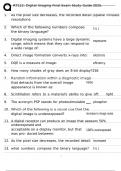
1. As the pixel size decreases, the recorded detail (spatial increases
resolution):
2. Which of the following numbers compose 0&1
the binary language?
3. Digital imaging systems have a large dynamic exposures
range, which means that they can respond to
a wide range of:
4. Direct image formation converts x-rays into: electrons
5. DQE is a measure of image: eflciency
6. How many shades of gray does an 8-bit display?256
7. Random information within a diagnostic image
that detracts from the overall image noise
appearance is known as:
8. Scintillation refers to a material's ability to give off: light
9. The acronym PSP stands for photostimulable . phosphor
10. Which of the following is a visual cue that the
digital image is underexposed? increase in image noise
11. A digital receptor can produce an image that appears 50%
underexposed and
acceptable on a display monitor, but that 100% overexposed
was pro- duced between:
12. As the pixel size decreases, the recorded detail: increases
13. what numbers compose the binary language? 0&1
1/
75
, RT122: Digital Imaging Final Exam Study Guide 2025.
14. CCDs are suitable for low-dose image because they: respond to low
light levels
15. During processing, image data is released from a PSP a red laser
beam
receptor after the receptor is struck by:
16. For flat-panel detectors, the spatial resolution is deter- DELs
mined by the size for the:
17. In an analog-to-digital converter, the electrons
analog input consists of:
18. Individual components of a digital image are collected DELs
in areas of a thin-film transistor known as:
19. Receptor blur is the result of: imaging equipment
20. Selecting a lower sampling frequency during larger pixel size and
image processing results in: lower spatial
resolution
21. The acronym PSP stands for Photostimuable . phosphor
22. The beam that contains useful or diagnostic magnifica
informa- tion is known as the: tion but-
ton is
23. The Nyquist theorem states that for a given used, the
spatial resolution, you must sample the resulting
signal at magnificat
ion is due
times the desired sampling frequency. to de-
crease in
24. When a digital fluoroscopy unit's
the size of
2/
75
, RT122: Digital Imaging Final Exam Study Guide 2025.
the: remnant beam
2
input phosphor
25. CR systems acquire clinical information by laser scanning a PSP
plate
26. All of the following are true of the Moiré effect EXCEPT:
3/
75
, RT122: Digital Imaging Final Exam Study Guide 2025.
It is most likely to occur with
DR technology, par-
ticularly amorphous
sele- nium.
27. In CR technology, preprocessing of data includeshistogram analysis.
grayscale analysis. exposure
data recognition (EDR).
28. A CR imaging plate that has been grossly ghosting.
overex- posed can demonstrate if the
erasure process in incomplete
29. What is the relationship between CR plate The best CR spatial
size and spatial resolution? reso- lution is achieved
with the smallest size
CR plates
30. In computer radiography, if the reader
scanning fre- quency and the radiographic grid Moiré ettect
frequency are simi- lar and in the same
orientation, what is likely to occur?
31. The laser scans the imaging plate in a pattern. raster
32. The phosphor layer is made of phosphors barium fluorohalide
from the
family.
33. Computed radiography is also referred to as PSP technology.
34. Pixel bit depth determines gray shade levels
35. Positioning of an AP wrist projection off center preprocessing errors
using a CR receptor, will likely lead to of the data.
4/
75
1. As the pixel size decreases, the recorded detail (spatial increases
resolution):
2. Which of the following numbers compose 0&1
the binary language?
3. Digital imaging systems have a large dynamic exposures
range, which means that they can respond to
a wide range of:
4. Direct image formation converts x-rays into: electrons
5. DQE is a measure of image: eflciency
6. How many shades of gray does an 8-bit display?256
7. Random information within a diagnostic image
that detracts from the overall image noise
appearance is known as:
8. Scintillation refers to a material's ability to give off: light
9. The acronym PSP stands for photostimulable . phosphor
10. Which of the following is a visual cue that the
digital image is underexposed? increase in image noise
11. A digital receptor can produce an image that appears 50%
underexposed and
acceptable on a display monitor, but that 100% overexposed
was pro- duced between:
12. As the pixel size decreases, the recorded detail: increases
13. what numbers compose the binary language? 0&1
1/
75
, RT122: Digital Imaging Final Exam Study Guide 2025.
14. CCDs are suitable for low-dose image because they: respond to low
light levels
15. During processing, image data is released from a PSP a red laser
beam
receptor after the receptor is struck by:
16. For flat-panel detectors, the spatial resolution is deter- DELs
mined by the size for the:
17. In an analog-to-digital converter, the electrons
analog input consists of:
18. Individual components of a digital image are collected DELs
in areas of a thin-film transistor known as:
19. Receptor blur is the result of: imaging equipment
20. Selecting a lower sampling frequency during larger pixel size and
image processing results in: lower spatial
resolution
21. The acronym PSP stands for Photostimuable . phosphor
22. The beam that contains useful or diagnostic magnifica
informa- tion is known as the: tion but-
ton is
23. The Nyquist theorem states that for a given used, the
spatial resolution, you must sample the resulting
signal at magnificat
ion is due
times the desired sampling frequency. to de-
crease in
24. When a digital fluoroscopy unit's
the size of
2/
75
, RT122: Digital Imaging Final Exam Study Guide 2025.
the: remnant beam
2
input phosphor
25. CR systems acquire clinical information by laser scanning a PSP
plate
26. All of the following are true of the Moiré effect EXCEPT:
3/
75
, RT122: Digital Imaging Final Exam Study Guide 2025.
It is most likely to occur with
DR technology, par-
ticularly amorphous
sele- nium.
27. In CR technology, preprocessing of data includeshistogram analysis.
grayscale analysis. exposure
data recognition (EDR).
28. A CR imaging plate that has been grossly ghosting.
overex- posed can demonstrate if the
erasure process in incomplete
29. What is the relationship between CR plate The best CR spatial
size and spatial resolution? reso- lution is achieved
with the smallest size
CR plates
30. In computer radiography, if the reader
scanning fre- quency and the radiographic grid Moiré ettect
frequency are simi- lar and in the same
orientation, what is likely to occur?
31. The laser scans the imaging plate in a pattern. raster
32. The phosphor layer is made of phosphors barium fluorohalide
from the
family.
33. Computed radiography is also referred to as PSP technology.
34. Pixel bit depth determines gray shade levels
35. Positioning of an AP wrist projection off center preprocessing errors
using a CR receptor, will likely lead to of the data.
4/
75