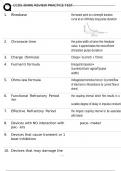
CCDS IBHRE REVIEW PRACTICE TEST.
1. Rheobase the lowest point on a strength duration
curve at an infinitely long pulse duration
2. Chronaxie time the pulse width at twice the rheobase
value. It approximates the most eflcient
stimulation pulse duration
3. Charge (formula) Charge= I(current) x T(time)
4. Furman's formula Energy(microjoules)=
I(current)xV(volt- age)xT(pulse
width)
5. Ohms law formula Voltage(electromotive force)= I(current/flow
of electrons) x R(resistance to current flow in
ohms)
6. Functional Refractory Period the coupling interval which first results in a
mea-
surable degree of delay in impulse conducti
7. Effective Refractory Period the longest coupling interval to be associated
with block
8. Devices with NO interaction with pace- maker
pac- ers
9. Devices that cause transient or 1
beat inhibition
10. Devices that may damage the
, CCDS IBHRE REVIEW PRACTICE TEST.
1. microwave oven, 2. CT scan/Ultrasound 3. X-rays electric blanket & power tools
(diagnostic)
1. MRI 2. Defibrillator 3. Cardioversion 4.
1. EAS 2. Cellphones 3. Arc Welding 4. airport metal Cautery/RF Ablation 5. Radiation
detector 5. TENS 6. Electric appliances such as Therapy
, CCDS IBHRE REVIEW PRACTICE TEST.
11. Resistance in Series Series means the beginning of one
resistance is connected to another
Sum the resistances: R1+R2= total
resistance. EX: A LEAD FRACTURE
(fractures INCREASE imped- ance)
12. Resistance in Parallel Parallel means all the resistances are
connected to the same point.
(R1xR2)/(R1+R2)= total resistance
EX: LEAD INSULATION DEFECTS
(insulation de- fects DECREASE
impedance)
13. Permanent pacemakers are ALL permanent pacemakers are constant
constant voltage or constant voltage devices.
current?
SOME temp pacemakers are constant
voltage, most are constant current.
14. LOAD Load refers to impedance (or resistance)
applied to a circuit.
A system with a SMALL load (low
impedance) applied to the circuit is said
to be a constant current device
A system with LARGE load is said to be a
constant voltage device
15. Guidelines for Permanent Pacing 1. Patient is symptomatic
2. The heart rate is less than 40 bpm
, CCDS IBHRE REVIEW PRACTICE TEST.
3. Asystole of greater than 3 seconds is
docu-
1. Rheobase the lowest point on a strength duration
curve at an infinitely long pulse duration
2. Chronaxie time the pulse width at twice the rheobase
value. It approximates the most eflcient
stimulation pulse duration
3. Charge (formula) Charge= I(current) x T(time)
4. Furman's formula Energy(microjoules)=
I(current)xV(volt- age)xT(pulse
width)
5. Ohms law formula Voltage(electromotive force)= I(current/flow
of electrons) x R(resistance to current flow in
ohms)
6. Functional Refractory Period the coupling interval which first results in a
mea-
surable degree of delay in impulse conducti
7. Effective Refractory Period the longest coupling interval to be associated
with block
8. Devices with NO interaction with pace- maker
pac- ers
9. Devices that cause transient or 1
beat inhibition
10. Devices that may damage the
, CCDS IBHRE REVIEW PRACTICE TEST.
1. microwave oven, 2. CT scan/Ultrasound 3. X-rays electric blanket & power tools
(diagnostic)
1. MRI 2. Defibrillator 3. Cardioversion 4.
1. EAS 2. Cellphones 3. Arc Welding 4. airport metal Cautery/RF Ablation 5. Radiation
detector 5. TENS 6. Electric appliances such as Therapy
, CCDS IBHRE REVIEW PRACTICE TEST.
11. Resistance in Series Series means the beginning of one
resistance is connected to another
Sum the resistances: R1+R2= total
resistance. EX: A LEAD FRACTURE
(fractures INCREASE imped- ance)
12. Resistance in Parallel Parallel means all the resistances are
connected to the same point.
(R1xR2)/(R1+R2)= total resistance
EX: LEAD INSULATION DEFECTS
(insulation de- fects DECREASE
impedance)
13. Permanent pacemakers are ALL permanent pacemakers are constant
constant voltage or constant voltage devices.
current?
SOME temp pacemakers are constant
voltage, most are constant current.
14. LOAD Load refers to impedance (or resistance)
applied to a circuit.
A system with a SMALL load (low
impedance) applied to the circuit is said
to be a constant current device
A system with LARGE load is said to be a
constant voltage device
15. Guidelines for Permanent Pacing 1. Patient is symptomatic
2. The heart rate is less than 40 bpm
, CCDS IBHRE REVIEW PRACTICE TEST.
3. Asystole of greater than 3 seconds is
docu-