

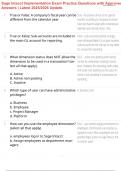
Sage Intacct Implementation Exam Practice Questions with Approved
Sage Intacct Implementer Exam Practice Questions
Answers | Latest 2025/2026 Update.
Study online at https://quizlet.com/_gshmlv
1. True or False: A company's fiscal year can be True - fiscal year can be set to specific
different from the calendar year months according to company structure.
Does not have to align with conventional
calendar year format of Jan - Dec.
2. True or False: Sub-accounts are included in False - sub-accounts provide a longer,
the main GL account for reporting. more distinguishable GL account number.
Sub-accounts do not 'roll-up' to any other
GL account for reporting.
3. What dimension status does NOT allow the B & C - active non-posting and inactive
dimension to be used in a transaction? (se- cannot be used when creating transac-
lect all that apply). tions. However, for reporting, both active
and active non-posting can be used. In-
A. Active active is not including in transactions or
B. Active non-posting reporting.
C. Inactive
4. Which type of user can have administrative A. Business User
privileges?
a. Business
b. Employee
c. Project Manager
d. Platform
5. How can you use the employee dimension? B & C - you cannot assign permissions to
(select all that apply) employees. Permissions can only be as-
signed to users. Also, employees are not
a. employees log in to Sage Intacct granted login access to Sage Intacct, this
b. Assign employees as department man- is only for users.
agers
, Sage Intacct Implementer Exam Practice Questions
Study online at https://quizlet.com/_gshmlv
c. transactions can be coded to employees
d. assign permissions to employees
6. True or False: You can assign multiple roles True - users may be assigned as many
to a user roles as needed.
7. How do you configure the User entities tab A. Do not select any entities. It is advised
of the user to grant access to all existing not to specify all entities for granting users
entities? access to all entities, instead if no entities
are selected for a user, they are consider
a. do not select any entities unrestricted and will have visibility to all
b. select each existing entity entities and top-level.
c. select enable access to top-level
8. True or False: A Location can be assigned to False - a location can be assigned to an-
multiple entities other location or a single entity, not multi-
ple.
9. True or False: When you post a transaction False - journal entries do not create items
to the Accounts Payable Journal, the trans- in subledgers. Only transactions entered
action also posts to the Accounts Payable in subledgers will create journal entries by
application. default in specified GL journals.
10. How do you post a journal entry to a closed B. Post an adjusting journal entry - only
period? adjusting journal entries can be posted to
closed periods. If the period is also locked,
a. assign permissions to post journal entries no entries (including adjustments) can be
to closed periods posted.
b. post an adjusting journal entry
c. you cannot post entries to a closed period
11. What are the characteristics of a deleted A. does not appear in the audit trail.
journal entry?
Sage Intacct Implementer Exam Practice Questions
Answers | Latest 2025/2026 Update.
Study online at https://quizlet.com/_gshmlv
1. True or False: A company's fiscal year can be True - fiscal year can be set to specific
different from the calendar year months according to company structure.
Does not have to align with conventional
calendar year format of Jan - Dec.
2. True or False: Sub-accounts are included in False - sub-accounts provide a longer,
the main GL account for reporting. more distinguishable GL account number.
Sub-accounts do not 'roll-up' to any other
GL account for reporting.
3. What dimension status does NOT allow the B & C - active non-posting and inactive
dimension to be used in a transaction? (se- cannot be used when creating transac-
lect all that apply). tions. However, for reporting, both active
and active non-posting can be used. In-
A. Active active is not including in transactions or
B. Active non-posting reporting.
C. Inactive
4. Which type of user can have administrative A. Business User
privileges?
a. Business
b. Employee
c. Project Manager
d. Platform
5. How can you use the employee dimension? B & C - you cannot assign permissions to
(select all that apply) employees. Permissions can only be as-
signed to users. Also, employees are not
a. employees log in to Sage Intacct granted login access to Sage Intacct, this
b. Assign employees as department man- is only for users.
agers
, Sage Intacct Implementer Exam Practice Questions
Study online at https://quizlet.com/_gshmlv
c. transactions can be coded to employees
d. assign permissions to employees
6. True or False: You can assign multiple roles True - users may be assigned as many
to a user roles as needed.
7. How do you configure the User entities tab A. Do not select any entities. It is advised
of the user to grant access to all existing not to specify all entities for granting users
entities? access to all entities, instead if no entities
are selected for a user, they are consider
a. do not select any entities unrestricted and will have visibility to all
b. select each existing entity entities and top-level.
c. select enable access to top-level
8. True or False: A Location can be assigned to False - a location can be assigned to an-
multiple entities other location or a single entity, not multi-
ple.
9. True or False: When you post a transaction False - journal entries do not create items
to the Accounts Payable Journal, the trans- in subledgers. Only transactions entered
action also posts to the Accounts Payable in subledgers will create journal entries by
application. default in specified GL journals.
10. How do you post a journal entry to a closed B. Post an adjusting journal entry - only
period? adjusting journal entries can be posted to
closed periods. If the period is also locked,
a. assign permissions to post journal entries no entries (including adjustments) can be
to closed periods posted.
b. post an adjusting journal entry
c. you cannot post entries to a closed period
11. What are the characteristics of a deleted A. does not appear in the audit trail.
journal entry?


