ACI STRENGTH TESTING| Answered 100% Correctly
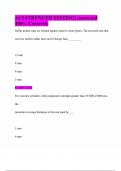
ACI STRENGTH TESTING| Answered 100% Correctly Sulfur mortar caps are formed against metal or stone plates. The recessed area that receives molten sulfur must not be deeper than _________ 12 mm 8 mm 6 mm 5 mm 12 mm (1/2 in) For concrete cylinders with compressive strength greater than 50 MPa (7000 psi), the maximum average thickness of the cap must be____ 3 mm 6 mm12 mm 25 mm 3 mm (1/8 in) Prepare sulfur mortar for use by heating it to about _______ as determined by an all-metal thermometer inserted near the center of the mass. 130 to 145 C (265 to 290 F) The ASTM C617 procedures for capping enable concrete cylinders and cores to meet the standard's requirements for ____ and ___. -alignment, perpendicularity -planeness, alignment -planeness, perpendicularity -strength, perpendicularity planeness, perpendicularly The strength of neat hydraulic cement paste used for capping cylinders depends on ______.-the water/cement ratio -time -its consistency -the type of cement -all of the above all of the above Hydrogen sulfide gas, which may be produced during capping, may be lethal in high concentrations. In lower concentrations, the gas may result in nausea, stomach distress, dizziness, headache, and irritation of the eyes. True or False True Plates for neat cement and high-strength gypsum plaster caps should be made of ______, metal, granite, or diabas
Written for
- Institution
- ACI STRENGTH
- Course
- ACI STRENGTH
Document information
- Uploaded on
- July 14, 2025
- Number of pages
- 43
- Written in
- 2024/2025
- Type
- Exam (elaborations)
- Contains
- Questions & answers
Subjects
- aci strength testing
-
sulfur mortar caps are formed against metal or sto
-
for concrete cylinders with compressive strength g
-
prepare sulfur mortar for use by heating it to abo

Also available in package deal