

2025 – S1 - HRM3705 – ASSESSMENT 4 – Q&A
QUIZ
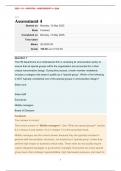
Assessment 4
Started on Monday, 12 May 2025
State Finished
Completed on Monday, 12 May 2025,
Time taken
Marks 20.00/20.00
Grade 100.00 out of 100.00
Question 1
The HR department at a multinational firm is reviewing its remuneration policy to
ensure that all special groups within the organisation are accounted for in their
unique remuneration design. During this process, a team member mistakenly
includes a category that doesn’t qualify as a "special group". Which of the following
is NOT typically considered one of the special groups in remuneration design?
Select one:
Sales staff
Executives
Middle managers
Board of Directors
Feedback
Your answer is correct.
The correct answer is “Middle managers”. See “What are special groups?” section
8.4 in lesson 8 and section 10.2 in chapter 10 of the prescribed book.
Middle managers are the correct answer because they are typically included in
general staff remuneration structures, not treated as a “special group” unless they
perform high-impact or business-critical roles. These roles do not usually require
custom-designed packages or governance oversight. Executives are a key special
group due to their strategic responsibilities, high risk/reward exposure, and need for
1
,2025 – S1 - HRM3705 – ASSESSMENT 4 – Q&A
alignment with shareholder value. Boards of Directors, particularly non-executive
directors (NEDs), are treated separately because they must remain independent and
impartial, and their pay is typically not performance-based. Sales staff are also
considered a special group due to their variable incentive-based earnings, which are
often linked to revenue performance or commissions. Understanding which
employee groups qualify as “special” is important because it guides how
remuneration packages are tailored, ensuring they’re fit-for-purpose and strategically
aligned.
Question 2
Considering the challenges faced by contemporary Remuneration Committees
(RemCos), as outlined by the Institute of Business Ethics (2016), critically discuss
the ethical implications of awarding bonuses during a crisis. What concerns arise in
relation to short-term versus long-term performance incentives, and how might such
decisions impact the organization's ethical standing and long-term sustainability?
Select one:
Bonuses might promote undesirable behaviours
Bonuses are linked to long-term performance targets
Bonuses might be too high for executives
Bonuses are solely set by the RemCo
Feedback
Your answer is incorrect.
The correct option is Bonuses might promote undesired behaviours. See
“Remunerating the Board of Directors”, section 8.6 in lesson 8 and section 10.4 in
chapter 10 of the prescribed book.
As highlighted by the Institute of Business Ethics (2016) in Lesson 8, one of the
central challenges faced by today's Remuneration Committees (RemCos) is
ensuring that performance-related incentives align with long-term organizational
goals and ethical standards. During a crisis or economic downturn, when
stakeholders such as shareholders have lost money and organizational layoffs have
occurred, awarding bonuses can create a conflict of interest. The immediate concern
2
,2025 – S1 - HRM3705 – ASSESSMENT 4 – Q&A
is that such bonuses might incentivise executives to prioritise short-term financial
results over long-term sustainability, potentially encouraging risky decision-making to
meet performance targets. In these circumstances, the issue is not necessarily the
size of the bonuses but whether they are ethically appropriate and aligned with the
organisation's long-term goals.
Furthermore, the decision-making power of the RemCo, while pivotal, is not the only
factor in play; the broader question involves assessing whether it is ethical and
prudent to award such bonuses when the company is undergoing significant
challenges. By focusing on these concerns, you should critically evaluate how
remuneration strategies during a crisis may inadvertently promote behaviours that
conflict with the company's ethical standards or undermine its future stability.
Question 3
Which of the following best explains why a strategically designed employee benefits
programme is critical to organisational performance and sustainability in the long
term?
Select one:
Because it ensures compliance with legal mandates, thus protecting the company
from litigation.
Because it supports employee well-being, which enhances engagement, reduces
turnover, and fosters a resilient workforce.
Because it allows organisations to standardised remuneration across global markets
with minimal adjustment.
Because it reduces short-term salary expenditure by substituting direct pay with non-
cash benefits.
Feedback
Your answer is incorrect.
The correct answer is “Because it supports employee well-being, which
enhances engagement, reduces turnover, and fosters a resilient
3
, 2025 – S1 - HRM3705 – ASSESSMENT 4 – Q&A
workforce”. See “Employee benefits” in lesson 7 and in chapter 7 of the prescribed
book.
The option “Because it ensures compliance with legal mandates, thus protecting the
company from litigation” is partially true. Compliance is a core purpose of employee
benefits, not a strategic goal. Well-designed benefits contribute to a healthier, more
engaged workforce, which in turn supports productivity and organisational
sustainability. While legal compliance is important, it is only a starting point. Strategic
employee benefits go beyond legal requirements to support employee needs and
enhance employer branding. While some employers may view benefits as cost-
effective, the option “Because it reduces short-term salary expenditure by
substituting direct pay with non-cash benefits” misrepresents the intent.
Overemphasising cost control can fail if benefits are perceived as inadequate or
misaligned with employee needs. The option “Because it allows organisations to
standardise remuneration across global markets with minimal adjustment” is
grounded in global HR practice but overly simplistic. Benefits are often highly
localised due to cultural, legal, and economic variations. Standardisation is a
logistical challenge, not a core objective.
Question 4
An organisation has recently redesigned its employee benefits package to include
wellness support, extended leave options, and flexible spending accounts. However,
post-implementation surveys show that employee uptake and satisfaction remain
low.
(🧠Here, "uptake" means the number of employees who actually made use of the
benefit.)
Question: Which of the following actions is most critical to ensuring employees fully
understand and value the benefits provided to them?
Select one:
Reducing discretionary benefits to focus on core entitlements
Limiting the number of benefit options to avoid decision fatigue
4
QUIZ
Assessment 4
Started on Monday, 12 May 2025
State Finished
Completed on Monday, 12 May 2025,
Time taken
Marks 20.00/20.00
Grade 100.00 out of 100.00
Question 1
The HR department at a multinational firm is reviewing its remuneration policy to
ensure that all special groups within the organisation are accounted for in their
unique remuneration design. During this process, a team member mistakenly
includes a category that doesn’t qualify as a "special group". Which of the following
is NOT typically considered one of the special groups in remuneration design?
Select one:
Sales staff
Executives
Middle managers
Board of Directors
Feedback
Your answer is correct.
The correct answer is “Middle managers”. See “What are special groups?” section
8.4 in lesson 8 and section 10.2 in chapter 10 of the prescribed book.
Middle managers are the correct answer because they are typically included in
general staff remuneration structures, not treated as a “special group” unless they
perform high-impact or business-critical roles. These roles do not usually require
custom-designed packages or governance oversight. Executives are a key special
group due to their strategic responsibilities, high risk/reward exposure, and need for
1
,2025 – S1 - HRM3705 – ASSESSMENT 4 – Q&A
alignment with shareholder value. Boards of Directors, particularly non-executive
directors (NEDs), are treated separately because they must remain independent and
impartial, and their pay is typically not performance-based. Sales staff are also
considered a special group due to their variable incentive-based earnings, which are
often linked to revenue performance or commissions. Understanding which
employee groups qualify as “special” is important because it guides how
remuneration packages are tailored, ensuring they’re fit-for-purpose and strategically
aligned.
Question 2
Considering the challenges faced by contemporary Remuneration Committees
(RemCos), as outlined by the Institute of Business Ethics (2016), critically discuss
the ethical implications of awarding bonuses during a crisis. What concerns arise in
relation to short-term versus long-term performance incentives, and how might such
decisions impact the organization's ethical standing and long-term sustainability?
Select one:
Bonuses might promote undesirable behaviours
Bonuses are linked to long-term performance targets
Bonuses might be too high for executives
Bonuses are solely set by the RemCo
Feedback
Your answer is incorrect.
The correct option is Bonuses might promote undesired behaviours. See
“Remunerating the Board of Directors”, section 8.6 in lesson 8 and section 10.4 in
chapter 10 of the prescribed book.
As highlighted by the Institute of Business Ethics (2016) in Lesson 8, one of the
central challenges faced by today's Remuneration Committees (RemCos) is
ensuring that performance-related incentives align with long-term organizational
goals and ethical standards. During a crisis or economic downturn, when
stakeholders such as shareholders have lost money and organizational layoffs have
occurred, awarding bonuses can create a conflict of interest. The immediate concern
2
,2025 – S1 - HRM3705 – ASSESSMENT 4 – Q&A
is that such bonuses might incentivise executives to prioritise short-term financial
results over long-term sustainability, potentially encouraging risky decision-making to
meet performance targets. In these circumstances, the issue is not necessarily the
size of the bonuses but whether they are ethically appropriate and aligned with the
organisation's long-term goals.
Furthermore, the decision-making power of the RemCo, while pivotal, is not the only
factor in play; the broader question involves assessing whether it is ethical and
prudent to award such bonuses when the company is undergoing significant
challenges. By focusing on these concerns, you should critically evaluate how
remuneration strategies during a crisis may inadvertently promote behaviours that
conflict with the company's ethical standards or undermine its future stability.
Question 3
Which of the following best explains why a strategically designed employee benefits
programme is critical to organisational performance and sustainability in the long
term?
Select one:
Because it ensures compliance with legal mandates, thus protecting the company
from litigation.
Because it supports employee well-being, which enhances engagement, reduces
turnover, and fosters a resilient workforce.
Because it allows organisations to standardised remuneration across global markets
with minimal adjustment.
Because it reduces short-term salary expenditure by substituting direct pay with non-
cash benefits.
Feedback
Your answer is incorrect.
The correct answer is “Because it supports employee well-being, which
enhances engagement, reduces turnover, and fosters a resilient
3
, 2025 – S1 - HRM3705 – ASSESSMENT 4 – Q&A
workforce”. See “Employee benefits” in lesson 7 and in chapter 7 of the prescribed
book.
The option “Because it ensures compliance with legal mandates, thus protecting the
company from litigation” is partially true. Compliance is a core purpose of employee
benefits, not a strategic goal. Well-designed benefits contribute to a healthier, more
engaged workforce, which in turn supports productivity and organisational
sustainability. While legal compliance is important, it is only a starting point. Strategic
employee benefits go beyond legal requirements to support employee needs and
enhance employer branding. While some employers may view benefits as cost-
effective, the option “Because it reduces short-term salary expenditure by
substituting direct pay with non-cash benefits” misrepresents the intent.
Overemphasising cost control can fail if benefits are perceived as inadequate or
misaligned with employee needs. The option “Because it allows organisations to
standardise remuneration across global markets with minimal adjustment” is
grounded in global HR practice but overly simplistic. Benefits are often highly
localised due to cultural, legal, and economic variations. Standardisation is a
logistical challenge, not a core objective.
Question 4
An organisation has recently redesigned its employee benefits package to include
wellness support, extended leave options, and flexible spending accounts. However,
post-implementation surveys show that employee uptake and satisfaction remain
low.
(🧠Here, "uptake" means the number of employees who actually made use of the
benefit.)
Question: Which of the following actions is most critical to ensuring employees fully
understand and value the benefits provided to them?
Select one:
Reducing discretionary benefits to focus on core entitlements
Limiting the number of benefit options to avoid decision fatigue
4


