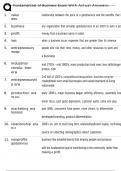
Fundamentals of Business Exam W i t h A c t u a l A n s w e r s .
1. value relationship between the price of a good/service and the benefits that i
otters
2. business any organization that provides goods/services in an ettort to earn a pro
3. profit money that a business earns in sales
4. loss when a business incurs expenses that are greater than its revenue
5. entrepreneurs people who risk their time, money, and other resources to start and
manage
a business
6. industrial mid 1700's - mid 1800's, mass production took over, less skills/larger
revolu- tion produc- tion
era
2nd half of 1800's, competition/manipulation, business empires
7. entrepreneurshi created/took over small businesses and raised standard of living
p era nationwide
8. production era early 1900's, major business began refining eflciency, assembly line
no cus-
tomer focus, post great depression, customer wants came into play
9. marketing era post WWII, consumers have power, more choice, to ditterentiate
businesses
developed branding, product ditterentiation
10. relationship era 1900's on, aim to build long term relationships/brand loyalty, technolog
as a
source of collecting demographics about customers
11. nonprofits business like establishments that employ people and produce
goods/services
with the fundamental goal of contributing to the community rather than
making a profit
1/
21
, Fundamentals of Business Exam W i t h A c t u a l A n s w e r s .
12. factors of four fundamental elements - natural, resources, capital, human
produc- tion resources, entrepreneurship
13. natural resources inputs that otter value in their natural state, value rises with high
demand, low
supply, or both
2/
21
, Fundamentals of Business Exam W i t h A c t u a l A n s w e r s .
14. capital machines, tools, buildings, information - synthetic resources that
businesses
need to produce goods/services, NOT MONEY
15. human resources physical, intellectual/creative contributions within an economy, technolog
replaces manual labor, education becomes more important, employees
16. entrepreneurship economic freedom of who to hire, for instance, what to produce, freedo
from excess regulation, and freedom from too much taxation (key to a
nation's wealth)
17. 5 key 1) economic environment 2) workforce advantage 3) technological
dimensions of environ- ment 4) social environment 6) global environment
business envi-
ronment
18. free trade international/economic/political movement designed to help
goods/services
flow more freely across nations
19. general int. trade agreement that has taken bold steps to lower taritts and
agreement on promote free trade
tariffs/trades
(GATT)
20. economy a financial and social system of how resources flow through society from
production to distribution to consumption
21. economics the study of the choices that people, companies and governments mak
in
allocating society's resources
22. macroeconomics the study of a country's overall economic dynamics, such as the
employment
3/
21
1. value relationship between the price of a good/service and the benefits that i
otters
2. business any organization that provides goods/services in an ettort to earn a pro
3. profit money that a business earns in sales
4. loss when a business incurs expenses that are greater than its revenue
5. entrepreneurs people who risk their time, money, and other resources to start and
manage
a business
6. industrial mid 1700's - mid 1800's, mass production took over, less skills/larger
revolu- tion produc- tion
era
2nd half of 1800's, competition/manipulation, business empires
7. entrepreneurshi created/took over small businesses and raised standard of living
p era nationwide
8. production era early 1900's, major business began refining eflciency, assembly line
no cus-
tomer focus, post great depression, customer wants came into play
9. marketing era post WWII, consumers have power, more choice, to ditterentiate
businesses
developed branding, product ditterentiation
10. relationship era 1900's on, aim to build long term relationships/brand loyalty, technolog
as a
source of collecting demographics about customers
11. nonprofits business like establishments that employ people and produce
goods/services
with the fundamental goal of contributing to the community rather than
making a profit
1/
21
, Fundamentals of Business Exam W i t h A c t u a l A n s w e r s .
12. factors of four fundamental elements - natural, resources, capital, human
produc- tion resources, entrepreneurship
13. natural resources inputs that otter value in their natural state, value rises with high
demand, low
supply, or both
2/
21
, Fundamentals of Business Exam W i t h A c t u a l A n s w e r s .
14. capital machines, tools, buildings, information - synthetic resources that
businesses
need to produce goods/services, NOT MONEY
15. human resources physical, intellectual/creative contributions within an economy, technolog
replaces manual labor, education becomes more important, employees
16. entrepreneurship economic freedom of who to hire, for instance, what to produce, freedo
from excess regulation, and freedom from too much taxation (key to a
nation's wealth)
17. 5 key 1) economic environment 2) workforce advantage 3) technological
dimensions of environ- ment 4) social environment 6) global environment
business envi-
ronment
18. free trade international/economic/political movement designed to help
goods/services
flow more freely across nations
19. general int. trade agreement that has taken bold steps to lower taritts and
agreement on promote free trade
tariffs/trades
(GATT)
20. economy a financial and social system of how resources flow through society from
production to distribution to consumption
21. economics the study of the choices that people, companies and governments mak
in
allocating society's resources
22. macroeconomics the study of a country's overall economic dynamics, such as the
employment
3/
21