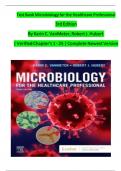
Test Bank Microbiology for the Healthcare Professional
k k k k k k
3rd Edition k
By Karin C. VanMeter, Robert J. Hubert
k k k k k k k
| Verified Chapter's 1 - 25 | Complete Newest Version
k k k k k k k k k
,Table of content
k k
1. k kScope kof kmicrobiology
2. k kChemistry kof klife
3. k kCell kstructure kand kfunction
4. k kBacteria kand karchaea
5. k kViruses
6. k kEukaryotic kmicroorganisms
7. k kPhysical kand kchemical kmethods kof kcontrol
8. k kMicrobiological klaboratory ktechniques
9. k kMicrobiological klaboratory ksafety kissues
10. k kPharmacology
11. k kAntimicrobial kdrugs
12. k kInfection kand kdisease
13. k kThe kimmune kresponse kand klymphatic ksystem
14. k kInfections kof kthe kintegumentary ksystem, ksoft ktissue, kand kmusculoskeletal ksystem
15. k kInfections kof kthe krespiratory ksystem
16. k kInfections kof kthe kgastrointestinal ksystem
k 17. k kInfections kof kthe knervous ksystem kand ksensory kstructures
k 18. k kInfections kof kthe kcardiovascular kand kcirculatory ksystems
k 19. k kInfections kof kthe kurinary ksystem
20. k kInfections kof kthe kreproductive ksystem
k 21. k kSexually ktransmitted kinfections kand kdiseases
22. k kHuman kage kand kmicroorganisms
k 23. k kMicroorganisms kin kthe kenvironment kand keffects kon khuman khealth
24. k kEmerging kinfectious kdiseases
25. k kBiotechnology
,Chapter k01: kScope kof kMicrobiology
VanMeter: kMicrobiology kfor kthe kHealthcare kProfessional, k3rd kEdition
MULTIPLE kCHOICE
1. In kthe ksixteenth kcentury ka kfather-and-son kteam, kby kthe kname kof , kproduced
acompound kmicroscope kconsisting kof ka ksimple ktube kwith klenses kat keach kend.
k k
a. van kLeeuwenhoek
b. Semmelweis
c. Janssen
d. Hooke
ANS: k C REF: k p. k3
2. “Animalcules” kwere kfirst kdescribed kby
a. Robert kHooke.
b. Antony kvan kLeeuwenhoek.
c. Hans kJanssen.
d. John kNeedham.
ANS: k B REF: k p. k3
3. Micrographia, ka kpublication killustrating kinsects, ksponges, kas kwell kas kplant kcells, kwas
kpublishedkby
a. Robert kHooke.
b. Antony kvan kLeeuwenhoek.
c. Hans kJanssen.
d. John kNeedham.
ANS: k A REF: k p. k3
4. Low-power kmicroscopes kdesigned kfor kobserving kfairly klarge kobjects ksuch kas kinsects kor
wormskare
k
a.electron kmicroscopes.
b.dark-field kmicroscopes.
c.fluorescence kmicroscopes.
d.stereomicroscopes.
ANS: k D REF: k p. k5
5. A kmicroscope kthat kprovides ka kthree-dimensional kimage kof ka kspecimen kis ka
a. dark-field kmicroscope.
b. transmission kelectron kmicroscope.
c. bright-field kmicroscope.
d. scanning kelectron kmicroscope.
ANS: k D REF: k p. k7
6. The ktool kof kchoice kto kobserve kliving kmicroorganisms kis kthe
a. bright-field kmicroscope.
b. phase-contrast kmicroscope.
, c. fluorescence kmicroscope.
d. electron kmicroscope.
ANS: k B REF: k p. k6
7. Which kscientist kis kmost kresponsible kfor kending kthe kcontroversy kabout kspontaneous kgeneration?
a. John kNeedham
b. Joseph kLister
c. Louis kPasteur
d. Robert kKoch
ANS: k C REF: k p. k8
8. Fossils kof kprokaryotes kgo kback billion kyears.
a. 4.0 kto k5.0
b. k k k 3.5 kto k4.0
c. 2.5 kto k3.0
d. k k k 2.2 kto k2.7
ANS: k B REF: k p. k9
9. Molds kbelong kto kwhich kof kthe kfollowing kgroups kof keukaryotic korganisms?
a. Protozoans
b. Archaea
c. Fungi
d. Algae
ANS: k C REF: k p. k11
10. The kcorrect kdescending korder kof ktaxonomic kcategories kis
a. species, kdomain, kphylum, kkingdom, korder, kdivision, kclass, kgenus.
b. domain, kkingdom, kphylum, kclass, kfamily, korder, kgenus, kspecies.
c. domain, kkingdom, kphylum, kclass, korder, kfamily, kgenus, kspecies.
d. kingdom, kdomain, kphylum, korder, kclass, kfamily, kgenus, kspecies.
ANS: k C REF: k p. k10
11. Complex kcommunities kof kmicroorganisms kon ksurfaces kare kcalled
a. colonies.
b. biofilms.
c. biospheres.
d. flora.
ANS: k B REF: k p. k12
12. A krelationship kbetween korganisms kin kwhich kthe kwaste kproduct kof kone kprovides
knutrients kforkanother kis kcalled
a. mutualism.
b. competition.
c. synergism.
d. commensalism.
ANS: k D REF: k p. k12
k k k k k k
3rd Edition k
By Karin C. VanMeter, Robert J. Hubert
k k k k k k k
| Verified Chapter's 1 - 25 | Complete Newest Version
k k k k k k k k k
,Table of content
k k
1. k kScope kof kmicrobiology
2. k kChemistry kof klife
3. k kCell kstructure kand kfunction
4. k kBacteria kand karchaea
5. k kViruses
6. k kEukaryotic kmicroorganisms
7. k kPhysical kand kchemical kmethods kof kcontrol
8. k kMicrobiological klaboratory ktechniques
9. k kMicrobiological klaboratory ksafety kissues
10. k kPharmacology
11. k kAntimicrobial kdrugs
12. k kInfection kand kdisease
13. k kThe kimmune kresponse kand klymphatic ksystem
14. k kInfections kof kthe kintegumentary ksystem, ksoft ktissue, kand kmusculoskeletal ksystem
15. k kInfections kof kthe krespiratory ksystem
16. k kInfections kof kthe kgastrointestinal ksystem
k 17. k kInfections kof kthe knervous ksystem kand ksensory kstructures
k 18. k kInfections kof kthe kcardiovascular kand kcirculatory ksystems
k 19. k kInfections kof kthe kurinary ksystem
20. k kInfections kof kthe kreproductive ksystem
k 21. k kSexually ktransmitted kinfections kand kdiseases
22. k kHuman kage kand kmicroorganisms
k 23. k kMicroorganisms kin kthe kenvironment kand keffects kon khuman khealth
24. k kEmerging kinfectious kdiseases
25. k kBiotechnology
,Chapter k01: kScope kof kMicrobiology
VanMeter: kMicrobiology kfor kthe kHealthcare kProfessional, k3rd kEdition
MULTIPLE kCHOICE
1. In kthe ksixteenth kcentury ka kfather-and-son kteam, kby kthe kname kof , kproduced
acompound kmicroscope kconsisting kof ka ksimple ktube kwith klenses kat keach kend.
k k
a. van kLeeuwenhoek
b. Semmelweis
c. Janssen
d. Hooke
ANS: k C REF: k p. k3
2. “Animalcules” kwere kfirst kdescribed kby
a. Robert kHooke.
b. Antony kvan kLeeuwenhoek.
c. Hans kJanssen.
d. John kNeedham.
ANS: k B REF: k p. k3
3. Micrographia, ka kpublication killustrating kinsects, ksponges, kas kwell kas kplant kcells, kwas
kpublishedkby
a. Robert kHooke.
b. Antony kvan kLeeuwenhoek.
c. Hans kJanssen.
d. John kNeedham.
ANS: k A REF: k p. k3
4. Low-power kmicroscopes kdesigned kfor kobserving kfairly klarge kobjects ksuch kas kinsects kor
wormskare
k
a.electron kmicroscopes.
b.dark-field kmicroscopes.
c.fluorescence kmicroscopes.
d.stereomicroscopes.
ANS: k D REF: k p. k5
5. A kmicroscope kthat kprovides ka kthree-dimensional kimage kof ka kspecimen kis ka
a. dark-field kmicroscope.
b. transmission kelectron kmicroscope.
c. bright-field kmicroscope.
d. scanning kelectron kmicroscope.
ANS: k D REF: k p. k7
6. The ktool kof kchoice kto kobserve kliving kmicroorganisms kis kthe
a. bright-field kmicroscope.
b. phase-contrast kmicroscope.
, c. fluorescence kmicroscope.
d. electron kmicroscope.
ANS: k B REF: k p. k6
7. Which kscientist kis kmost kresponsible kfor kending kthe kcontroversy kabout kspontaneous kgeneration?
a. John kNeedham
b. Joseph kLister
c. Louis kPasteur
d. Robert kKoch
ANS: k C REF: k p. k8
8. Fossils kof kprokaryotes kgo kback billion kyears.
a. 4.0 kto k5.0
b. k k k 3.5 kto k4.0
c. 2.5 kto k3.0
d. k k k 2.2 kto k2.7
ANS: k B REF: k p. k9
9. Molds kbelong kto kwhich kof kthe kfollowing kgroups kof keukaryotic korganisms?
a. Protozoans
b. Archaea
c. Fungi
d. Algae
ANS: k C REF: k p. k11
10. The kcorrect kdescending korder kof ktaxonomic kcategories kis
a. species, kdomain, kphylum, kkingdom, korder, kdivision, kclass, kgenus.
b. domain, kkingdom, kphylum, kclass, kfamily, korder, kgenus, kspecies.
c. domain, kkingdom, kphylum, kclass, korder, kfamily, kgenus, kspecies.
d. kingdom, kdomain, kphylum, korder, kclass, kfamily, kgenus, kspecies.
ANS: k C REF: k p. k10
11. Complex kcommunities kof kmicroorganisms kon ksurfaces kare kcalled
a. colonies.
b. biofilms.
c. biospheres.
d. flora.
ANS: k B REF: k p. k12
12. A krelationship kbetween korganisms kin kwhich kthe kwaste kproduct kof kone kprovides
knutrients kforkanother kis kcalled
a. mutualism.
b. competition.
c. synergism.
d. commensalism.
ANS: k D REF: k p. k12