
Agricultural Crop Disease Management - Category 1C - Iowa Commercia
Pesticide Applicator Manual - Vocabulary
Study online at https://quizlet.com/_7wa85s
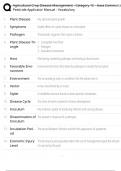
1. Plant Disease Any abnormal plant growth.
2. Symptoms Visible effects of a plant disease on a host plant.
3. Pathogen The parasitic organism that causes a disease.
4. Plant Disease Tri- 1 - Susceptible Host Plant
angle 2 - Pathogen
3 - Favorable Environment
5. Host Plant being invaded by pathogen and serving as food source.
6. Favorable Envi- Environmental factors that allow the pathogen to invade the host plant.
ronment
7. Environment The surroundings and/ or conditions that the plants exist in.
8. Vector A virus transmitted by an insect.
9. Stylet A needlelike structure found on plant-parasitic nematodes.
10. Disease Cycle The chain of events involved in disease development.
11. Inoculum Any material capable of producing infection and causing disease.
12. Dissemination of The spread or dispersal of a pathogen.
Inoculum
13. Incubation Peri- The period between infection and the first appearance of symptoms.
od
14. Economic Injury The density of a pest population when the cost of management equals the amount
Level of crop lost by the pest.
1/5
, Agricultural Crop Disease Management - Category 1C - Iowa Commercia
Pesticide Applicator Manual - Vocabulary
Study online at https://quizlet.com/_7wa85s
15. Economic The density of a pest population that justifies a management measure to keep an
Threshold increasing population from reaching the economic injury level.
16. Immune The pathogen cannot cause disease even under favorable conditions.
17. Tolerant Even with a pathogen present, the plant can produce a good yield.
18. Susceptible With a pathogen present, the plant(s) will be greatly damaged or killed by the
pathogen.
19. Fungicides Chemical or physical agents that kill or inhibit the growth of fungi.
20. Chemical Name The name of an active ingredient in a fungicide.
21. Common Name The non-technical term for the active ingredient or chemical name.
22. Trade Name The patented name under which a product is commercially available.
23. Contact Fungi- Remain on the surface of the plant where they are applied but do not go deeper.
cides There is no after-infection activity.
24. Systemic Fungi- Are absorbed into the plant tissue and may offer some after-infection activity.
cides
25. Preventative Ac- Occurs when a fungicide is present on the plant as a protective barrier before the
tivity pathogen arrives or begins to develop.
26. Early-Infection Occurs when the active ingredient of a fungicide penetrates the plant and stopes
Activity the pathogen in the plant tissues.
27. Anti-Sporulant Prevents spores from being produced.
Activity
28.
2/5
Pesticide Applicator Manual - Vocabulary
Study online at https://quizlet.com/_7wa85s
1. Plant Disease Any abnormal plant growth.
2. Symptoms Visible effects of a plant disease on a host plant.
3. Pathogen The parasitic organism that causes a disease.
4. Plant Disease Tri- 1 - Susceptible Host Plant
angle 2 - Pathogen
3 - Favorable Environment
5. Host Plant being invaded by pathogen and serving as food source.
6. Favorable Envi- Environmental factors that allow the pathogen to invade the host plant.
ronment
7. Environment The surroundings and/ or conditions that the plants exist in.
8. Vector A virus transmitted by an insect.
9. Stylet A needlelike structure found on plant-parasitic nematodes.
10. Disease Cycle The chain of events involved in disease development.
11. Inoculum Any material capable of producing infection and causing disease.
12. Dissemination of The spread or dispersal of a pathogen.
Inoculum
13. Incubation Peri- The period between infection and the first appearance of symptoms.
od
14. Economic Injury The density of a pest population when the cost of management equals the amount
Level of crop lost by the pest.
1/5
, Agricultural Crop Disease Management - Category 1C - Iowa Commercia
Pesticide Applicator Manual - Vocabulary
Study online at https://quizlet.com/_7wa85s
15. Economic The density of a pest population that justifies a management measure to keep an
Threshold increasing population from reaching the economic injury level.
16. Immune The pathogen cannot cause disease even under favorable conditions.
17. Tolerant Even with a pathogen present, the plant can produce a good yield.
18. Susceptible With a pathogen present, the plant(s) will be greatly damaged or killed by the
pathogen.
19. Fungicides Chemical or physical agents that kill or inhibit the growth of fungi.
20. Chemical Name The name of an active ingredient in a fungicide.
21. Common Name The non-technical term for the active ingredient or chemical name.
22. Trade Name The patented name under which a product is commercially available.
23. Contact Fungi- Remain on the surface of the plant where they are applied but do not go deeper.
cides There is no after-infection activity.
24. Systemic Fungi- Are absorbed into the plant tissue and may offer some after-infection activity.
cides
25. Preventative Ac- Occurs when a fungicide is present on the plant as a protective barrier before the
tivity pathogen arrives or begins to develop.
26. Early-Infection Occurs when the active ingredient of a fungicide penetrates the plant and stopes
Activity the pathogen in the plant tissues.
27. Anti-Sporulant Prevents spores from being produced.
Activity
28.
2/5


