

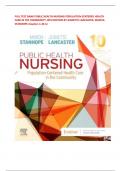
FULL TEST BANK PUBLIC HEALTH NURSING POPULATION-CENTERED HEALTH
CARE IN THE COMMUNITY 10TH EDITION BY JEANETTE LANCASTER, MARCIA
STANHOPE chapters 1-46 A+
,Contents
Chapter 01: Public Health Foundations and Population Health ........................................... 4
Chapter 02: History of Public Health and Public and Community Health Nursing ............... 21
Chapter 03: Public Health, Primary Care, and Primary Health............................................ 34
Chapter 04: Perspectives in Global Health Care ................................................................ 46
Chapter 05: Economics of Health Care Delivery................................................................. 62
Chapter 06: Environmental Health.................................................................................... 78
Chapter 07: Application of Ethics in the Community ......................................................... 90
Chapter 08: Achieving Cultural Competence in Community Health Nursing ..................... 102
Chapter 09: Public Health Policy ..................................................................................... 121
Chapter 10: Evidence-Based Practice .............................................................................. 137
Chapter 11: Population-Based Public Health Nursing Practice: The Intervention Wheel... 145
Chapter 12: Genomics in Public Health Nursing .............................................................. 157
Chapter 13: Epidemiology .............................................................................................. 169
Chapter 14: Infectious Disease Prevention and Control ................................................... 186
Chapter 15: Communicable and Infectious Disease Risks ................................................ 200
Chapter 16: Promoting Healthy Communities ................................................................. 212
Chapter 17: Community as Client: Assessment and Analysis ........................................... 222
Chapter 18: Building a Culture of Health to Influence Health Equity Within Communities 238
Chapter 19: Health Education Principles Applied in Communities, Groups, Families, and
Individuals for Healthy Change ....................................................................................... 250
Chapter 20: The Nurse Managed Health Center: A Model for Public Health Nursing Practice
...................................................................................................................................... 266
Chapter 21: Public Health Nursing Practice and the Disaster Management Cycle ............. 280
Chapter 22: Public Health Surveillance and Outbreak Investigation ................................ 291
Chapter 23: Program Management................................................................................. 303
Chapter 24: Quality Management................................................................................... 319
Chapter 25: Case Management ....................................................................................... 333
Chapter 26: Working With Families in the Community for Healthy Outcomes ................. 348
,Chapter 27: Family Health Risks ..................................................................................... 361
Chapter 28: Child and Adolescent Health ........................................................................ 374
Chapter 29: Major Health Issues and Chronic Disease Management of Adults Across the Life
Span .............................................................................................................................. 385
Chapter 30: Disability Health Care Across the Lifespan.................................................... 398
Chapter 31: Vulnerability and Vulnerable Populations .................................................... 411
Chapter 32: Rural Health Issues ...................................................................................... 422
Chapter 33: Poverty and Homelessness .......................................................................... 433
Chapter 34: Migrant Health Issues .................................................................................. 443
Chapter 35: Teen Pregnancy ........................................................................................... 453
Chapter 36: Mental Health Issues ................................................................................... 463
Chapter 37: Alcohol, Tobacco and Other Drug Problems ................................................. 478
Chapter 38: Violence and Human Abuse ......................................................................... 493
Chapter 39: The Advanced Practice Nurse in the Community .......................................... 506
Chapter 40: The Nurse Leader in the Community ............................................................ 518
Chapter 41: The Nurse in Public Health, Home Health, Hospice, and Palliative Care ........ 531
Chapter 42: The Nurse in the Schools ............................................................................. 542
Chapter 43: The Nurse in Occupational Health ................................................................ 551
Chapter 44: Forensic Nursing in the Community ............................................................. 564
Chapter 45: The Nurse in the Faith Community ............................................................... 576
Chapter 46: Public Health Nursing at Local, State, and National Levels ............................ 588
,Chapter 01: Public Health Foundations and Population Health
MULTIPLE CHOICE
1. What is the primary focus to be addressed concerning the improvement of the health of the
American people in the twenty-first century?
a. Bioterrorism and global health threats
b. Delivery of individual care and hygiene
c. The need for increased hospital and acute care
d. Chronic disease and disability management
ANS: A
There are new concerns, and of the most serious are bioterrorism and globally induced infections, such
as the avian flu. These threats will divert health care funds and resources from other health care
programs to be spent for public safety. The others are not related to public health or are concerns that
have been present for many years.
DIF: Cognitive level: Understanding TOP: Nursing process: Planning MSC: NCLEX: Health
Promotion and Maintenance
2. A community is concerned about the threat of bioterrorism. Which of the following best
describes the basis for this concern?
a. Bioterrorism has the potential to dissolve community-based programs.
b. This threat could causeNthUeRhSeaIlthNcGaTreBs.ysCteOmMto collapse.
c. The threat may divert funds from other public safety health care programs.
d. Fear of bioterrorism will increase the need for shelters.
ANS: C
Bioterrorism may have an impact on the availability of resources for public safety health care programs.
Because funds are diverted it is possible that community-based programs would be eliminated, the
health care system could experience changes, and that there would be an increase in the need for
shelter. However, all the remaining options would happen because of the diversion of funds.
DIF: Cognitive level: Analyzing TOP: Nursing process: Diagnosis MSC: NCLEX: Physiological
Integrity
,3. Which statement describes the consequence of the successful implementation of the Affordable
Care Act?
a. Americans will pay closer attention to their health status.
b. Most of the population will be covered by health insurance.
c. Public health departments will need to increase the number of nursing positions.
d. The prevalence of obesity will decrease. ANS: B
One consequence of successful implementation of the Affordable Care Act might be that the majority of
the population would be covered by insurance and public health agencies will not need to provide direct
clinical services in order to assure that those who need them can receive them. The Affordable Care Act
will not directly cause Americans to pay closer attention to their health status or decrease the
prevalence of obesity.
DIF: Cognitive level: Understanding TOP: Nursing process: Assessment MSC: NCLEX: Health
Promotion and Maintenance
4. The public health nurse (PHN) must participate in the essential services of public health. What is
one of the essential services of public health nursing?
a. Monitoring health status by completing a community assessment
b. Diagnosing and investigating health problems in the world
c. Informing, educating, and empowering people about health issues
d. Working in law enforcement to regulate health and ensure safety
ANS: C
The PHN monitors health status in several ways, completing a community assessment is only one way
that health status is monitored. The PHN would not diagnose or solve “world” problems, or work in law
enforcement. Rather, the PHN would participate with local regulators to protect communities and
empower people to address health issues.
DIF: Cognitive level: Understanding TOP: Nursing process: Implementation MSC: NCLEX: Health
Promotion and Maintenance
,5. A public health department is using the mission of public health as described by the Institute of
Medicine when planningNitsRheaIlth pGrogBra.mCminMg. Which of the following activities will most
likely be implemented?
a. Tracking avian flu outbreaks and doing surveillance in the United States
b. Providing a flu shot for an elderly person at the health department
c. Keeping track of alternative therapies in use in the United States
d. Keeping snake antivenom at the Centers for Disease Control and Prevention in Atlanta
ANS: A
The Institute of Medicine’s stated mission on public health is “to generate organized community and
technical knowledge to prevent disease and promote health.” Tracking avian flu outbreaks and doing
surveillance applies this concept at a population level. Providing a flu shot for an elderly person only
addresses individual care. Keeping track of the use of alternative therapies does nothing to prevent
disease or promote health of the population.
Keeping snake antivenom is aimed at disease care for an individual, not health promotion or disease
prevention.
DIF: Cognitive level: Analyzing TOP: Nursing process: Assessment MSC: NCLEX: Health
Promotion and Maintenance
6. A public health department makes sure that the essential community-oriented health services
are available in the community. Which of the following core public health functions is being
implemented?
a. Policy development
b. Assessment
c. Assurance
d. Scientific knowledge-based care
ANS: C
Assurance focuses on the responsibility of public health agencies to ensure certain activities have been
appropriately carried out to meet public health goals and plans. Policy development seeks to build
constituencies that can help bring about change in public policy. Assessment includes activities that
involve collecting, analyzing, and disseminating information on both the health status and the health-
, related aspects of a community or a specific population. Public health is based on scientific knowledge
but is not a core function.
DIF: Cognitive level: Applying TOP: Nursing process: Assessment MSC: NCLEX: Health
Promotion and Maintenance
7. What is the purpose of public health core functions?
a. Clarifying the role of the government in fulfilling the mission of public health
b. Ensuring the safety of populations in receiving quality health care
c. Providing community-based individualized care to every person in the United States
d. Uniting public and private providers of care in a comprehensive approach to providing health
care
ANS: A
As defined by the Institute of Medicine in its 1988 report The Future of Public Health, assessment, policy
development, and assurance are core functions at all levels of government for the
purposeNofRclarIifyiGng tBhe.gCoveMrnment’s role.
DIF: Cognitive level: Understanding TOP: Nursing process: Assessment MSC: NCLEX: Health
Promotion and Maintenance
8. Which of the following statements about public health is accurate?
a. Prevention of early deaths can be more effectively accomplished by medical treatment than by
public health approaches.
b. Expenditures and resources for public health have increased in recent years.
c. Historically, gains in the health of populations have been related largely to changes in safety,
sanitation, and food safety.
d. Reform of the medical insurance system is the single change needed to improve the health of
Americans.
ANS: C
Fielding and Tilson have asserted that most of the increase in life span has been made through
improvements in sanitation, clean water supplies, making workplaces safer, improving food and drug
safety, immunizing children, and improving nutrition, hygiene, and housing. Medical treatment has not
made as significant of an impact on the life span as public health measures. Funding for public health in
recent years has been on a gradual decline. Although reform of the medical insurance system may help
improve the health of Americans, there are many other factors that will need to be addressed.
DIF: Cognitive level: Understanding TOP: Nursing process: Assessment
CARE IN THE COMMUNITY 10TH EDITION BY JEANETTE LANCASTER, MARCIA
STANHOPE chapters 1-46 A+
,Contents
Chapter 01: Public Health Foundations and Population Health ........................................... 4
Chapter 02: History of Public Health and Public and Community Health Nursing ............... 21
Chapter 03: Public Health, Primary Care, and Primary Health............................................ 34
Chapter 04: Perspectives in Global Health Care ................................................................ 46
Chapter 05: Economics of Health Care Delivery................................................................. 62
Chapter 06: Environmental Health.................................................................................... 78
Chapter 07: Application of Ethics in the Community ......................................................... 90
Chapter 08: Achieving Cultural Competence in Community Health Nursing ..................... 102
Chapter 09: Public Health Policy ..................................................................................... 121
Chapter 10: Evidence-Based Practice .............................................................................. 137
Chapter 11: Population-Based Public Health Nursing Practice: The Intervention Wheel... 145
Chapter 12: Genomics in Public Health Nursing .............................................................. 157
Chapter 13: Epidemiology .............................................................................................. 169
Chapter 14: Infectious Disease Prevention and Control ................................................... 186
Chapter 15: Communicable and Infectious Disease Risks ................................................ 200
Chapter 16: Promoting Healthy Communities ................................................................. 212
Chapter 17: Community as Client: Assessment and Analysis ........................................... 222
Chapter 18: Building a Culture of Health to Influence Health Equity Within Communities 238
Chapter 19: Health Education Principles Applied in Communities, Groups, Families, and
Individuals for Healthy Change ....................................................................................... 250
Chapter 20: The Nurse Managed Health Center: A Model for Public Health Nursing Practice
...................................................................................................................................... 266
Chapter 21: Public Health Nursing Practice and the Disaster Management Cycle ............. 280
Chapter 22: Public Health Surveillance and Outbreak Investigation ................................ 291
Chapter 23: Program Management................................................................................. 303
Chapter 24: Quality Management................................................................................... 319
Chapter 25: Case Management ....................................................................................... 333
Chapter 26: Working With Families in the Community for Healthy Outcomes ................. 348
,Chapter 27: Family Health Risks ..................................................................................... 361
Chapter 28: Child and Adolescent Health ........................................................................ 374
Chapter 29: Major Health Issues and Chronic Disease Management of Adults Across the Life
Span .............................................................................................................................. 385
Chapter 30: Disability Health Care Across the Lifespan.................................................... 398
Chapter 31: Vulnerability and Vulnerable Populations .................................................... 411
Chapter 32: Rural Health Issues ...................................................................................... 422
Chapter 33: Poverty and Homelessness .......................................................................... 433
Chapter 34: Migrant Health Issues .................................................................................. 443
Chapter 35: Teen Pregnancy ........................................................................................... 453
Chapter 36: Mental Health Issues ................................................................................... 463
Chapter 37: Alcohol, Tobacco and Other Drug Problems ................................................. 478
Chapter 38: Violence and Human Abuse ......................................................................... 493
Chapter 39: The Advanced Practice Nurse in the Community .......................................... 506
Chapter 40: The Nurse Leader in the Community ............................................................ 518
Chapter 41: The Nurse in Public Health, Home Health, Hospice, and Palliative Care ........ 531
Chapter 42: The Nurse in the Schools ............................................................................. 542
Chapter 43: The Nurse in Occupational Health ................................................................ 551
Chapter 44: Forensic Nursing in the Community ............................................................. 564
Chapter 45: The Nurse in the Faith Community ............................................................... 576
Chapter 46: Public Health Nursing at Local, State, and National Levels ............................ 588
,Chapter 01: Public Health Foundations and Population Health
MULTIPLE CHOICE
1. What is the primary focus to be addressed concerning the improvement of the health of the
American people in the twenty-first century?
a. Bioterrorism and global health threats
b. Delivery of individual care and hygiene
c. The need for increased hospital and acute care
d. Chronic disease and disability management
ANS: A
There are new concerns, and of the most serious are bioterrorism and globally induced infections, such
as the avian flu. These threats will divert health care funds and resources from other health care
programs to be spent for public safety. The others are not related to public health or are concerns that
have been present for many years.
DIF: Cognitive level: Understanding TOP: Nursing process: Planning MSC: NCLEX: Health
Promotion and Maintenance
2. A community is concerned about the threat of bioterrorism. Which of the following best
describes the basis for this concern?
a. Bioterrorism has the potential to dissolve community-based programs.
b. This threat could causeNthUeRhSeaIlthNcGaTreBs.ysCteOmMto collapse.
c. The threat may divert funds from other public safety health care programs.
d. Fear of bioterrorism will increase the need for shelters.
ANS: C
Bioterrorism may have an impact on the availability of resources for public safety health care programs.
Because funds are diverted it is possible that community-based programs would be eliminated, the
health care system could experience changes, and that there would be an increase in the need for
shelter. However, all the remaining options would happen because of the diversion of funds.
DIF: Cognitive level: Analyzing TOP: Nursing process: Diagnosis MSC: NCLEX: Physiological
Integrity
,3. Which statement describes the consequence of the successful implementation of the Affordable
Care Act?
a. Americans will pay closer attention to their health status.
b. Most of the population will be covered by health insurance.
c. Public health departments will need to increase the number of nursing positions.
d. The prevalence of obesity will decrease. ANS: B
One consequence of successful implementation of the Affordable Care Act might be that the majority of
the population would be covered by insurance and public health agencies will not need to provide direct
clinical services in order to assure that those who need them can receive them. The Affordable Care Act
will not directly cause Americans to pay closer attention to their health status or decrease the
prevalence of obesity.
DIF: Cognitive level: Understanding TOP: Nursing process: Assessment MSC: NCLEX: Health
Promotion and Maintenance
4. The public health nurse (PHN) must participate in the essential services of public health. What is
one of the essential services of public health nursing?
a. Monitoring health status by completing a community assessment
b. Diagnosing and investigating health problems in the world
c. Informing, educating, and empowering people about health issues
d. Working in law enforcement to regulate health and ensure safety
ANS: C
The PHN monitors health status in several ways, completing a community assessment is only one way
that health status is monitored. The PHN would not diagnose or solve “world” problems, or work in law
enforcement. Rather, the PHN would participate with local regulators to protect communities and
empower people to address health issues.
DIF: Cognitive level: Understanding TOP: Nursing process: Implementation MSC: NCLEX: Health
Promotion and Maintenance
,5. A public health department is using the mission of public health as described by the Institute of
Medicine when planningNitsRheaIlth pGrogBra.mCminMg. Which of the following activities will most
likely be implemented?
a. Tracking avian flu outbreaks and doing surveillance in the United States
b. Providing a flu shot for an elderly person at the health department
c. Keeping track of alternative therapies in use in the United States
d. Keeping snake antivenom at the Centers for Disease Control and Prevention in Atlanta
ANS: A
The Institute of Medicine’s stated mission on public health is “to generate organized community and
technical knowledge to prevent disease and promote health.” Tracking avian flu outbreaks and doing
surveillance applies this concept at a population level. Providing a flu shot for an elderly person only
addresses individual care. Keeping track of the use of alternative therapies does nothing to prevent
disease or promote health of the population.
Keeping snake antivenom is aimed at disease care for an individual, not health promotion or disease
prevention.
DIF: Cognitive level: Analyzing TOP: Nursing process: Assessment MSC: NCLEX: Health
Promotion and Maintenance
6. A public health department makes sure that the essential community-oriented health services
are available in the community. Which of the following core public health functions is being
implemented?
a. Policy development
b. Assessment
c. Assurance
d. Scientific knowledge-based care
ANS: C
Assurance focuses on the responsibility of public health agencies to ensure certain activities have been
appropriately carried out to meet public health goals and plans. Policy development seeks to build
constituencies that can help bring about change in public policy. Assessment includes activities that
involve collecting, analyzing, and disseminating information on both the health status and the health-
, related aspects of a community or a specific population. Public health is based on scientific knowledge
but is not a core function.
DIF: Cognitive level: Applying TOP: Nursing process: Assessment MSC: NCLEX: Health
Promotion and Maintenance
7. What is the purpose of public health core functions?
a. Clarifying the role of the government in fulfilling the mission of public health
b. Ensuring the safety of populations in receiving quality health care
c. Providing community-based individualized care to every person in the United States
d. Uniting public and private providers of care in a comprehensive approach to providing health
care
ANS: A
As defined by the Institute of Medicine in its 1988 report The Future of Public Health, assessment, policy
development, and assurance are core functions at all levels of government for the
purposeNofRclarIifyiGng tBhe.gCoveMrnment’s role.
DIF: Cognitive level: Understanding TOP: Nursing process: Assessment MSC: NCLEX: Health
Promotion and Maintenance
8. Which of the following statements about public health is accurate?
a. Prevention of early deaths can be more effectively accomplished by medical treatment than by
public health approaches.
b. Expenditures and resources for public health have increased in recent years.
c. Historically, gains in the health of populations have been related largely to changes in safety,
sanitation, and food safety.
d. Reform of the medical insurance system is the single change needed to improve the health of
Americans.
ANS: C
Fielding and Tilson have asserted that most of the increase in life span has been made through
improvements in sanitation, clean water supplies, making workplaces safer, improving food and drug
safety, immunizing children, and improving nutrition, hygiene, and housing. Medical treatment has not
made as significant of an impact on the life span as public health measures. Funding for public health in
recent years has been on a gradual decline. Although reform of the medical insurance system may help
improve the health of Americans, there are many other factors that will need to be addressed.
DIF: Cognitive level: Understanding TOP: Nursing process: Assessment


