

Written by students who passed Immediately available after payment Read online or as PDF Wrong document? Swap it for free 4.6 TrustPilot
logo-home
Document preview thumbnail
Preview 4 out of 2090 pages
Exam (elaborations)

TEST BANK Understanding Business, 13th Edition By William Nickels, Jim McHugh, Chapters 1 – 20 TABLE OF CONTENTS CHAPTER 1: Taking Risks and Making Profits within the Dynamic Business Environment CHAPTER 2: Understanding Economics and How It Affects

Document preview thumbnail
Preview 4 out of 2090 pages

TEST BANK Understanding Business, 13th Edition By William Nickels, Jim McHugh, Chapters 1 – 20 TABLE OF CONTENTS CHAPTER 1: Taking Risks and Making Profits within the Dynamic Business Environment CHAPTER 2: Understanding Economics and How It Affects Business CHAPTER 3: Doing Business in Global Markets CHAPTER 4: Demanding Ethical and Socially Responsible Behavior CHAPTER 5: How to Form a Business CHAPTER 6: Entrepreneurship and Starting a Small Business CHAPTER 7: Management and Leadership CHAPTER 8: Structuring Organizations for Today’s Challenges CHAPTER 9: Production and Operations Management CHAPTER 10: Motivating Employees CHAPTER 11: Human Resource Management: Finding and Keeping the Best Employees CHAPTER 12: Dealing with Employee–Management Issues CHAPTER 13: Marketing: Helping Buyers Buy CHAPTER 14: Developing and Pricing Goods and Services CHAPTER 15: Distributing Products CHAPTER 16: Using Effective Promotions CHAPTER 17: Understanding Accounting and Financial Information CHAPTER 18: Financial Management CHAPTER 19: Using Securities Markets for Financing and Investing Opportunities CHAPTER 20: Money, Financial Institutions, and the Federal Reserve Answers are at the end of Each chapter Chapter 1 Student name: 1) Describe three ways that governments can foster entrepreneurship and encourage the creation of wealth 2) 3) Describe how businesses can use technology to be more responsive to customers. Competition among businesses has never been greater. Identify and describe two ways that businesses can become more competitive. 4) What is demography? Identify two demographic trends in the United States and discuss how they will impactUnited States businesses. 5) Describe what we mean by greening and thinking green. List five ways that people and businesses are participating in the green movement. List business opportunities that may emerge from this movement. 6) Trace the evolution of American business. Identify the key trends, and discuss the implications these trends have for the future. 7) 8) An entity that seeks to earn a profit by providing a good or service is known as a(n) A) industry. B) corporation. C) business. D) service. is the amount a business earns after deducting what it spends for salaries and other expenses. A) Profit B) Revenue C) Interest D) Dividends 9) A business incurs a if its costs and expenses exceed its revenues. A) loss B) liability C) debit D) dividend 10) is the chance a business owner will lose the time and money invested in a business that proves to be unprofitable. A) Depreciation B) Risk C) Opportunity D) Redundancy 11) The total amount of money that businesses take in by selling goods and services is called A) profit. B) revenue. C) loss. D) retained earnings. 12) 13) 14) 15) A(n) A) manager B) entrepreneur C) employee D) stakeholder is a person who assumes the risk of starting a business. Starting a business always involves A) profit. B) loss. C) revenue. D) risk Often in business the greater the risk, the A) greater the potential reward. B) lower the expected revenues. C) lower the value provided to society. D) greater the number of stakeholders. is a measure of the general well-being and satisfaction derived from a variety of factors including political freedom, safety, education, and a clean environment. A) Standard of living B) Quality of life C) Gross national income D) Social satisfaction 16) The amount of goods and services people can buy with the money they have is called their 17) A) nominal income. B) consumer price index. C) profit margin. D) standard of living. The customers, employees, stockholders, suppliers, creditors, and others who stand to gain or lose by the policies and activities of a business represent the firm's A) market makers. B) economic environment. C) stakeholders. D) social environment. 18) The most important difference between for-profit businesses and nonprofit organizations is that A) for-profit businesses do not benefit society. B) nonprofit organizations seek to make a profit for their owners and organizers. C) nonprofit organizations do not seek a profit for their owners or organizers. D) nonprofit organizations do not answer to stakeholders. 19) A common characteristic of most entrepreneurs is that they A) accept the risks involved in starting and managing a business. B) have a high level of scientific and technical expertise. C) possess a great deal of personal wealth. D) have experience in running large, complex organizations. 20) 21) What is the best example of a business whose goal is to earn a profit? A) a community college B) American Red Cross C) League of Women Voters D) Amazon In order to make an intelligent investment decision, entrepreneurs should A) limit their options to those business investments that are backed by the U.S. government. B) invest in businesses that have generated a stable rate of profit for at least the past 10 years. C) invest only in business opportunities where it is possible to take an active role in management. D) compare the risks of potential investments to their expected profits and find the right balance between profit and risk. 22) Honda and Hyundai have insourced for years to design and manufacture cars in the United States. What statement is accurate about this practice? A) Insourcing helps offset the number of jobs being outsourced. B) Insourcing increases the number of jobs being outsourced. C) Insourcing damages the United States economy. D) Insourcing causes jobs to be lost to overseas competitors. 23) Public schools, charities, and government agencies generally A) have the same goals as for-profit businesses. B) do not seek to earn a profit. C) provide goods rather than services. D) do not have any stakeholders. 24) 25) 26) 27) For-profit businesses and nonprofit organizations are similar in that they both A) contribute to the welfare of society. B) seek to earn a profit. C) have a limited life. D) must be controlled by a board of directors. The standard of living for a nation's people depends mainly on A) the quality of the natural environment. B) how much political freedom they have. C) their income and the prices of the goods and services they can buy. D) the amount of labor and capital available employed in the manufacturing sector. Today’s businesses attempt to meet the needs of A) their customers, even if it comes at the expense of employees and other stakeholders. B) their employees, even if it means shortchanging customers by charging higher prices. C) all stakeholders. D) exclusively their owners, since they are ultimately the ones who pay the bills. What is the most accurate statement about the impact of business on society? A) When businesses earn a profit for their owners, they usually do so at the expense of the rest of society, which proves it is never a win-win situation. B) While businesses often improve the standard of living within a society, they can do little to improve the quality of life. C) Businesses often improve the quality of life, but can do little to improve the standard of living for most people. D) Businesses can have a positive impact on both the standard of living and the quality of life within a society. 28) Last year, Jensen Consulting reported revenues of $34 million while its total expenses were $10 million. Based on this information, Jensen reported A) profits of $24 million. B) profits of $34 million. C) losses of $24 million. D) losses of $34 million. 29) Taylor recently started selling her invention: A bed that looks like it floats in mid-air. The bed is actually suspended by magnetic forces. Taylor is a(n) A) arbitrageur. B) entrepreneur. C) speculator. D) account manager. 30) Roman wants to invest some money that he just inherited. His friend Jon wants him to invest in his new food truck business, promising Roman a better return on his investment than a traditional savings account. Roman should keep in mind that to earn a higher return on his money he A) will have to invest overseas. B) should only invest in a long-standing business. C) will probably have to accept a higher level of risk. D) will probably have to engage in illegal activities. 31) Though the prices of things she buys have gone up, Maya's income has remained stable over the past few years. Nevertheless, Maya feels better off because the environment is cleaner, the crime rate has dropped, she has more relaxation time, and the quality of medical care has improved. If Maya's experience is typical, we can assume that the standard of living has A) increased, but the quality of life has decreased. B) increased, and so has the quality of life. C) declined, but the quality of life has increased. D) declined, and so has the quality of life. 32) Hyun and her three college friends enjoy perfumes. As a special gift to each of them last holiday season, Hyun found a way to make scented candles with each friend's favorite perfume scent. The three friends loved her gift idea and encouraged Hyun to create more and sell them online. Recently, she is filling orders from her website, and turning a profit. Hyun is proof that A) personalized products will always be successful. B) when you successfully fill a market need, you can make money. C) the Internet is a way to distribute just about anything. D) the cost of supplies to make candles is relatively cheap. 33) Miranda wants to operate a small catering business out of her home, located in a quiet residential neighborhood. She asks for input from her neighbors, the homeowner's association, her suppliers, and the zoning commission about issues including parking, noise, safety concerns, and operating hours. Before officially opening, Miranda adjusts her business plan based on the feedback she received. Miranda has discovered tha

Content preview

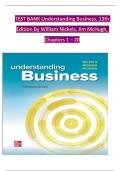
TEST BANK Understanding Business, 13th
Edition By William Nickels, Jim McHugh,
Chapters 1 – 20

,TABLE OF CONTENTS

CHAPTER 1: Taking Risks and Making Profits within the Dynamic Business Environment

CHAPTER 2: Understanding Economics and How It Affects Business

CHAPTER 3: Doing Business in Global Markets

CHAPTER 4: Demanding Ethical and Socially Responsible Behavior

CHAPTER 5: How to Form a Business

CHAPTER 6: Entrepreneurship and Starting a Small Business

CHAPTER 7: Management and Leadership

CHAPTER 8: Structuring Organizations for Today’s Challenges

CHAPTER 9: Production and Operations Management

CHAPTER 10: Motivating Employees

CHAPTER 11: Human Resource Management: Finding and Keeping the Best Employees

CHAPTER 12: Dealing with Employee–Management Issues

CHAPTER 13: Marketing: Helping Buyers Buy

CHAPTER 14: Developing and Pricing Goods and Services

CHAPTER 15: Distributing Products

CHAPTER 16: Using Effective Promotions

CHAPTER 17: Understanding Accounting and Financial Information

CHAPTER 18: Financial Management

CHAPTER 19: Using Securities Markets for Financing and Investing Opportunities

CHAPTER 20: Money, Financial Institutions, and the Federal Reserve

,Answers are at the end of Each chapter


Chapter 1
Student name:
1) Describe three ways that governments can foster entrepreneurship and encourage
the creation of wealth


2) Describe how businesses can use technology to be more responsive to customers.


3) Competition among businesses has never been greater. Identify and describe two
ways that businesses can become more competitive.


4) What is demography? Identify two demographic trends in the United States and
discuss how they will impactUnited States businesses.


5) Describe what we mean by greening and thinking green. List five ways that people and
businesses are participating in the green movement. List business opportunities that may
emerge from this movement.


6) Trace the evolution of American business. Identify the key trends, and discuss the
implications these trends have for the future.

, 7) An entity that seeks to earn a profit by providing a good or service is known as a(n)

A) industry.
B) corporation.
C) business.
D) service.


8) is the amount a business earns after deducting what it spends for salaries
and other expenses.

A) Profit
B) Revenue
C) Interest
D) Dividends

9) A business incurs a if its costs and expenses exceed its revenues.

A) loss
B) liability
C) debit
D) dividend

10) is the chance a business owner will lose the time and money invested in a
business that proves to be unprofitable.

A) Depreciation
B) Risk
C) Opportunity
D) Redundancy


11) The total amount of money that businesses take in by selling goods and services is called

Connected book
 image
William Nickels, Susan McHugh, James McHugh Understanding Business
Publisher: 2012 ISBN: 9780073524597 Edition: Unknown

Document information

Uploaded on
July 2, 2025
Number of pages
2090
Written in
2024/2025
Type
Exam (elaborations)
Contains
Questions & answers
$15.99

Wrong document? Swap it for free Within 14 days of purchase and before downloading, you can choose a different document. You can simply spend the amount again.
Written by students who passed
Immediately available after payment
Read online or as PDF

Seller avatar
Reputation scores are based on the amount of documents a seller has sold for a fee and the reviews they have received for those documents. There are three levels: Bronze, Silver and Gold. The better the reputation, the more your can rely on the quality of the sellers work.
DRERIC
3.3
(8)
Sold
25
Followers
1
Items
1175
Last sold
1 month ago


Why students choose Stuvia

Created by fellow students, verified by reviews

Quality you can trust: written by students who passed their tests and reviewed by others who've used these notes.

Didn't get what you expected? Choose another document

No worries! You can instantly pick a different document that better fits what you're looking for.

Pay as you like, start learning right away

No subscription, no commitments. Pay the way you're used to via credit card and download your PDF document instantly.

Student with book image

“Bought, downloaded, and aced it. It really can be that simple.”

Alisha Student

Working on your references?

Create accurate citations in APA, MLA and Harvard with our free citation generator.

Working on your references?

Frequently asked questions
