
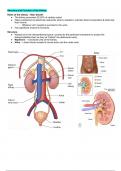
Structure and Function of the Kidney
Roles of the kidney – filter blood!!
● The kidney processes 22-25% of cardiac output
● Filters substances & selectively reabsorbs what is needed to maintain blood composition & total body
fluid volume
○ Whatever isn’t needed is excreted in the urine
● Has significant endocrine functions
Structure
● Kidneys sit in the retroperitoneal space; covered by the peritoneal membrane to protect the
kidneys/stabilize them as they sit “behind” the abdominal cavity
● Nephrons → functional units of the kidney
● Hilus → where blood vessels & nerves enter and the ureter exits
,
,Outer cortex → red-brown in color, glomeruli & convoluted tubules of the nephron, blood vessels
Medula → light colored, renal pyramids (renal papillae, loop of Henle, renal pelvic & collecting system
, Tubules and Loops
Proximal tubule → drains from the Bowman capsule,
secretion of large amounts of sodium & byproducts of
metabolism (oxalates, urates) and other compounds
(some abx, aspirin, and other drugs)
● 65% of the reabsorption & secretory
processes happen here
● As reabsorption occurs, substances are moved
from the tube into the cells lining the tube = a
concentration gradient is established = fluid
outside the tube is more concentrated than the
fluid inside the tube = concentration gradient
passively pulls water out of the tubule
● Has a transport maximum
○ Ex → transport maximum of glucose in
the proximal tubule is 150 and the pt. has
a BS of 200…we have exceeded the
transport/reabsorption for glucose & will
see a spilling of glucose in the urine (aka
“renal threshold”)
● Secretion is competitive here…for example, if a
patient has gout & high levels of uric acid AND is taking aspirin…the aspirin will compete with the uric
acid to be secreted = higher levels of uric acid; this is why patients with gout don’t take ASA
Loop of Henle → largest concentration of urine…the loop always absorbs more Na+ and Cl- than water
● Descending limb = very permeable to water
○ The greatest concentration of urine takes place
● Ascending limb = impermeable to water
○ Solutes are reabsorbed, water doesn’t follow = diluting the urine, particles are moving out of the
urine making it more diluted
● Thick ascending limb = impermeable to water
○ Where reabsorption of Na+/K+/2Cl- occurs, results in a dilute filtrate
○ About 20% of Na+ is reabsorbed here…this is where the loop diuretics (lasix) work to
remove Na+ (by preventing the reabsorption of Na+)
Roles of the kidney – filter blood!!
● The kidney processes 22-25% of cardiac output
● Filters substances & selectively reabsorbs what is needed to maintain blood composition & total body
fluid volume
○ Whatever isn’t needed is excreted in the urine
● Has significant endocrine functions
Structure
● Kidneys sit in the retroperitoneal space; covered by the peritoneal membrane to protect the
kidneys/stabilize them as they sit “behind” the abdominal cavity
● Nephrons → functional units of the kidney
● Hilus → where blood vessels & nerves enter and the ureter exits
,
,Outer cortex → red-brown in color, glomeruli & convoluted tubules of the nephron, blood vessels
Medula → light colored, renal pyramids (renal papillae, loop of Henle, renal pelvic & collecting system
, Tubules and Loops
Proximal tubule → drains from the Bowman capsule,
secretion of large amounts of sodium & byproducts of
metabolism (oxalates, urates) and other compounds
(some abx, aspirin, and other drugs)
● 65% of the reabsorption & secretory
processes happen here
● As reabsorption occurs, substances are moved
from the tube into the cells lining the tube = a
concentration gradient is established = fluid
outside the tube is more concentrated than the
fluid inside the tube = concentration gradient
passively pulls water out of the tubule
● Has a transport maximum
○ Ex → transport maximum of glucose in
the proximal tubule is 150 and the pt. has
a BS of 200…we have exceeded the
transport/reabsorption for glucose & will
see a spilling of glucose in the urine (aka
“renal threshold”)
● Secretion is competitive here…for example, if a
patient has gout & high levels of uric acid AND is taking aspirin…the aspirin will compete with the uric
acid to be secreted = higher levels of uric acid; this is why patients with gout don’t take ASA
Loop of Henle → largest concentration of urine…the loop always absorbs more Na+ and Cl- than water
● Descending limb = very permeable to water
○ The greatest concentration of urine takes place
● Ascending limb = impermeable to water
○ Solutes are reabsorbed, water doesn’t follow = diluting the urine, particles are moving out of the
urine making it more diluted
● Thick ascending limb = impermeable to water
○ Where reabsorption of Na+/K+/2Cl- occurs, results in a dilute filtrate
○ About 20% of Na+ is reabsorbed here…this is where the loop diuretics (lasix) work to
remove Na+ (by preventing the reabsorption of Na+)


