
A and B Recommendations by the
USPSTF UPDATED ACTUAL Exam
Questions and CORRECT Answers
Save
Terms in this set (58)
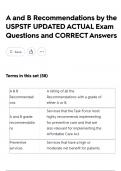
A& B A listing of all the
Recommendati Recommendations with a grade of
ons either A or B.
Services that the Task Force most
A and B grade highly recommends implementing
recommendatio for preventive care and that are
ns also relevant for implementing the
Affordable Care Act.
Preventive Services that have a high or
services moderate net benefit for patients.
, The USPSTF recommends 1-time
Abdominal
screening for abdominal aortic
Aortic
aneurysm (AAA) with
Aneurysm
ultrasonography in men aged 65 to
Screening
75 years who have ever smoked.
Anxiety The USPSTF recommends
Disorders in screening for anxiety disorders in
Adults adults, including pregnant and
Screening postpartum persons.
Anxiety in The USPSTF recommends
Children and screening for anxiety in children
Adolescents and adolescents aged 8 to 18
Screening years.
The USPSTF recommends the use
Aspirin Use to of low-dose aspirin (81 mg/day) as
Prevent preventive medication after 12
Preeclampsia weeks of gestation in persons who
are at high risk for preeclampsia.
Asymptomatic The USPSTF recommends
Bacteriuria in screening for asymptomatic
Adults bacteriuria using urine culture in
Screening pregnant persons.
, The USPSTF recommends that
primary care clinicians assess
women with a personal or family
history of breast, ovarian, tubal, or
BRCA-Related
peritoneal cancer or who have an
Cancer Risk
ancestry associated with breast
Assessment
cancer susceptibility 1 and 2
(BRCA1/2) gene mutations with an
appropriate brief familial risk
assessment tool.
Women with a positive result on
Genetic
the risk assessment tool should
Counseling and
receive genetic counseling and, if
Testing for
indicated after counseling, genetic
BRCA
testing.
The USPSTF recommends that
clinicians offer to prescribe risk-
reducing medications, such as
Breast Cancer
tamoxifen, raloxifene, or aromatase
Medication Use
inhibitors, to women who are at
to Reduce Risk
increased risk for breast cancer
and at low risk for adverse
medication effects.
USPSTF UPDATED ACTUAL Exam
Questions and CORRECT Answers
Save
Terms in this set (58)
A& B A listing of all the
Recommendati Recommendations with a grade of
ons either A or B.
Services that the Task Force most
A and B grade highly recommends implementing
recommendatio for preventive care and that are
ns also relevant for implementing the
Affordable Care Act.
Preventive Services that have a high or
services moderate net benefit for patients.
, The USPSTF recommends 1-time
Abdominal
screening for abdominal aortic
Aortic
aneurysm (AAA) with
Aneurysm
ultrasonography in men aged 65 to
Screening
75 years who have ever smoked.
Anxiety The USPSTF recommends
Disorders in screening for anxiety disorders in
Adults adults, including pregnant and
Screening postpartum persons.
Anxiety in The USPSTF recommends
Children and screening for anxiety in children
Adolescents and adolescents aged 8 to 18
Screening years.
The USPSTF recommends the use
Aspirin Use to of low-dose aspirin (81 mg/day) as
Prevent preventive medication after 12
Preeclampsia weeks of gestation in persons who
are at high risk for preeclampsia.
Asymptomatic The USPSTF recommends
Bacteriuria in screening for asymptomatic
Adults bacteriuria using urine culture in
Screening pregnant persons.
, The USPSTF recommends that
primary care clinicians assess
women with a personal or family
history of breast, ovarian, tubal, or
BRCA-Related
peritoneal cancer or who have an
Cancer Risk
ancestry associated with breast
Assessment
cancer susceptibility 1 and 2
(BRCA1/2) gene mutations with an
appropriate brief familial risk
assessment tool.
Women with a positive result on
Genetic
the risk assessment tool should
Counseling and
receive genetic counseling and, if
Testing for
indicated after counseling, genetic
BRCA
testing.
The USPSTF recommends that
clinicians offer to prescribe risk-
reducing medications, such as
Breast Cancer
tamoxifen, raloxifene, or aromatase
Medication Use
inhibitors, to women who are at
to Reduce Risk
increased risk for breast cancer
and at low risk for adverse
medication effects.


