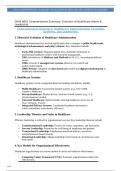
D545 COMPREHENSIVE SUMMARY: EVOLUTION OF HEALTHCARE ADMIN & LEADERSHIP
D545 WGU Comprehensive Summary: Evolution of Healthcare Admin &
Leadership.
Comprehensive Summary: Healthcare Administration Evolution,
Systems, and Leadership.
1. Historical Evolution of Healthcare Administration
Healthcare administration has evolved significantly due to changes in public health needs,
technological advancements, and policy reforms. Key milestones include:
• Early 20th Century: Hospitals shifted from charitable institutions to
professional healthcare centers with structured management.
• 1965: Introduction of Medicare and Medicaid in the U.S., increasing healthcare
access.
• 1990s: Growth of managed care systems aimed at cost control and
quality improvement.
• 2000s-Present: Adoption of value-based care models and digital transformation in
healthcare administration.
2. Healthcare Systems
Healthcare systems can be categorized based on funding and delivery models:
• Public Healthcare: Government-funded systems (e.g., UK’s NHS,
Canada’s Medicare).
• Private Healthcare: Market-driven, insurance-based systems (e.g., U.S.
private insurance model).
• Universal Healthcare: Hybrid models ensuring healthcare access for all
(e.g., Germany, France).
• Integrated Delivery Systems: Coordinated healthcare networks to
reduce redundancy and enhance efficiency.
3. Leadership Theories and Styles in Healthcare
Effective leadership is critical for organizational success. Key leadership theories include:
• Transformational Leadership: Focuses on vision, inspiration, and innovation.
• Servant Leadership: Prioritizes the well-being of employees and patients.
• Transactional Leadership: Emphasizes structured policies, incentives,
and performance-based rewards.
• Situational Leadership: Adapts leadership styles based on circumstances and
team needs.
4. Key Models for Organizational Effectiveness
Healthcare organizations use various models to assess and enhance effectiveness:
• Competing Values Framework (CVF): Evaluates organizational culture and
effectiveness.
®™
D545 WGU Comprehensive Summary: Evolution of Healthcare Admin &
Leadership.
Comprehensive Summary: Healthcare Administration Evolution,
Systems, and Leadership.
1. Historical Evolution of Healthcare Administration
Healthcare administration has evolved significantly due to changes in public health needs,
technological advancements, and policy reforms. Key milestones include:
• Early 20th Century: Hospitals shifted from charitable institutions to
professional healthcare centers with structured management.
• 1965: Introduction of Medicare and Medicaid in the U.S., increasing healthcare
access.
• 1990s: Growth of managed care systems aimed at cost control and
quality improvement.
• 2000s-Present: Adoption of value-based care models and digital transformation in
healthcare administration.
2. Healthcare Systems
Healthcare systems can be categorized based on funding and delivery models:
• Public Healthcare: Government-funded systems (e.g., UK’s NHS,
Canada’s Medicare).
• Private Healthcare: Market-driven, insurance-based systems (e.g., U.S.
private insurance model).
• Universal Healthcare: Hybrid models ensuring healthcare access for all
(e.g., Germany, France).
• Integrated Delivery Systems: Coordinated healthcare networks to
reduce redundancy and enhance efficiency.
3. Leadership Theories and Styles in Healthcare
Effective leadership is critical for organizational success. Key leadership theories include:
• Transformational Leadership: Focuses on vision, inspiration, and innovation.
• Servant Leadership: Prioritizes the well-being of employees and patients.
• Transactional Leadership: Emphasizes structured policies, incentives,
and performance-based rewards.
• Situational Leadership: Adapts leadership styles based on circumstances and
team needs.
4. Key Models for Organizational Effectiveness
Healthcare organizations use various models to assess and enhance effectiveness:
• Competing Values Framework (CVF): Evaluates organizational culture and
effectiveness.
®™