
• Wrong document? Swap it for free
  • Written by students who passed
  • Immediately available after payment
  • Read online or as PDF
Sell
Where do you study
Your language
Document preview thumbnail
Preview 1 out of 4 pages
Exam (elaborations)

Epidemiology Chapter 9 Questions and Correct Answers/ Latest Update / Already Graded

Document preview thumbnail
Preview 1 out of 4 pages

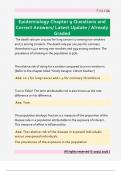
The death rate per 100,000 for lung cancer is 7 among non-smokers and 71 among smokers. The death rate per 100,000 for coronary thrombosis is 422 among non-smokers and 599 among smokers. The prevalence of smoking in the population is 55%. The relative risk of dying for a smoker compared to a non-smoker is: [Refer to the chapter titled "Study Designs: Cohort Studies"] Ans: 10.1 for lung cancer and 1.4 for coronary thrombosis True or False? The term attributable risk is also known as the rate difference or risk difference. Ans: True The population etiologic fraction is a measure of the proportion of the disease rate in a population attributable to the exposure of interest. This measure of effect is influenced by Ans: The relative risk of the disease in exposed individuals versus unexposed individuals. The prevalence of the exposure in the population All rights reserved © 2025/ 2026 | Page | 2 (A and C) The population etiologic fraction for a particular disease from Factor X alone is five times greater than that from Factor Y alone. If the relative risk associated with Factor X is 2, and with Factor Y is 20, which of the following statements is true? Ans: Fewer persons are exposed to Factor Y than to Factor X Refer to the 2 by 2 table below

Content preview

Page |1


Epidemiology Chapter 9 Questions and
Correct Answers/ Latest Update / Already
Graded
The death rate per 100,000 for lung cancer is 7 among non-smokers
and 71 among smokers. The death rate per 100,000 for coronary
thrombosis is 422 among non-smokers and 599 among smokers. The
prevalence of smoking in the population is 55%.


The relative risk of dying for a smoker compared to a non-smoker is:
[Refer to the chapter titled "Study Designs: Cohort Studies"]

Ans: 10.1 for lung cancer and 1.4 for coronary thrombosis


True or False? The term attributable risk is also known as the rate
difference or risk difference.

Ans: True


The population etiologic fraction is a measure of the proportion of the
disease rate in a population attributable to the exposure of interest.
This measure of effect is influenced by

Ans: The relative risk of the disease in exposed individuals
versus unexposed individuals.
The prevalence of the exposure in the population

All rights reserved © 2025/ 2026 |

Document information

Uploaded on
June 28, 2025
Number of pages
4
Written in
2024/2025
Type
Exam (elaborations)
Contains
Questions & answers
$13.49

Wrong document? Swap it for free Within 14 days of purchase and before downloading, you can choose a different document. You can simply spend the amount again.
Written by students who passed
Immediately available after payment
Read online or as PDF

Seller avatar
Reputation scores are based on the amount of documents a seller has sold for a fee and the reviews they have received for those documents. There are three levels: Bronze, Silver and Gold. The better the reputation, the more your can rely on the quality of the sellers work.
Expert1
4.1
(9)
Sold
69
Followers
3
Items
7590
Last sold
1 week ago


Why students choose Stuvia

Created by fellow students, verified by reviews

Quality you can trust: written by students who passed their tests and reviewed by others who've used these notes.

Didn't get what you expected? Choose another document

No worries! You can instantly pick a different document that better fits what you're looking for.

Pay as you like, start learning right away

No subscription, no commitments. Pay the way you're used to via credit card and download your PDF document instantly.

Student with book image

“Bought, downloaded, and aced it. It really can be that simple.”

Alisha Student

Working on your references?

Create accurate citations in APA, MLA and Harvard with our free citation generator.

Working on your references?

Frequently asked questions
