
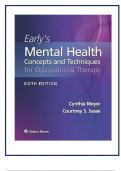
,Cynthia Meyer & Courtney Sasse’s Mental
Health in OT – 460-Item NCLEX® Review
Comprehensive Review with NCLEX®-Style Questions &
Rationales – Cynthia Meyer & Courtney Sasse, 6th Edition
• 23-Chapter Full Coverage | 20 MCQs Per Chapter
• Verified Answers & Evidence-Based Rationales
• Designed for OT/OTA Certification Success
• Pass with Confidence – Ideal for Coursework, Licensure &
Board Prep
SECTION ONE: Principles of Occupational Therapy in Mental Health
,Unit 1: History and Foundations
Chapter 1: History and Foundational Concepts
Chapter 2: Medical and Psychological Theories, Frames of Reference, and Models of Mental Health
and Mental Illness
Chapter 3: Occupational Therapy Frames of Reference and Practice Models
SECTION TWO: Mental Illness
Chapter 4: Understanding Psychiatric Diagnoses
SECTION THREE: Service Provision
Chapter 5: Human Occupation and Mental Health Throughout the Life Span With Those We Serve
SECTION THREE: Service Provision
Chapter 6: Methods and Models of Interaction and Intervention
Chapter 7: Service Areas, Environments, and Focuses
SECTION FOUR: Professional Practice Considerations
Chapter 8: Medications, Medical-Based Treatments, Complementary Practices, and Detoxification
Chapter 9: Safety Considerations and Techniques
Chapter 10: Using Evidence
Chapter 11: Professional Issues: Supervision, Teams, Roles, and Self-Management
Chapter 12: Evaluation and Data Collection
Chapter 13: Determining Type and Approach to Intervention
Chapter 14: Matching Occupational Demands to Intervention Types
Chapter 15: Therapeutic Use of Self
,Chapter 16: Group Concepts and Techniques in OT
Chapter 17: Facilitating Recovery Using Biopsychosocial Models
Chapter 18: Anxiety and Occupational Engagement
Chapter 20: Hallucinations, Delusions, and Paranoia
Chapter 22: Anger, Hostility, and Aggression
Chapter 23: Substance-Related and Addictive Disorders
,Chapter 1
Introduction (3 questions)
1. Which statement best defines the primary goal of
occupational therapy in mental health?
A. To reduce psychiatric symptoms through medication
management
B. To enable clients to engage in meaningful occupations
despite mental health challenges
C. To provide long-term institutional care for clients with
severe mental illness
D. To teach clients about the biological basis of their
diagnoses
Correct: B
Rationale: OT focuses on enabling participation in daily
activities; options A and D are more
medical/psychoeducational, and C describes custodial care
rather than rehabilitation.
2. The term “occupation” in OT most accurately refers to:
A. Paid employment only
B. Any meaningful daily activity that occupies one’s time
C. Occupational injuries and safety practices
D. Volunteer work in community settings
Correct: B
Rationale: “Occupation” in OT is broad and includes self-
care, leisure, and productivity; A, C, and D are narrower.
, 3. Early’s Mental Health Concepts and Techniques
emphasizes which principle as foundational to OT?
A. Psychoanalytic interpretation of dreams
B. Use of restrictive interventions when clients become
agitated
C. Client-centered engagement in purposeful activities
D. Sole reliance on group psychotherapy
Correct: C
Rationale: The text underscores purposeful activity as
core; A and D are specific modalities, B contradicts least-
restrictive practice.
Mental Health and Mental Illness (3 questions)
4. Which describes the DSM’s primary function?
A. To prescribe occupational therapy interventions
B. To classify mental disorders based on symptom clusters
C. To provide guidelines for hospital accreditation
D. To detail pharmacologic protocols
Correct: B
Rationale: DSM categorizes mental disorders; A and D are
treatment-focused, C is administrative.
5. A key difference between “mental health” and “mental
illness” is that mental health refers to:
A. The absence of any emotional distress
B. An individual’s overall psychological well-being and
resilience
, C. The presence of psychiatric diagnoses only
D. Institutional versus community living status
Correct: B
Rationale: Mental health denotes wellness; mental illness
denotes diagnosable conditions. A is unattainable ideal; C
and D are incorrect.
6. Which factor is NOT typically considered part of the
biopsychosocial model?
A. Genetic predisposition
B. Social support
C. Spiritual rituals
D. Meteorological forecasts
Correct: D
Rationale: Weather is environmental but not a core
biopsychosocial factor; A, B, and C influence health.
Relation of Occupation to Mental Health (3 questions)
7. Engagement in meaningful occupation can improve
mental health by:
A. Eliminating all stressors from one’s environment
B. Promoting a sense of competence and self-esteem
C. Ensuring total dependence on caregivers
D. Reducing the need for community integration
Correct: B
Rationale: Purposeful activity enhances self-efficacy; A and
, C are unrealistic or undesirable, D opposes community
integration.
8. Which scenario best illustrates occupational adaptation?
A. A client refuses to try new tasks due to fear of failure
B. A client switches from woodworking to painting after a
hand injury
C. A client is secluded due to severe anxiety
D. A client takes medication instead of practicing coping
strategies
Correct: B
Rationale: Adapting occupations to match abilities; A and
C show lack of adaptation, D bypasses OT strategies.
9. The concept of “flow” in occupational therapy refers to:
A. The movement of clients through hospital units
B. Deep engagement when challenge matches skill level
C. The sequence of self-care tasks in morning routines
D. The path of circulation in the brain
Correct: B
Rationale: Flow is optimal engagement; A, C, and D are
unrelated or anatomical.
A Few Words About Language (2 questions)
10. Person-first language in mental health emphasizes:
A. Referring to clients by diagnosis (“the schizophrenic”)
B. Using labels that describe behavior
, C. Recognizing the individual before the condition (“person
with schizophrenia”)
D. Avoiding any mention of diagnosis
Correct: C
Rationale: Person-first reduces stigma; A perpetuates it, B
is vague, D can obscure needs.
11. According to Early, stigmatizing language in mental
health practice can:
A. Enhance therapeutic rapport
B. Increase social isolation and self-stigma
C. Improve diagnostic accuracy
D. Reduce the need for psychoeducation
Correct: B
Rationale: Negative labels harm self-esteem and
engagement; A and C are false, D is irrelevant.
Thoughts About Terminology (3 questions)
12. “Recovery” as used in mental health OT primarily
means:
A. Full cure and elimination of all symptoms
B. Living a satisfying life despite ongoing challenges
C. Isolation until medication is stabilized
D. Return to pre-morbid functioning only
Correct: B
Rationale: Recovery-oriented practice focuses on
meaningful life; A is unrealistic, C is isolating, D is narrow.
, 13. Which term refers to the belief that one’s thoughts
can directly influence their emotional state?
A. Kinesiology
B. Cognitive restructuring
C. Ergonomics
D. Sociometry
Correct: B
Rationale: Cognitive restructuring is a CBT strategy; A, C, D
are unrelated disciplines.
14. The shift from “mental illness” to “behavioral
health” terminology reflects:
A. A desire to medicalize normal behavior
B. A focus on legal aspects of care
C. An emphasis on behavior rather than pathology
D. Reduction in insurance coverage
Correct: C
Rationale: Behavioral health frames conditions as
behaviors to address; A and D are misconceptions, B is off-
topic.
Historical Understanding (3 questions)
15. Which civilization is credited with one of the earliest
written accounts of mental disorders?
A. Ancient Rome
B. Ancient Greece
C. Ancient China
Health in OT – 460-Item NCLEX® Review
Comprehensive Review with NCLEX®-Style Questions &
Rationales – Cynthia Meyer & Courtney Sasse, 6th Edition
• 23-Chapter Full Coverage | 20 MCQs Per Chapter
• Verified Answers & Evidence-Based Rationales
• Designed for OT/OTA Certification Success
• Pass with Confidence – Ideal for Coursework, Licensure &
Board Prep
SECTION ONE: Principles of Occupational Therapy in Mental Health
,Unit 1: History and Foundations
Chapter 1: History and Foundational Concepts
Chapter 2: Medical and Psychological Theories, Frames of Reference, and Models of Mental Health
and Mental Illness
Chapter 3: Occupational Therapy Frames of Reference and Practice Models
SECTION TWO: Mental Illness
Chapter 4: Understanding Psychiatric Diagnoses
SECTION THREE: Service Provision
Chapter 5: Human Occupation and Mental Health Throughout the Life Span With Those We Serve
SECTION THREE: Service Provision
Chapter 6: Methods and Models of Interaction and Intervention
Chapter 7: Service Areas, Environments, and Focuses
SECTION FOUR: Professional Practice Considerations
Chapter 8: Medications, Medical-Based Treatments, Complementary Practices, and Detoxification
Chapter 9: Safety Considerations and Techniques
Chapter 10: Using Evidence
Chapter 11: Professional Issues: Supervision, Teams, Roles, and Self-Management
Chapter 12: Evaluation and Data Collection
Chapter 13: Determining Type and Approach to Intervention
Chapter 14: Matching Occupational Demands to Intervention Types
Chapter 15: Therapeutic Use of Self
,Chapter 16: Group Concepts and Techniques in OT
Chapter 17: Facilitating Recovery Using Biopsychosocial Models
Chapter 18: Anxiety and Occupational Engagement
Chapter 20: Hallucinations, Delusions, and Paranoia
Chapter 22: Anger, Hostility, and Aggression
Chapter 23: Substance-Related and Addictive Disorders
,Chapter 1
Introduction (3 questions)
1. Which statement best defines the primary goal of
occupational therapy in mental health?
A. To reduce psychiatric symptoms through medication
management
B. To enable clients to engage in meaningful occupations
despite mental health challenges
C. To provide long-term institutional care for clients with
severe mental illness
D. To teach clients about the biological basis of their
diagnoses
Correct: B
Rationale: OT focuses on enabling participation in daily
activities; options A and D are more
medical/psychoeducational, and C describes custodial care
rather than rehabilitation.
2. The term “occupation” in OT most accurately refers to:
A. Paid employment only
B. Any meaningful daily activity that occupies one’s time
C. Occupational injuries and safety practices
D. Volunteer work in community settings
Correct: B
Rationale: “Occupation” in OT is broad and includes self-
care, leisure, and productivity; A, C, and D are narrower.
, 3. Early’s Mental Health Concepts and Techniques
emphasizes which principle as foundational to OT?
A. Psychoanalytic interpretation of dreams
B. Use of restrictive interventions when clients become
agitated
C. Client-centered engagement in purposeful activities
D. Sole reliance on group psychotherapy
Correct: C
Rationale: The text underscores purposeful activity as
core; A and D are specific modalities, B contradicts least-
restrictive practice.
Mental Health and Mental Illness (3 questions)
4. Which describes the DSM’s primary function?
A. To prescribe occupational therapy interventions
B. To classify mental disorders based on symptom clusters
C. To provide guidelines for hospital accreditation
D. To detail pharmacologic protocols
Correct: B
Rationale: DSM categorizes mental disorders; A and D are
treatment-focused, C is administrative.
5. A key difference between “mental health” and “mental
illness” is that mental health refers to:
A. The absence of any emotional distress
B. An individual’s overall psychological well-being and
resilience
, C. The presence of psychiatric diagnoses only
D. Institutional versus community living status
Correct: B
Rationale: Mental health denotes wellness; mental illness
denotes diagnosable conditions. A is unattainable ideal; C
and D are incorrect.
6. Which factor is NOT typically considered part of the
biopsychosocial model?
A. Genetic predisposition
B. Social support
C. Spiritual rituals
D. Meteorological forecasts
Correct: D
Rationale: Weather is environmental but not a core
biopsychosocial factor; A, B, and C influence health.
Relation of Occupation to Mental Health (3 questions)
7. Engagement in meaningful occupation can improve
mental health by:
A. Eliminating all stressors from one’s environment
B. Promoting a sense of competence and self-esteem
C. Ensuring total dependence on caregivers
D. Reducing the need for community integration
Correct: B
Rationale: Purposeful activity enhances self-efficacy; A and
, C are unrealistic or undesirable, D opposes community
integration.
8. Which scenario best illustrates occupational adaptation?
A. A client refuses to try new tasks due to fear of failure
B. A client switches from woodworking to painting after a
hand injury
C. A client is secluded due to severe anxiety
D. A client takes medication instead of practicing coping
strategies
Correct: B
Rationale: Adapting occupations to match abilities; A and
C show lack of adaptation, D bypasses OT strategies.
9. The concept of “flow” in occupational therapy refers to:
A. The movement of clients through hospital units
B. Deep engagement when challenge matches skill level
C. The sequence of self-care tasks in morning routines
D. The path of circulation in the brain
Correct: B
Rationale: Flow is optimal engagement; A, C, and D are
unrelated or anatomical.
A Few Words About Language (2 questions)
10. Person-first language in mental health emphasizes:
A. Referring to clients by diagnosis (“the schizophrenic”)
B. Using labels that describe behavior
, C. Recognizing the individual before the condition (“person
with schizophrenia”)
D. Avoiding any mention of diagnosis
Correct: C
Rationale: Person-first reduces stigma; A perpetuates it, B
is vague, D can obscure needs.
11. According to Early, stigmatizing language in mental
health practice can:
A. Enhance therapeutic rapport
B. Increase social isolation and self-stigma
C. Improve diagnostic accuracy
D. Reduce the need for psychoeducation
Correct: B
Rationale: Negative labels harm self-esteem and
engagement; A and C are false, D is irrelevant.
Thoughts About Terminology (3 questions)
12. “Recovery” as used in mental health OT primarily
means:
A. Full cure and elimination of all symptoms
B. Living a satisfying life despite ongoing challenges
C. Isolation until medication is stabilized
D. Return to pre-morbid functioning only
Correct: B
Rationale: Recovery-oriented practice focuses on
meaningful life; A is unrealistic, C is isolating, D is narrow.
, 13. Which term refers to the belief that one’s thoughts
can directly influence their emotional state?
A. Kinesiology
B. Cognitive restructuring
C. Ergonomics
D. Sociometry
Correct: B
Rationale: Cognitive restructuring is a CBT strategy; A, C, D
are unrelated disciplines.
14. The shift from “mental illness” to “behavioral
health” terminology reflects:
A. A desire to medicalize normal behavior
B. A focus on legal aspects of care
C. An emphasis on behavior rather than pathology
D. Reduction in insurance coverage
Correct: C
Rationale: Behavioral health frames conditions as
behaviors to address; A and D are misconceptions, B is off-
topic.
Historical Understanding (3 questions)
15. Which civilization is credited with one of the earliest
written accounts of mental disorders?
A. Ancient Rome
B. Ancient Greece
C. Ancient China


