
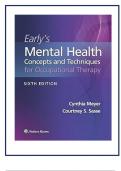
,2025 Master Test Bank: Mental Health
Concepts in Occupational Therapy – 6th
Ed.
Comprehensive Review with NCLEX®-Style Questions &
Rationales – Cynthia Meyer & Courtney Sasse, 6th Edition
• 23-Chapter Full Coverage | 20 MCQs Per Chapter
• Verified Answers & Evidence-Based Rationales
• Designed for OT/OTA Certification Success
• Pass with Confidence – Ideal for Coursework, Licensure &
Board Prep
,SECTION ONE: Principles of Occupational Therapy in Mental Health
Unit 1: History and Foundations
Chapter 1: History and Foundational Concepts
Chapter 2: Medical and Psychological Theories, Frames of Reference, and Models of Mental Health
and Mental Illness
Chapter 3: Occupational Therapy Frames of Reference and Practice Models
SECTION TWO: Mental Illness
Chapter 4: Understanding Psychiatric Diagnoses
SECTION THREE: Service Provision
Chapter 5: Human Occupation and Mental Health Throughout the Life Span With Those We Serve
SECTION THREE: Service Provision
Chapter 6: Methods and Models of Interaction and Intervention
Chapter 7: Service Areas, Environments, and Focuses
SECTION FOUR: Professional Practice Considerations
Chapter 8: Medications, Medical-Based Treatments, Complementary Practices, and Detoxification
Chapter 9: Safety Considerations and Techniques
Chapter 10: Using Evidence
Chapter 11: Professional Issues: Supervision, Teams, Roles, and Self-Management
Chapter 12: Evaluation and Data Collection
Chapter 13: Determining Type and Approach to Intervention
Chapter 14: Matching Occupational Demands to Intervention Types
,Chapter 15: Therapeutic Use of Self
Chapter 16: Group Concepts and Techniques in OT
Chapter 17: Facilitating Recovery Using Biopsychosocial Models
Chapter 18: Anxiety and Occupational Engagement
Chapter 20: Hallucinations, Delusions, and Paranoia
Chapter 22: Anger, Hostility, and Aggression
Chapter 23: Substance-Related and Addictive Disorders
,Chapter 1
Introduction
1. Which statement best defines the primary goal of
occupational therapy in mental health?
A. Eliminating all symptoms of mental illness
B. Facilitating engagement in meaningful activities to
improve well-being
C. Prescribing medication to manage behaviors
D. Diagnosing psychiatric disorders
Correct: B
Rationale: Occupational therapy focuses on meaningful activity
engagement to support health and well-being. Options A, C,
and D are roles of other disciplines.
2. The “person–environment–occupation” (PEO) model
highlights which relationship?
A. Interaction among cognition, emotion, and behavior
B. Link between diagnostic criteria and treatment plans
C. Dynamic fit of person, environment, and occupation
D. Sequence of historical OT practice developments
Correct: C
Rationale: The PEO model describes the dynamic transaction
among person, environment, and occupation; distractors
describe other theoretical or historical concepts.
3. In Early’s framework, what is considered the
“cornerstone” of occupational therapy?
, A. Biomechanical interventions
B. Engagement in purposeful activity
C. Electroconvulsive therapy
D. Psychopharmacology
Correct: B
Rationale: Purposeful activity is foundational to OT; options A,
C, and D are outside foundational OT principles.
4. An entry-level OT student is asked to articulate the vision
of OT in mental health. Which phrase aligns most closely?
A. “Cure mental illness through occupation.”
B. “Promote holistic recovery via daily activities.”
C. “Replace all medications with crafts.”
D. “Focus exclusively on diagnostic testing.”
Correct: B
Rationale: OT emphasizes holistic recovery through meaningful
activities; options A and C misstate OT scope, D contradicts
client-centered focus.
Mental Health and Mental Illness
5. Which definition distinguishes mental health from
mental illness?
A. Mental health is the absence of stress; mental illness is
any diagnosis
B. Mental health is a state of well-being; mental illness
involves clinically significant distress
, C. Mental health refers to behavior; mental illness refers
to personality
D. Mental health is measured by IQ; mental illness by DSM
codes
Correct: B
Rationale: Mental health is well-being; mental illness involves
distress or impairment per DSM. Other options conflate
concepts incorrectly.
6. According to Early, which factor is NOT typically
considered in assessing mental health?
A. Emotional regulation
B. Occupational engagement
C. Family medical history
D. Social participation
Correct: C
Rationale: Family medical history relates to genetic risk, not
directly to mental health assessment in OT; A, B, and D are core
assessment domains.
7. A client reports persistent sadness for 8 months
interfering with work. This presentation best exemplifies:
A. Acute stress reaction
B. Major depressive disorder
C. Hypomania
D. Adjustment disorder
,Correct: B
Rationale: Persistent sadness ≥2 weeks with functional
impairment aligns with major depression; acute stress and
adjustment are shorter, hypomania is elevated mood.
8. Which statement reflects a recovery-oriented perspective
in mental health?
A. “Recovery means complete symptom elimination.”
B. “Coping skills are secondary to medication.”
C. “Clients define their own goals for wellness.”
D. “Occupational engagement is optional.”
Correct: C
Rationale: Recovery-oriented care emphasizes client-defined
goals; distractors contradict client empowerment and OT role.
Relation of Occupation to Mental Health
9. Which mechanism best explains how occupation
promotes mental health?
A. Increasing neurotransmitter levels directly
B. Structuring time, fostering competence, and enhancing
identity
C. Serving as a placebo for medication
D. Eliminating environmental stressors entirely
Correct: B
Rationale: Occupations structure time and build
,competence/identity; occupation doesn’t directly alter
neurotransmitters or serve as placebo.
10. An OTA designs a daily schedule for a client with
anxiety. This intervention primarily targets:
A. Cognitive reframing
B. Activity scheduling
C. Psychoeducation
D. Sensory desensitization
Correct: B
Rationale: Activity scheduling structures daily occupations;
other options refer to different therapeutic approaches.
11. Which outcome is most likely when clients engage in
meaningful occupation?
A. Reduced need for social support
B. Improved self-efficacy and mood
C. Immediate cure of psychiatric symptoms
D. Elimination of all stressors
Correct: B
Rationale: Meaningful activities enhance self-efficacy and
mood; social support remains important and occupation
doesn’t instantly cure disorders.
12. In a case vignette, a client chooses gardening to
manage stress. This choice exemplifies:
A. Top-down approach
B. Bottom-up sensory intervention
, C. Directive group therapy
D. Diagnostic assessment
Correct: A
Rationale: Top-down approach starts with meaningful
activities; bottom-up focuses on components like sensation.
A Few Words About Language
13. Why does Early emphasize careful language use in
mental health OT?
A. To comply with insurance billing codes
B. To reduce stigma and promote respect
C. To simplify documentation
D. To avoid legal liability
Correct: B
Rationale: Respectful language reduces stigma; billing,
simplicity, and liability are secondary concerns.
14. Which term is preferred over “schizophrenic”?
A. Schizophrenia patient
B. Individual with schizophrenia
C. Schizophrenic disorder
D. Person who is schizophrenic
Correct: B
Rationale: Person-first language (“individual with
schizophrenia”) is preferred; others label the person by the
diagnosis.
Concepts in Occupational Therapy – 6th
Ed.
Comprehensive Review with NCLEX®-Style Questions &
Rationales – Cynthia Meyer & Courtney Sasse, 6th Edition
• 23-Chapter Full Coverage | 20 MCQs Per Chapter
• Verified Answers & Evidence-Based Rationales
• Designed for OT/OTA Certification Success
• Pass with Confidence – Ideal for Coursework, Licensure &
Board Prep
,SECTION ONE: Principles of Occupational Therapy in Mental Health
Unit 1: History and Foundations
Chapter 1: History and Foundational Concepts
Chapter 2: Medical and Psychological Theories, Frames of Reference, and Models of Mental Health
and Mental Illness
Chapter 3: Occupational Therapy Frames of Reference and Practice Models
SECTION TWO: Mental Illness
Chapter 4: Understanding Psychiatric Diagnoses
SECTION THREE: Service Provision
Chapter 5: Human Occupation and Mental Health Throughout the Life Span With Those We Serve
SECTION THREE: Service Provision
Chapter 6: Methods and Models of Interaction and Intervention
Chapter 7: Service Areas, Environments, and Focuses
SECTION FOUR: Professional Practice Considerations
Chapter 8: Medications, Medical-Based Treatments, Complementary Practices, and Detoxification
Chapter 9: Safety Considerations and Techniques
Chapter 10: Using Evidence
Chapter 11: Professional Issues: Supervision, Teams, Roles, and Self-Management
Chapter 12: Evaluation and Data Collection
Chapter 13: Determining Type and Approach to Intervention
Chapter 14: Matching Occupational Demands to Intervention Types
,Chapter 15: Therapeutic Use of Self
Chapter 16: Group Concepts and Techniques in OT
Chapter 17: Facilitating Recovery Using Biopsychosocial Models
Chapter 18: Anxiety and Occupational Engagement
Chapter 20: Hallucinations, Delusions, and Paranoia
Chapter 22: Anger, Hostility, and Aggression
Chapter 23: Substance-Related and Addictive Disorders
,Chapter 1
Introduction
1. Which statement best defines the primary goal of
occupational therapy in mental health?
A. Eliminating all symptoms of mental illness
B. Facilitating engagement in meaningful activities to
improve well-being
C. Prescribing medication to manage behaviors
D. Diagnosing psychiatric disorders
Correct: B
Rationale: Occupational therapy focuses on meaningful activity
engagement to support health and well-being. Options A, C,
and D are roles of other disciplines.
2. The “person–environment–occupation” (PEO) model
highlights which relationship?
A. Interaction among cognition, emotion, and behavior
B. Link between diagnostic criteria and treatment plans
C. Dynamic fit of person, environment, and occupation
D. Sequence of historical OT practice developments
Correct: C
Rationale: The PEO model describes the dynamic transaction
among person, environment, and occupation; distractors
describe other theoretical or historical concepts.
3. In Early’s framework, what is considered the
“cornerstone” of occupational therapy?
, A. Biomechanical interventions
B. Engagement in purposeful activity
C. Electroconvulsive therapy
D. Psychopharmacology
Correct: B
Rationale: Purposeful activity is foundational to OT; options A,
C, and D are outside foundational OT principles.
4. An entry-level OT student is asked to articulate the vision
of OT in mental health. Which phrase aligns most closely?
A. “Cure mental illness through occupation.”
B. “Promote holistic recovery via daily activities.”
C. “Replace all medications with crafts.”
D. “Focus exclusively on diagnostic testing.”
Correct: B
Rationale: OT emphasizes holistic recovery through meaningful
activities; options A and C misstate OT scope, D contradicts
client-centered focus.
Mental Health and Mental Illness
5. Which definition distinguishes mental health from
mental illness?
A. Mental health is the absence of stress; mental illness is
any diagnosis
B. Mental health is a state of well-being; mental illness
involves clinically significant distress
, C. Mental health refers to behavior; mental illness refers
to personality
D. Mental health is measured by IQ; mental illness by DSM
codes
Correct: B
Rationale: Mental health is well-being; mental illness involves
distress or impairment per DSM. Other options conflate
concepts incorrectly.
6. According to Early, which factor is NOT typically
considered in assessing mental health?
A. Emotional regulation
B. Occupational engagement
C. Family medical history
D. Social participation
Correct: C
Rationale: Family medical history relates to genetic risk, not
directly to mental health assessment in OT; A, B, and D are core
assessment domains.
7. A client reports persistent sadness for 8 months
interfering with work. This presentation best exemplifies:
A. Acute stress reaction
B. Major depressive disorder
C. Hypomania
D. Adjustment disorder
,Correct: B
Rationale: Persistent sadness ≥2 weeks with functional
impairment aligns with major depression; acute stress and
adjustment are shorter, hypomania is elevated mood.
8. Which statement reflects a recovery-oriented perspective
in mental health?
A. “Recovery means complete symptom elimination.”
B. “Coping skills are secondary to medication.”
C. “Clients define their own goals for wellness.”
D. “Occupational engagement is optional.”
Correct: C
Rationale: Recovery-oriented care emphasizes client-defined
goals; distractors contradict client empowerment and OT role.
Relation of Occupation to Mental Health
9. Which mechanism best explains how occupation
promotes mental health?
A. Increasing neurotransmitter levels directly
B. Structuring time, fostering competence, and enhancing
identity
C. Serving as a placebo for medication
D. Eliminating environmental stressors entirely
Correct: B
Rationale: Occupations structure time and build
,competence/identity; occupation doesn’t directly alter
neurotransmitters or serve as placebo.
10. An OTA designs a daily schedule for a client with
anxiety. This intervention primarily targets:
A. Cognitive reframing
B. Activity scheduling
C. Psychoeducation
D. Sensory desensitization
Correct: B
Rationale: Activity scheduling structures daily occupations;
other options refer to different therapeutic approaches.
11. Which outcome is most likely when clients engage in
meaningful occupation?
A. Reduced need for social support
B. Improved self-efficacy and mood
C. Immediate cure of psychiatric symptoms
D. Elimination of all stressors
Correct: B
Rationale: Meaningful activities enhance self-efficacy and
mood; social support remains important and occupation
doesn’t instantly cure disorders.
12. In a case vignette, a client chooses gardening to
manage stress. This choice exemplifies:
A. Top-down approach
B. Bottom-up sensory intervention
, C. Directive group therapy
D. Diagnostic assessment
Correct: A
Rationale: Top-down approach starts with meaningful
activities; bottom-up focuses on components like sensation.
A Few Words About Language
13. Why does Early emphasize careful language use in
mental health OT?
A. To comply with insurance billing codes
B. To reduce stigma and promote respect
C. To simplify documentation
D. To avoid legal liability
Correct: B
Rationale: Respectful language reduces stigma; billing,
simplicity, and liability are secondary concerns.
14. Which term is preferred over “schizophrenic”?
A. Schizophrenia patient
B. Individual with schizophrenia
C. Schizophrenic disorder
D. Person who is schizophrenic
Correct: B
Rationale: Person-first language (“individual with
schizophrenia”) is preferred; others label the person by the
diagnosis.


