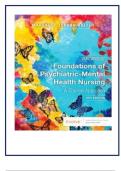
,Mastering Psychiatric Nursing for the
NCLEX: 720 Practice Questions Aligned
with Varcarolis 2025
A Guaranteed-Pass Resource for Nursing Students, Instructors, and
Exam Prep Aligned with the Latest Clinical Standards and NCLEX-RN
Test Plan.
UNIT I: Foundations in Theory
1. Mental Health and Mental Illness
Definitions of mental health and mental illness
Continuum of mental health
Risk and protective factors
Stigma and public perceptions
Diagnostic classification systems (DSM-5-TR, ICD-11)
Recovery-oriented care
2. Theories and Therapies
Psychoanalytic theory (Freud)
Developmental theories (Erikson, Piaget)
Behavioral and cognitive theories (Pavlov, Skinner, Beck)
Humanistic theories (Maslow, Rogers)
Biological theories
Milieu therapy
, Therapeutic modalities (CBT, DBT, group therapy)
3. Psychobiology and Psychopharmacology
Structure and function of the nervous system
Neurotransmitters and psychiatric disorders
Brain imaging techniques
Psychotropic medications:
o Antidepressants
o Antipsychotics
o Mood stabilizers
o Anxiolytics
Side effects and nursing implications
Pharmacogenetics
UNIT II: Foundations for Practice
4. Treatment Settings
Inpatient vs. outpatient care
Roles in interdisciplinary teams
Levels of prevention (primary, secondary, tertiary)
Mental health parity and access to care
Continuum of care
5. Cultural Implications
Cultural competence and humility
Transcultural nursing theories (e.g., Leininger)
Impact of culture on mental health
Culture-bound syndromes
Communication barriers and strategies
6. Legal and Ethical Considerations
Patients’ rights (informed consent, right to treatment/refusal)
Confidentiality and HIPAA
, Commitment procedures (voluntary, involuntary)
Ethical principles (autonomy, beneficence, justice)
Legal issues in mental health nursing
Tarasoff ruling and duty to warn
UNIT III: Psychosocial Nursing Tools
7. The Nursing Process and Standards of Care
ANA Psychiatric Nursing Standards
Assessment, Diagnosis, Planning, Implementation, Evaluation
Nursing diagnoses (NANDA)
Documentation and evaluation tools
Evidence-based practice
8. Therapeutic Relationships
Phases of nurse–patient relationship (Peplau’s theory)
Boundaries and transference/countertransference
Empathy vs. sympathy
Building trust and rapport
9. Therapeutic Communication
Verbal and non-verbal communication
Therapeutic vs. non-therapeutic techniques
Active listening
Motivational interviewing
Communication with special populations
10. Stress Responses and Stress Management
Physiological and psychological responses to stress
General adaptation syndrome
Coping strategies (adaptive and maladaptive)
Stress reduction techniques (relaxation, mindfulness)
,UNIT IV: Psychobiological Disorders
11. Childhood and Neurodevelopmental Disorders
Autism spectrum disorder
ADHD
Tic disorders (Tourette’s)
Intellectual disabilities
Assessment and treatment strategies
Family involvement
12. Schizophrenia Spectrum Disorders
Symptoms (positive, negative, cognitive)
Phases of schizophrenia
Risk factors and neurobiology
Treatment (medications, therapy, psychoeducation)
Nursing care plans
13. Bipolar and Related Disorders
Bipolar I and II
Cyclothymic disorder
Mania and depression symptoms
Pharmacologic and non-pharmacologic treatments
Managing risk behaviors
14. Depressive Disorders
Major depressive disorder
Persistent depressive disorder (dysthymia)
Grief vs. clinical depression
Antidepressants and therapies (CBT, ECT)
Suicide risk assessment
15. Anxiety and Obsessive-Compulsive Disorders
Generalized anxiety disorder
Panic disorder
, Phobias
OCD and related disorders
Behavioral therapies (exposure, desensitization)
16. Trauma, Stressor-Related, and Dissociative Disorders
PTSD and acute stress disorder
Reactive attachment disorder
Dissociative identity disorder
Trauma-informed care
Treatment options and nursing roles
17. Somatic Symptom Disorders
Illness anxiety disorder
Conversion disorder
Factitious disorder
Managing symptoms without reinforcing them
18. Eating and Feeding Disorders
Anorexia nervosa
Bulimia nervosa
Binge-eating disorder
Nutritional and psychological interventions
Family therapy
19. Sleep-Wake Disorders
Insomnia and hypersomnia
Narcolepsy
Sleep apnea
Circadian rhythm disturbances
Sleep hygiene
20. Sexual Dysfunction, Gender Dysphoria, and Paraphilic Disorders
Types of sexual dysfunction
DSM-5 gender dysphoria criteria
, Paraphilic disorders (exhibitionism, pedophilia)
Therapeutic approaches and ethical issues
21. Impulse Control Disorders
Intermittent explosive disorder
Kleptomania
Pyromania
Nursing interventions and behavioral management
22. Substance-Related and Addictive Disorders
Alcohol, opioids, stimulants
CAGE and SBIRT screening tools
Detoxification and withdrawal management
Relapse prevention
12-step and other treatment programs
23. Neurocognitive Disorders
Delirium vs. dementia
Alzheimer’s disease and related dementias
Pharmacologic management
Safety and communication strategies
24. Personality Disorders
Cluster A, B, and C disorders
Borderline, antisocial, narcissistic traits
Dialectical behavior therapy (DBT)
Setting limits and managing manipulative behavior
UNIT V: Trauma Interventions
25. Suicide and Non-suicidal Self-Injury
Risk factors and warning signs
Suicide assessment tools (SAD PERSONS scale)
Levels of risk and interventions
, Safety planning and crisis intervention
Managing self-harming behaviors
26. Crisis and Disaster
Types of crisis (maturational, situational, adventitious)
Phases of crisis intervention
Psychological first aid
Community disaster mental health
27. Anger, Aggression, and Violence
Triggers and risk assessment
De-escalation strategies
Use of restraints and seclusion
Staff safety and legal documentation
28. Child, Older Adult, and Intimate Partner Violence
Forms and signs of abuse
Mandatory reporting laws
Trauma-informed assessment
Safety planning
29. Sexual Assault
Acute stress and rape trauma syndrome
Sexual Assault Nurse Examiner (SANE) role
Legal and ethical care considerations
Emotional and psychological support
UNIT VI: Interventions for Special Populations
30. Dying, Death, and Grieving
Theories of grief (Kubler-Ross, Worden)
Anticipatory grief and complicated grief
Culturally sensitive care
Supporting families and caregivers
,31. Older Adults
Normal vs. abnormal aging
Polypharmacy concerns
Cognitive and sensory changes
Abuse and neglect in older adults
32. Serious Mental Illness
Characteristics of SMI
Stigma and social issues
Recovery models and ACT teams
Housing and employment supports
33. Forensic Nursing
Roles in criminal justice system
Competency and criminal responsibility
Court testimony and documentation
Ethical and legal issues
UNIT VII: Other Intervention Modalities
34. Therapeutic Groups
Types of groups (psychoeducational, support, therapy)
Group development and roles
Facilitator responsibilities
Managing group dynamics
35. Family Interventions
Family systems theory
Psychoeducation
Family assessment tools
Involving families in treatment planning
36. Integrative Care
Complementary and alternative therapies
, Mind-body practices (yoga, meditation)
Herbal remedies and their risks
Whole-person and holistic models
Unit I: Foundations in Theory from Varcarolis’ Foundations of
Psychiatric-Mental Health Nursing, 9th Ed.
Q1. Which of the following best defines mental health?
a. Absence of any psychiatric diagnosis
b. Ability to perform daily activities and manage stress
effectively
c. Consistent positive mood without negative emotions
d. Complete independence from social support
Correct answer: b
Rationale: Mental health is characterized by functional coping,
resilience, and self-management of stressors, not merely
absence of illness. (K)
Q2. A client states, “I feel sad sometimes, but I can still go to
work and enjoy time with friends.” This reflects which point on
the mental health–illness continuum?
a. Severe mental illness
b. Moderate impairment
c. Optimal mental health
d. Normal fluctuations with no impairment
Correct answer: d
NCLEX: 720 Practice Questions Aligned
with Varcarolis 2025
A Guaranteed-Pass Resource for Nursing Students, Instructors, and
Exam Prep Aligned with the Latest Clinical Standards and NCLEX-RN
Test Plan.
UNIT I: Foundations in Theory
1. Mental Health and Mental Illness
Definitions of mental health and mental illness
Continuum of mental health
Risk and protective factors
Stigma and public perceptions
Diagnostic classification systems (DSM-5-TR, ICD-11)
Recovery-oriented care
2. Theories and Therapies
Psychoanalytic theory (Freud)
Developmental theories (Erikson, Piaget)
Behavioral and cognitive theories (Pavlov, Skinner, Beck)
Humanistic theories (Maslow, Rogers)
Biological theories
Milieu therapy
, Therapeutic modalities (CBT, DBT, group therapy)
3. Psychobiology and Psychopharmacology
Structure and function of the nervous system
Neurotransmitters and psychiatric disorders
Brain imaging techniques
Psychotropic medications:
o Antidepressants
o Antipsychotics
o Mood stabilizers
o Anxiolytics
Side effects and nursing implications
Pharmacogenetics
UNIT II: Foundations for Practice
4. Treatment Settings
Inpatient vs. outpatient care
Roles in interdisciplinary teams
Levels of prevention (primary, secondary, tertiary)
Mental health parity and access to care
Continuum of care
5. Cultural Implications
Cultural competence and humility
Transcultural nursing theories (e.g., Leininger)
Impact of culture on mental health
Culture-bound syndromes
Communication barriers and strategies
6. Legal and Ethical Considerations
Patients’ rights (informed consent, right to treatment/refusal)
Confidentiality and HIPAA
, Commitment procedures (voluntary, involuntary)
Ethical principles (autonomy, beneficence, justice)
Legal issues in mental health nursing
Tarasoff ruling and duty to warn
UNIT III: Psychosocial Nursing Tools
7. The Nursing Process and Standards of Care
ANA Psychiatric Nursing Standards
Assessment, Diagnosis, Planning, Implementation, Evaluation
Nursing diagnoses (NANDA)
Documentation and evaluation tools
Evidence-based practice
8. Therapeutic Relationships
Phases of nurse–patient relationship (Peplau’s theory)
Boundaries and transference/countertransference
Empathy vs. sympathy
Building trust and rapport
9. Therapeutic Communication
Verbal and non-verbal communication
Therapeutic vs. non-therapeutic techniques
Active listening
Motivational interviewing
Communication with special populations
10. Stress Responses and Stress Management
Physiological and psychological responses to stress
General adaptation syndrome
Coping strategies (adaptive and maladaptive)
Stress reduction techniques (relaxation, mindfulness)
,UNIT IV: Psychobiological Disorders
11. Childhood and Neurodevelopmental Disorders
Autism spectrum disorder
ADHD
Tic disorders (Tourette’s)
Intellectual disabilities
Assessment and treatment strategies
Family involvement
12. Schizophrenia Spectrum Disorders
Symptoms (positive, negative, cognitive)
Phases of schizophrenia
Risk factors and neurobiology
Treatment (medications, therapy, psychoeducation)
Nursing care plans
13. Bipolar and Related Disorders
Bipolar I and II
Cyclothymic disorder
Mania and depression symptoms
Pharmacologic and non-pharmacologic treatments
Managing risk behaviors
14. Depressive Disorders
Major depressive disorder
Persistent depressive disorder (dysthymia)
Grief vs. clinical depression
Antidepressants and therapies (CBT, ECT)
Suicide risk assessment
15. Anxiety and Obsessive-Compulsive Disorders
Generalized anxiety disorder
Panic disorder
, Phobias
OCD and related disorders
Behavioral therapies (exposure, desensitization)
16. Trauma, Stressor-Related, and Dissociative Disorders
PTSD and acute stress disorder
Reactive attachment disorder
Dissociative identity disorder
Trauma-informed care
Treatment options and nursing roles
17. Somatic Symptom Disorders
Illness anxiety disorder
Conversion disorder
Factitious disorder
Managing symptoms without reinforcing them
18. Eating and Feeding Disorders
Anorexia nervosa
Bulimia nervosa
Binge-eating disorder
Nutritional and psychological interventions
Family therapy
19. Sleep-Wake Disorders
Insomnia and hypersomnia
Narcolepsy
Sleep apnea
Circadian rhythm disturbances
Sleep hygiene
20. Sexual Dysfunction, Gender Dysphoria, and Paraphilic Disorders
Types of sexual dysfunction
DSM-5 gender dysphoria criteria
, Paraphilic disorders (exhibitionism, pedophilia)
Therapeutic approaches and ethical issues
21. Impulse Control Disorders
Intermittent explosive disorder
Kleptomania
Pyromania
Nursing interventions and behavioral management
22. Substance-Related and Addictive Disorders
Alcohol, opioids, stimulants
CAGE and SBIRT screening tools
Detoxification and withdrawal management
Relapse prevention
12-step and other treatment programs
23. Neurocognitive Disorders
Delirium vs. dementia
Alzheimer’s disease and related dementias
Pharmacologic management
Safety and communication strategies
24. Personality Disorders
Cluster A, B, and C disorders
Borderline, antisocial, narcissistic traits
Dialectical behavior therapy (DBT)
Setting limits and managing manipulative behavior
UNIT V: Trauma Interventions
25. Suicide and Non-suicidal Self-Injury
Risk factors and warning signs
Suicide assessment tools (SAD PERSONS scale)
Levels of risk and interventions
, Safety planning and crisis intervention
Managing self-harming behaviors
26. Crisis and Disaster
Types of crisis (maturational, situational, adventitious)
Phases of crisis intervention
Psychological first aid
Community disaster mental health
27. Anger, Aggression, and Violence
Triggers and risk assessment
De-escalation strategies
Use of restraints and seclusion
Staff safety and legal documentation
28. Child, Older Adult, and Intimate Partner Violence
Forms and signs of abuse
Mandatory reporting laws
Trauma-informed assessment
Safety planning
29. Sexual Assault
Acute stress and rape trauma syndrome
Sexual Assault Nurse Examiner (SANE) role
Legal and ethical care considerations
Emotional and psychological support
UNIT VI: Interventions for Special Populations
30. Dying, Death, and Grieving
Theories of grief (Kubler-Ross, Worden)
Anticipatory grief and complicated grief
Culturally sensitive care
Supporting families and caregivers
,31. Older Adults
Normal vs. abnormal aging
Polypharmacy concerns
Cognitive and sensory changes
Abuse and neglect in older adults
32. Serious Mental Illness
Characteristics of SMI
Stigma and social issues
Recovery models and ACT teams
Housing and employment supports
33. Forensic Nursing
Roles in criminal justice system
Competency and criminal responsibility
Court testimony and documentation
Ethical and legal issues
UNIT VII: Other Intervention Modalities
34. Therapeutic Groups
Types of groups (psychoeducational, support, therapy)
Group development and roles
Facilitator responsibilities
Managing group dynamics
35. Family Interventions
Family systems theory
Psychoeducation
Family assessment tools
Involving families in treatment planning
36. Integrative Care
Complementary and alternative therapies
, Mind-body practices (yoga, meditation)
Herbal remedies and their risks
Whole-person and holistic models
Unit I: Foundations in Theory from Varcarolis’ Foundations of
Psychiatric-Mental Health Nursing, 9th Ed.
Q1. Which of the following best defines mental health?
a. Absence of any psychiatric diagnosis
b. Ability to perform daily activities and manage stress
effectively
c. Consistent positive mood without negative emotions
d. Complete independence from social support
Correct answer: b
Rationale: Mental health is characterized by functional coping,
resilience, and self-management of stressors, not merely
absence of illness. (K)
Q2. A client states, “I feel sad sometimes, but I can still go to
work and enjoy time with friends.” This reflects which point on
the mental health–illness continuum?
a. Severe mental illness
b. Moderate impairment
c. Optimal mental health
d. Normal fluctuations with no impairment
Correct answer: d