

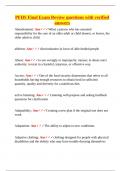
PFHS Final Exam Review questions with verified
answers
Abandonment: Ans✓✓✓When a person who has assumed
responsibility for the care of an older adult or child deserts, or leaves, the
older adult or child.
ableism: Ans✓✓✓discrimination in favor of able-bodied people
Abuse: Ans✓✓✓to use wrongly or improperly; misuse; to abuse one's
authority; to treat in a harmful, injurious, or offensive way.
Access: Ans✓✓✓One of the food security dimensions that refers to all
households having enough resources to obtain food in sufficient
quantity, quality and diversity for a nutritious diet.
active listening: Ans✓✓✓Listening with purpose and asking feedback
questions for clarification
Adaptability: Ans✓✓✓Creating a new plan if the original one does not
work.
Adaptation: Ans✓✓✓The ability to adjust to new conditions.
Adaptive clothing: Ans✓✓✓clothing designed for people with physical
disabilities and the elderly who may have trouble dressing themselves
,due to an inability to manipulate closures, such as buttons and zippers,
or due to a lack of a full range of motion required for self-dressing.
Administration For Children and Families: Ans✓✓✓These programs
include assistance with welfare, child support enforcement, adoption
assistance, foster care, child care, and child abuse.
Adoptive family: Ans✓✓✓Parents and one or more children that are
permanently and legally added to the family; these families may be
nuclear, single-parent, blended or extended family structures.
Adult Protective Services: Ans✓✓✓The primary agency that
investigates claims of elder abuse and neglect.
Adviser: Ans✓✓✓Team role of who encourages the search for more
information.
Advocacy: Ans✓✓✓the act or process of supporting a cause or
proposal
African Americans: Ans✓✓✓Education gap; Culture of poverty,
including family structure and incarceration issues; Institutional racism;
Minimum wage jobs, few benefits, little to no insurance.
ageism: Ans✓✓✓bias against, or unfair treatment of, persons based on
their age
,Alzheimer's disease: Ans✓✓✓A progressive brain disorder that
includes not only memory loss, but also progressively severe confusion.
Americans with Disabilities Act (ADA): Ans✓✓✓a law that prohibits
discrimination against people with disabilities in employment,
transportation, public accommodation, communications, and
governmental activities
Americans with Disabilities Act (ADA): Ans✓✓✓Legislation passed in
1990 that prohibits discrimination against people with disabilities. Under
this Act, discrimination against a disabled person is illegal in
employment, transportation, public accommodations, communications
and government activities.
Anna Y. Reed: Ans✓✓✓Author of Junior Wage Earners book. Written
in 1920. Proponent of children's education and vocational guidance in
learning to better employment potential. Also outspoken in the area of
Prison Reform and the need to link prison placement with rehabilitation.
Annual percentage rate (APR): Ans✓✓✓interest rate charged on a
credit card
Anorexia Nervosa: Ans✓✓✓This is characterized by weight loss often
due to excessive dieting and exercise, sometimes to the point of
starvation. People with anorexia can never be thin enough and continue
to see themselves as "fat" despite extreme weight loss.
, Arts and culture: Ans✓✓✓Community component fostering creative
expression and artistic pleasure
Assessor: Ans✓✓✓Team role of who offers insightful analysis of
options.
Assign: Ans✓✓✓A tenant can assign a lease to someone else. The
original tenant and assignee both remain responsible for the obligations
of the lease to the landlord, unless the landlord releases the original
tenant from the lease.
assimilation: Ans✓✓✓adopting the habits, customs, and patterns of a
new culture
Asynchrony: Ans✓✓✓Body growth that occurs at different rates.
Authoritarian Parent: Ans✓✓✓Parent that responds quickly and firmly
to broken rules.
Autocratic Leadership: Ans✓✓✓Also known as authoritarian
leadership, is a leadership style characterized by individual control over
all decisions and little input from group members.
answers
Abandonment: Ans✓✓✓When a person who has assumed
responsibility for the care of an older adult or child deserts, or leaves, the
older adult or child.
ableism: Ans✓✓✓discrimination in favor of able-bodied people
Abuse: Ans✓✓✓to use wrongly or improperly; misuse; to abuse one's
authority; to treat in a harmful, injurious, or offensive way.
Access: Ans✓✓✓One of the food security dimensions that refers to all
households having enough resources to obtain food in sufficient
quantity, quality and diversity for a nutritious diet.
active listening: Ans✓✓✓Listening with purpose and asking feedback
questions for clarification
Adaptability: Ans✓✓✓Creating a new plan if the original one does not
work.
Adaptation: Ans✓✓✓The ability to adjust to new conditions.
Adaptive clothing: Ans✓✓✓clothing designed for people with physical
disabilities and the elderly who may have trouble dressing themselves
,due to an inability to manipulate closures, such as buttons and zippers,
or due to a lack of a full range of motion required for self-dressing.
Administration For Children and Families: Ans✓✓✓These programs
include assistance with welfare, child support enforcement, adoption
assistance, foster care, child care, and child abuse.
Adoptive family: Ans✓✓✓Parents and one or more children that are
permanently and legally added to the family; these families may be
nuclear, single-parent, blended or extended family structures.
Adult Protective Services: Ans✓✓✓The primary agency that
investigates claims of elder abuse and neglect.
Adviser: Ans✓✓✓Team role of who encourages the search for more
information.
Advocacy: Ans✓✓✓the act or process of supporting a cause or
proposal
African Americans: Ans✓✓✓Education gap; Culture of poverty,
including family structure and incarceration issues; Institutional racism;
Minimum wage jobs, few benefits, little to no insurance.
ageism: Ans✓✓✓bias against, or unfair treatment of, persons based on
their age
,Alzheimer's disease: Ans✓✓✓A progressive brain disorder that
includes not only memory loss, but also progressively severe confusion.
Americans with Disabilities Act (ADA): Ans✓✓✓a law that prohibits
discrimination against people with disabilities in employment,
transportation, public accommodation, communications, and
governmental activities
Americans with Disabilities Act (ADA): Ans✓✓✓Legislation passed in
1990 that prohibits discrimination against people with disabilities. Under
this Act, discrimination against a disabled person is illegal in
employment, transportation, public accommodations, communications
and government activities.
Anna Y. Reed: Ans✓✓✓Author of Junior Wage Earners book. Written
in 1920. Proponent of children's education and vocational guidance in
learning to better employment potential. Also outspoken in the area of
Prison Reform and the need to link prison placement with rehabilitation.
Annual percentage rate (APR): Ans✓✓✓interest rate charged on a
credit card
Anorexia Nervosa: Ans✓✓✓This is characterized by weight loss often
due to excessive dieting and exercise, sometimes to the point of
starvation. People with anorexia can never be thin enough and continue
to see themselves as "fat" despite extreme weight loss.
, Arts and culture: Ans✓✓✓Community component fostering creative
expression and artistic pleasure
Assessor: Ans✓✓✓Team role of who offers insightful analysis of
options.
Assign: Ans✓✓✓A tenant can assign a lease to someone else. The
original tenant and assignee both remain responsible for the obligations
of the lease to the landlord, unless the landlord releases the original
tenant from the lease.
assimilation: Ans✓✓✓adopting the habits, customs, and patterns of a
new culture
Asynchrony: Ans✓✓✓Body growth that occurs at different rates.
Authoritarian Parent: Ans✓✓✓Parent that responds quickly and firmly
to broken rules.
Autocratic Leadership: Ans✓✓✓Also known as authoritarian
leadership, is a leadership style characterized by individual control over
all decisions and little input from group members.


