
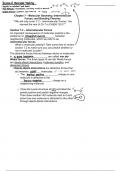
Review of Molecular Polarity :
-
depends on individual bond dipoles
T
-C HHo , Ha
Polar Molecules things diff. at each end
⑪
:
nonsymmetrical when are
-
,
↑
Molecules : symmetrical sameteached & NEN c 0
Nonpolar 0
- = =
, ,
,
,
Chapter 7 – Molecular Geometry, Intermolecular
Forces, and Bonding Theories
**We will only cover 7.3 – Intermolecular Forces. You
learned the rest of Ch 7 in CHEM 1251!**
Section 7.3 – Intermolecular Forces
An important consequence of molecular polarity is the
existence of ______________________
attractive-forces between
neighboring molecules, which we refer to as
intermolecular forces.
What is molecular polarity? Take some time to review
section 7.2 to make sure you can predict whether or
not a molecular is polar!
The attractive forces that act between atoms or molecules
in _________________________
a
pure substance are called van der
Waals forces. The three types of van der Waals forces
are dipole-dipole interactions, hydrogen bonding, and
dispersion forces.
• Dipole-dipole interactions are attractive forces that
polar molecules. St-s-dipole-dipole
act between ________
o The _______________________
Partial positive charge on one
molecule is attracted to the
_______________________
Partial negative charge on a
neighboring molecule.
o Draw the Lewis structure of HCl and label the *H -
partial positive and partial negative charges. -
⑳
Then draw another HCl molecule next to it and
show how one molecule is attracted to the other
through dipole-dipole interactions.
-
depends on individual bond dipoles
T
-C HHo , Ha
Polar Molecules things diff. at each end
⑪
:
nonsymmetrical when are
-
,
↑
Molecules : symmetrical sameteached & NEN c 0
Nonpolar 0
- = =
, ,
,
,
Chapter 7 – Molecular Geometry, Intermolecular
Forces, and Bonding Theories
**We will only cover 7.3 – Intermolecular Forces. You
learned the rest of Ch 7 in CHEM 1251!**
Section 7.3 – Intermolecular Forces
An important consequence of molecular polarity is the
existence of ______________________
attractive-forces between
neighboring molecules, which we refer to as
intermolecular forces.
What is molecular polarity? Take some time to review
section 7.2 to make sure you can predict whether or
not a molecular is polar!
The attractive forces that act between atoms or molecules
in _________________________
a
pure substance are called van der
Waals forces. The three types of van der Waals forces
are dipole-dipole interactions, hydrogen bonding, and
dispersion forces.
• Dipole-dipole interactions are attractive forces that
polar molecules. St-s-dipole-dipole
act between ________
o The _______________________
Partial positive charge on one
molecule is attracted to the
_______________________
Partial negative charge on a
neighboring molecule.
o Draw the Lewis structure of HCl and label the *H -
partial positive and partial negative charges. -
⑳
Then draw another HCl molecule next to it and
show how one molecule is attracted to the other
through dipole-dipole interactions.


