
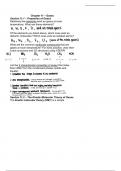
Chapter 11 – Gases
Section 11.1 – Properties of Gases
Relatively few elements exist as gases at room
temperature. What are these elements?
H ,
N , O ,
F ,
Cl ,
and all noble gases
Of the elements you listed above, which ones exist as
diatomic molecules? Which ones exist as isolated atoms?
Hz , N2 ,
Oz ,
F2 ,
Cl2 (none of the noble gases
What are the common molecular compounds that are
gases at room temperature? For extra practice, draw their
Lewis structures and 3D structures using VSEPR!
HCI NHz CO2 N2O CHy HCN
H
H-I H-N =: NEN-i C CN
:
H H H
-
- -
it
List the 4 characteristic properties of gases that make
them differ from the condensed phases (solids and
liquids):
1. Assumes the shapes volume of its container
possible to
2. Are compressable -
Since gas molecules are so far
more them closer by
apart
confining them to
, its
a smaller volume.
3. Smaller Densities that are highly variablebased on
temp + pressure
-
usually density of gas is expressed in
g/L
4. Form homogenous mixtures (solutions) -
since gas particles are
so far apart gases don't interact w/eachother significantly
,
unless a chemical xn is occuring .
This allows gases to mix uniformly
Section 11.2 – The Kinetic Molecular Theory of Gases
The kinetic molecular theory (KMT) is a simple
, microscopic model that explains how the molecular nature
of gases gives rise to their macroscopic properties. In your
own words, summarize the 4 basic assumptions of KMT:
1. Gases are compressible be molecules in the gas phase are separated
by large distances + can be moved closer by decreasing the volume
2. Gas molecules constantly in random motion more in straight paths + collide
,
w/ the walls of container. Energy is transferred but not lost in the collisions
3. Gases don't exert attractive or repulsive forces on one another
4.The average kinetic energy (EK) of gas molecules in a sample
kinetic energy
is proportional
associated w/ motion
to the absolute temperature * Recall that is energy
EnCT
Write the equation that relates the kinetic energy (E ) of a k
particle to its mass (m) and speed (u): E
* k
Ei
= mu
At a given temperature, all gases have the same average
____________________________
Average Kinetic Energy for their molecules.
Write the equation that relates the root mean square
speed (u ), temperature, and molar mass:
rms
u
num rms
Urms
=
• If the temperature of a gas increases, its average
kinetic energy _____________________,
increases and the
average speed of the gas particles _____________.
increases
• For any two samples of gas at the same temperature,
the gas with the ____________
higher molar mass will have
the lower average speed (u ). ↑ speed h molar mass rms
=
Diffusion is defined as: the mixing of gases
Effusion is defined as: movement of gas through a hole into a vaccum -
State Graham’s law: the rate of diffusion or effusion of a
means a
space
that has no
gas is inversely proportional to the sq root of it's molar mass
.
gas molecules
↓
Section 11.3 – Gas Pressure Rate
Pressure is defined as
& tional to
_____________________________________.
the force applied
per unit area Pressure
is:
pressure
=
Force
Section 11.1 – Properties of Gases
Relatively few elements exist as gases at room
temperature. What are these elements?
H ,
N , O ,
F ,
Cl ,
and all noble gases
Of the elements you listed above, which ones exist as
diatomic molecules? Which ones exist as isolated atoms?
Hz , N2 ,
Oz ,
F2 ,
Cl2 (none of the noble gases
What are the common molecular compounds that are
gases at room temperature? For extra practice, draw their
Lewis structures and 3D structures using VSEPR!
HCI NHz CO2 N2O CHy HCN
H
H-I H-N =: NEN-i C CN
:
H H H
-
- -
it
List the 4 characteristic properties of gases that make
them differ from the condensed phases (solids and
liquids):
1. Assumes the shapes volume of its container
possible to
2. Are compressable -
Since gas molecules are so far
more them closer by
apart
confining them to
, its
a smaller volume.
3. Smaller Densities that are highly variablebased on
temp + pressure
-
usually density of gas is expressed in
g/L
4. Form homogenous mixtures (solutions) -
since gas particles are
so far apart gases don't interact w/eachother significantly
,
unless a chemical xn is occuring .
This allows gases to mix uniformly
Section 11.2 – The Kinetic Molecular Theory of Gases
The kinetic molecular theory (KMT) is a simple
, microscopic model that explains how the molecular nature
of gases gives rise to their macroscopic properties. In your
own words, summarize the 4 basic assumptions of KMT:
1. Gases are compressible be molecules in the gas phase are separated
by large distances + can be moved closer by decreasing the volume
2. Gas molecules constantly in random motion more in straight paths + collide
,
w/ the walls of container. Energy is transferred but not lost in the collisions
3. Gases don't exert attractive or repulsive forces on one another
4.The average kinetic energy (EK) of gas molecules in a sample
kinetic energy
is proportional
associated w/ motion
to the absolute temperature * Recall that is energy
EnCT
Write the equation that relates the kinetic energy (E ) of a k
particle to its mass (m) and speed (u): E
* k
Ei
= mu
At a given temperature, all gases have the same average
____________________________
Average Kinetic Energy for their molecules.
Write the equation that relates the root mean square
speed (u ), temperature, and molar mass:
rms
u
num rms
Urms
=
• If the temperature of a gas increases, its average
kinetic energy _____________________,
increases and the
average speed of the gas particles _____________.
increases
• For any two samples of gas at the same temperature,
the gas with the ____________
higher molar mass will have
the lower average speed (u ). ↑ speed h molar mass rms
=
Diffusion is defined as: the mixing of gases
Effusion is defined as: movement of gas through a hole into a vaccum -
State Graham’s law: the rate of diffusion or effusion of a
means a
space
that has no
gas is inversely proportional to the sq root of it's molar mass
.
gas molecules
↓
Section 11.3 – Gas Pressure Rate
Pressure is defined as
& tional to
_____________________________________.
the force applied
per unit area Pressure
is:
pressure
=
Force


