
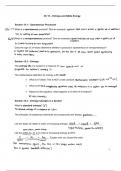
Ch 15 – Entropy and Gibbs Energy
Section 15.1 – Spontaneous Processes
AG = ( )
What is a spontaneous process? Give an example. A process that occurs under a specific set of conditions
Ex) Ice melting at room temperature
DG (t) What is a nonspontaneous process? Give an example. A process that
= does not occur under a
specific set of
conditions .
Ex) water freezing at room temperature
Does the sign of ΔH alone determine whether a process is spontaneous or nonspontaneous?
a negative SH (exothermic) tends to be
spontaneous but the sign of
, Al alone cannot predict spontaneity
in
every circumstance
Section 15.2 – Entropy
The entropy (S) of a system is a measure of: how
spread out or
dispersed the system's energy is .
The mathematical definition for entropy is S = klnW
• What is k? (Note: This is NOT a rate constant.)Boltzmann constant (1 38x10-23(/K) .
• What is W? # of energetically equivalent ways the molecules in a system can be arranged
• Based on this equation, what happens to S when W increases?
W also increases
Section 15.3 – Entropy Changes in a System
What is standard entropy? (S )
%
the absolute of
entropy a substance at lati
The entropies of substances (elements and compounds) are always ___________.
positive
solid Liquid gas
List the states of matter in order of increasing entropy: ________<________<________
same state same temp
higher thetemp greater the entropy
,
,
List the solids Au, Al,
-
98
C in order of increasing entropy at 25oC:
26 12 01
196 9
. .
.
C Al Al
________<________<________. Explain why you chose this order.
lightest
- heaviest
/for monatomic
species the one w/ ,
the larger molar mass
has a greater standard entropy (
1
, O3(g) and F2(g) are in the same phase has have relatively similar molar masses. Which one has
the greater standard entropy? Explain your answer. Oz will have the greater standard entropy .
For 2 substances w/ similar molar masses in the same phase ,
the substance with the more complex
molar structure has the greater So .
For the reaction aA + bB → cC + dD, write the equation you would use to calculate the standard
entropy change of the reaction (ΔS°), given the standard entropies of the components of the
reaction: products reactants -
15 xn
=
[25 °
(a) +
dSCD)] -
[aS °
(A) + bS
°
(B)]
Work through Worked Example 15.2. Once you understand the steps needed to solve this type
of problem, challenge yourself with the 3 Practice Problems (Attempt, Build, Conceptualize).
This should seem familiar to you, since you did something similar in General Chemistry I with
enthalpy (ΔH) values!
When the temperature of a system increases, the entropy ______________.
increases
When a substance dissolves in a solvent, the entropy often ________________.
increases
Review pages 696-697, then summarize the 6 main factors that influence the entropy of a
system:
• volume change
-
when volume increased ,
more energy levels become available within
which the energy can disperse
a vol =
↑ entropy (direct
•
Temperature change -
at higher temp molecules
, have a greater Kinetic energy making more energy
levess accessible
Temp
↑
=
Pentropy (direct)
• MolecularComplexity the greater a molecules
complexity the it can rotate vibrate
-
more ways +
,
which results
energy levels for system to
disperse
in more a
complexity =
Tentropy (direct)
• Molar
↑
mass-
molar mass =
q entropy (direct
• PhaseChange (s -1)
entropy increases when a molecule melted vaporized Is eg) ,
-
is
,
or sublimed(S-9) bc entropy increases in this order : S
,
1,.
9
• Chemical reaction -
when a chemicalrxn produces more
gas molecules than it consumes,
of (w)
possible arrangements
the # of diff molecules increases & entropy increases
2
(When Phase changes from above occur in chew rxn .
, entropy increases
Section 15.1 – Spontaneous Processes
AG = ( )
What is a spontaneous process? Give an example. A process that occurs under a specific set of conditions
Ex) Ice melting at room temperature
DG (t) What is a nonspontaneous process? Give an example. A process that
= does not occur under a
specific set of
conditions .
Ex) water freezing at room temperature
Does the sign of ΔH alone determine whether a process is spontaneous or nonspontaneous?
a negative SH (exothermic) tends to be
spontaneous but the sign of
, Al alone cannot predict spontaneity
in
every circumstance
Section 15.2 – Entropy
The entropy (S) of a system is a measure of: how
spread out or
dispersed the system's energy is .
The mathematical definition for entropy is S = klnW
• What is k? (Note: This is NOT a rate constant.)Boltzmann constant (1 38x10-23(/K) .
• What is W? # of energetically equivalent ways the molecules in a system can be arranged
• Based on this equation, what happens to S when W increases?
W also increases
Section 15.3 – Entropy Changes in a System
What is standard entropy? (S )
%
the absolute of
entropy a substance at lati
The entropies of substances (elements and compounds) are always ___________.
positive
solid Liquid gas
List the states of matter in order of increasing entropy: ________<________<________
same state same temp
higher thetemp greater the entropy
,
,
List the solids Au, Al,
-
98
C in order of increasing entropy at 25oC:
26 12 01
196 9
. .
.
C Al Al
________<________<________. Explain why you chose this order.
lightest
- heaviest
/for monatomic
species the one w/ ,
the larger molar mass
has a greater standard entropy (
1
, O3(g) and F2(g) are in the same phase has have relatively similar molar masses. Which one has
the greater standard entropy? Explain your answer. Oz will have the greater standard entropy .
For 2 substances w/ similar molar masses in the same phase ,
the substance with the more complex
molar structure has the greater So .
For the reaction aA + bB → cC + dD, write the equation you would use to calculate the standard
entropy change of the reaction (ΔS°), given the standard entropies of the components of the
reaction: products reactants -
15 xn
=
[25 °
(a) +
dSCD)] -
[aS °
(A) + bS
°
(B)]
Work through Worked Example 15.2. Once you understand the steps needed to solve this type
of problem, challenge yourself with the 3 Practice Problems (Attempt, Build, Conceptualize).
This should seem familiar to you, since you did something similar in General Chemistry I with
enthalpy (ΔH) values!
When the temperature of a system increases, the entropy ______________.
increases
When a substance dissolves in a solvent, the entropy often ________________.
increases
Review pages 696-697, then summarize the 6 main factors that influence the entropy of a
system:
• volume change
-
when volume increased ,
more energy levels become available within
which the energy can disperse
a vol =
↑ entropy (direct
•
Temperature change -
at higher temp molecules
, have a greater Kinetic energy making more energy
levess accessible
Temp
↑
=
Pentropy (direct)
• MolecularComplexity the greater a molecules
complexity the it can rotate vibrate
-
more ways +
,
which results
energy levels for system to
disperse
in more a
complexity =
Tentropy (direct)
• Molar
↑
mass-
molar mass =
q entropy (direct
• PhaseChange (s -1)
entropy increases when a molecule melted vaporized Is eg) ,
-
is
,
or sublimed(S-9) bc entropy increases in this order : S
,
1,.
9
• Chemical reaction -
when a chemicalrxn produces more
gas molecules than it consumes,
of (w)
possible arrangements
the # of diff molecules increases & entropy increases
2
(When Phase changes from above occur in chew rxn .
, entropy increases


