Evaluating Natural Law
Strengths and Weaknesses:
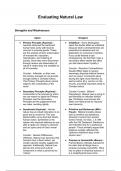
Agree Disagree
● Primary Precepts (Aquinas) - ● Unbiblical - Some theologians
Aquinas observed the world and reject the double effect as unbiblical
human telos (unity with God) to because God’s commandments are
uncover 5 universal goods. These presented as absolute and not
are the worship of God, preservation dependent on someone’s intention.
of innocent life, education, If you could foresee a bad
reproduction, and ordering of consequence, the fact that it was a
society. Since they were discovered secondary effect beside the effect
through reason and observation of you did intend doesn’t justify it
nature it means they are available to
all of humanity. Counter : Resolves Contradictions,
Double Effect helps to resolve
Counter : Inflexible, on their own, seemingly disparate biblical themes,
the primary precepts do not provide such as Jesus’ commands about
enough clarity in Christian Ethics. having the right moral intention as
The Primary Precepts alone cannot well as action (E.g. sermon on the
adapt to the complexities of the mount), providing important clarity to
world Christian ethics
● Secondary Precepts (Aquinas) - Counter Counter : Biblical
Conscientia is the process by which Precedence, Natural Law is trying to
we use reason to apply the Primary add flexibility to inflexible biblical
Precepts, and the Secondary law. Christians must choose the
Precepts are the judgements that Bible over Natural law by Aquinas’
we make, avoiding rigidity. own hierarchy
● Synderesis (Aquinas) - Human ● Primitive and Barbarous (Mill +
nature has an inbuilt inclination to do Freud) - Biblical morality (divine
good and to avoid evil. This was law) is primitive and barbarous,
placed within us by God and directs showing it comes from ancient
human action. Synderesis is the human minds, not God. J. S. Mill
reason why Aquinas believes we are calls the Old Testament “Barbarous,
able to apply our reason to discover and intended only for a barbarous
and act upon parts of God’s moral people”. Freud similarly argued that
law religious morality reflected the
“ignorant childhood days of the
Counter : Genetic Differences human race”.
(Nielsen), Natural Law assumes that
humans have a fixed nature, yet ● Purpose is Unscientific (Bacon) -
modern genetic studies suggest the Francis Bacon criticises Aquinas for
opposite. Additionally, Natural Law his claim that all things have a
ignores the social and cultural purpose as being unscientific. Telos
component to what is perceived as has no place in empirical science, it
‘nature’. is a metaphysical issue since
Strengths and Weaknesses:
Agree Disagree
● Primary Precepts (Aquinas) - ● Unbiblical - Some theologians
Aquinas observed the world and reject the double effect as unbiblical
human telos (unity with God) to because God’s commandments are
uncover 5 universal goods. These presented as absolute and not
are the worship of God, preservation dependent on someone’s intention.
of innocent life, education, If you could foresee a bad
reproduction, and ordering of consequence, the fact that it was a
society. Since they were discovered secondary effect beside the effect
through reason and observation of you did intend doesn’t justify it
nature it means they are available to
all of humanity. Counter : Resolves Contradictions,
Double Effect helps to resolve
Counter : Inflexible, on their own, seemingly disparate biblical themes,
the primary precepts do not provide such as Jesus’ commands about
enough clarity in Christian Ethics. having the right moral intention as
The Primary Precepts alone cannot well as action (E.g. sermon on the
adapt to the complexities of the mount), providing important clarity to
world Christian ethics
● Secondary Precepts (Aquinas) - Counter Counter : Biblical
Conscientia is the process by which Precedence, Natural Law is trying to
we use reason to apply the Primary add flexibility to inflexible biblical
Precepts, and the Secondary law. Christians must choose the
Precepts are the judgements that Bible over Natural law by Aquinas’
we make, avoiding rigidity. own hierarchy
● Synderesis (Aquinas) - Human ● Primitive and Barbarous (Mill +
nature has an inbuilt inclination to do Freud) - Biblical morality (divine
good and to avoid evil. This was law) is primitive and barbarous,
placed within us by God and directs showing it comes from ancient
human action. Synderesis is the human minds, not God. J. S. Mill
reason why Aquinas believes we are calls the Old Testament “Barbarous,
able to apply our reason to discover and intended only for a barbarous
and act upon parts of God’s moral people”. Freud similarly argued that
law religious morality reflected the
“ignorant childhood days of the
Counter : Genetic Differences human race”.
(Nielsen), Natural Law assumes that
humans have a fixed nature, yet ● Purpose is Unscientific (Bacon) -
modern genetic studies suggest the Francis Bacon criticises Aquinas for
opposite. Additionally, Natural Law his claim that all things have a
ignores the social and cultural purpose as being unscientific. Telos
component to what is perceived as has no place in empirical science, it
‘nature’. is a metaphysical issue since