
Summary Design Methodology Test
Tutorial 1
Design Methodology for Psychology can be considered as the discipline
that encompasses knowledge and skills to systematically develop
psychological interventions and to use or apply these interventions in
order to solve psychological problems
What is behavior?
1. You can do it
2. Directly observable
3. It is concrete
4. Is described by active verbs
Intervention = “A set of measures, resources and people which is employed to influence or change
people’s behaviour”
ASCE model is about influencing and/or altering human habits and behaviours for the long term.
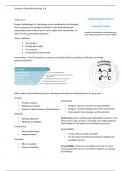
Analysis
Involvement
• Problem analysis
• Behavioural analysis • Designer informs environment about activities
• Analysis of determinants of the behaviour • Designer considers feelings and views environment
• Environment trusts designer and his activities
Synthesis
• Defining objectives Involvement means working with stakeholders and users. You
• Methods & strategies inform them, listen to them, and adapt your design based on
their feedback. This builds trust and improves success.
Construction
Accountability
• Intervention design
• Implementation • Is every step correctly executed?
• Are all choices and desicions based on reliable and
Evaluation scientific sources?
• Effect evaluation
• Process evaluation Accountability means you can justify every step. Are your
choices backed by science? Can others replicate or evaluate
your design?
, Summary Design Methodology Test
Important Models/Theories You Should Know
Theory of Planned Behaviour (Ajzen):
Behaviour is influenced by attitude, subjective norm, and perceived behavioural control.
PRECEDE Model:
Analyses behaviour in terms of:
o Predisposing (e.g., beliefs)
o Enabling (e.g., access)
o Reinforcing (e.g., peer support)
Problem-solving heuristics (Polya):
1. Understand the problem
2. Devise a plan
3. Carry out the plan
4. Look back
Empirical vs. Regulative Cycle
Empirical = observe, hypothesise, test → theory
Regulative = analyse problem → design → apply → evaluate solution
Design methodology = regulative cycle


