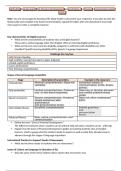
D096 WGU : Study Guide on Physical Development & Els Module 5 : Physical Development Study
Guide.
Note: You are encouraged to download the Study Guide to document your responses. If you plan to print the
Study Guide and complete it by hand (recommended), expand the tables after you download it to provide
more space to enter a complete response.
Key Characteristics of English Learners:
• What are the characteristics of students who are English learners?
Those with a native language other than English. Who are learning English proficiency.
• What are the two most common disability categories in which ELs with disabilities are often
classified? Specific learning disability (SLD), Speech/ Language Impairment
Challenge ELs may face
Little formal schooling
High mobility/ moving from place to place (migrant)
Limited english proficiency
Lower achievement
Poor listening comprehension
Stages of Second Language Acquisition
Stage Description/Characteristics Example in the classroom
Preproduction Minimal comprehension. Does not nonverbal means of
verbalize. communication (nods, draws,
points).
Early production Limited comprehension. Produces Uses key or familiar phrases
one- or two-word responses. and mostly present tense
verbs.
Speech emergence Decent comprehension. Produces Does not often understand
simple sentences with jokes.
grammatical
and pronunciation errors.
Intermediate fluency Excellent comprehension limited grammar
and
pronunciation
errors.
Advanced fluency Near native comprehension and
communication
• Define the term “Zone of Proximal Development.”
The difference between what a student can do without help and what a student can do with help.
• Explain how the Zone of Proximal Development applies to teaching students who are English
learners. Used to gauge what the student needs to acquire as well as what they already know to
advance through the stages of language acquisition.
Instructional Practices to Support Needs of Newcomers
• What are the three needs of students who are newcomers?
Issues of Culture and Language in Education of ELs
• Describe some of the stress-related culture shocks that newcomers may
Guide.
Note: You are encouraged to download the Study Guide to document your responses. If you plan to print the
Study Guide and complete it by hand (recommended), expand the tables after you download it to provide
more space to enter a complete response.
Key Characteristics of English Learners:
• What are the characteristics of students who are English learners?
Those with a native language other than English. Who are learning English proficiency.
• What are the two most common disability categories in which ELs with disabilities are often
classified? Specific learning disability (SLD), Speech/ Language Impairment
Challenge ELs may face
Little formal schooling
High mobility/ moving from place to place (migrant)
Limited english proficiency
Lower achievement
Poor listening comprehension
Stages of Second Language Acquisition
Stage Description/Characteristics Example in the classroom
Preproduction Minimal comprehension. Does not nonverbal means of
verbalize. communication (nods, draws,
points).
Early production Limited comprehension. Produces Uses key or familiar phrases
one- or two-word responses. and mostly present tense
verbs.
Speech emergence Decent comprehension. Produces Does not often understand
simple sentences with jokes.
grammatical
and pronunciation errors.
Intermediate fluency Excellent comprehension limited grammar
and
pronunciation
errors.
Advanced fluency Near native comprehension and
communication
• Define the term “Zone of Proximal Development.”
The difference between what a student can do without help and what a student can do with help.
• Explain how the Zone of Proximal Development applies to teaching students who are English
learners. Used to gauge what the student needs to acquire as well as what they already know to
advance through the stages of language acquisition.
Instructional Practices to Support Needs of Newcomers
• What are the three needs of students who are newcomers?
Issues of Culture and Language in Education of ELs
• Describe some of the stress-related culture shocks that newcomers may