100% satisfaction guarantee Immediately available after payment Both online and in PDF No strings attached 4.2 TrustPilot
logo-home
Exam (elaborations)

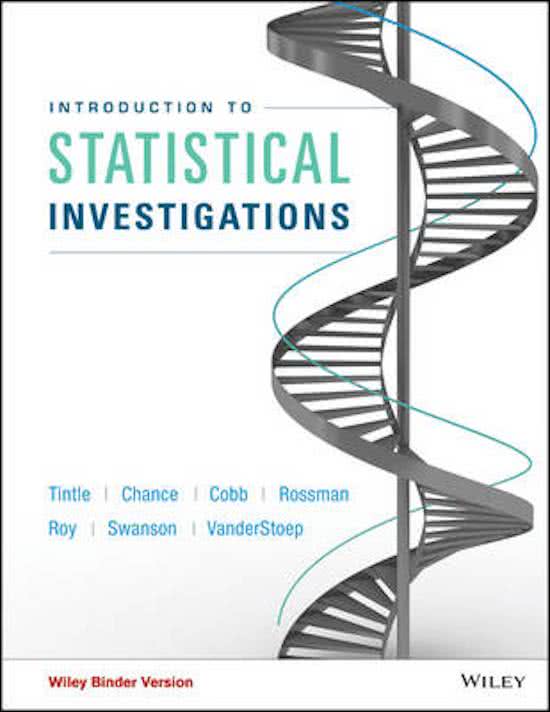
TEST BANK Introduction to Statistical Investigations, 2/// nd Edition Nathan Tintle; Beth L. Chance Chapters 1 - 11, Complete DR ERIC

Rating
-
Sold
-
Pages
300
Grade
A+
Uploaded on
23-06-2025
Written in
2024/2025

TEST BANK Introduction to Statistical Investigations, 2/// nd Edition Nathan Tintle; Beth L. Chance Chapters 1 - 11, Complete DR ERIC DR ERIC FOR INSTRUCTOR USE ONLY TABLE OF CONTENTS Chapter 1 – Significance: How Strong is the Evidence Chapter 2 – Generalization: How Broadly Do the Results Apply? Chapter 3 – Estimation: How Large is the Effect? Chapter 4 – Causation: Can We Say What Caused the Effect? Chapter 5 – Comparing Two Proportions Chapter 6 – Comparing Two Means Chapter 7 – Paired Data: One Quantitative Variable Chapter 8 – Comparing More Than Two Proportions Chapter 9 – Comparing More Than Two Means Chapter 10 – Two Quantitative Variables Chapter 11 – Modeling Randomness DR ERIC DR ERIC FOR INSTRUCTOR USE ONLY Chapter 1 Note: TE = Text entry TE-N = Text entry - NumericMa = Matching MS = Multiple select MC = Multiple choice TF = True-FalseE = Easy, M = Medium, H = Hard CHAPTER 1 LEARNING OBJECTIVES CLO1-1: Use the chance model to determine whether an observed statistic is unlikely to occur. CLO1-2: Calculate and interpret a p-value, and state the strength of evidence it provides againstthe null hypothesis. CLO1-3: Calculate a standardized statistic for a single proportion and evaluate the strength of evidence it provides against a null hypothesis. CLO1-4: Describe how the distance of the observed statistic from the parameter value specifiedby the null hypothesis, sample size, and one- vs. two-sided tests affect the strength of evidence against the null hypothesis. CLO1-5: Describe how to carry out a theory-based, one-proportion z-test. Section 1.1: Introduction to Chance Models LO1.1-1: Recognize the difference between parameters and statistics. LO1.1-2: Describe how to use coin tossing to simulate outcomes from a chance model of the ran-dom choice between two events. LO1.1-3: Use the One Proportion applet to carry out the coin tossing simulation. LO1.1-4: Identify whether or not study results are statistically significant and whether or not the chance model is a plausible explanation for the data. LO1.1-5: Implement the 3S strategy: find a statistic, simulate results from a chance model, and comment on strength of evidence against observed study results happening by chance alone. LO1.1-6: Differentiate between saying the chance model is plausible and the chance model is thecorrect explanation for the observed data. DR ERIC DR ERIC FOR INSTRUCTOR USE ONLY 1-2 Test Bank for Introduction to Statistical Investigations, 2nd Edition Questions 1 through 4: Do red uniform wearers tend to win more often than those wearing blue uniforms in Taekwondo matches where competitors are randomly assigned to wear either a red or blue uniform? In a sample of 80 Taekwondo matches, there were 45 matches where thered uniform wearer won. 1. What is the parameter of interest for this study? A. The long-run proportion of Taekwondo matches in which the red uniform wearerwins B. The proportion of matches in which the red uniform wearer wins in a sample of 80 Taekwondo matches C. Whether the red uniform wearer wins a match D. 0.50 Ans: A; LO: 1.1-1; Difficulty: Easy; Type: MC 2. What is the statistic for this study? A. The long-run proportion of Taekwondo matches in which the red uniform wearerwins B. The proportion of matches in which the red uniform wearer wins in a sample of 80 Taekwondo matches C. Whether the red uniform wearer wins a match D. 0.50 Ans: B; LO: 1.1-1; Difficulty: Easy; Type: MC 3. Given below is the simulated distribution of the number of ―red wins‖ that could happen by chance alone in a sample of 80 matches. Based on this simulation, is our observed result statistically significant? A. Yes, since 45 is larger than 40. B. Yes, since the height of the dotplot above 45 is smaller than the height of the dotplot above 40. C. No, since 45 is a fairly typical outcome if the color of the winner‘s uniform was determined by chance alone. DR ERIC DR ERIC FOR INSTRUCTOR USE ONLY Introduction to Financial Statements 1-3 D. No, since we could have observed a value greater than 45 just by random chance. Ans: C; LO: 1.1-4; Difficulty: Medium; Type: MC 4. What can we conclude from the results of this study? Select all that apply. A. The results of this study are something that could easily have happened if thecolor of the winner‘s uniform was determined by chance alone. B. We do not have convincing evidence against the ―by-chance-alone‖ model. C. The results of this study prove that the color of the winner‘s uniform was determined by chance alone. D. We do not have convincing evidence that red uniform wearers tend to win moreoften than those wearing blue uniforms. Ans: A, B, D; LO: 1.1-6; Difficulty: Hard; Type: MS Questions 5 through 8: Suppose you are testing to see if your dog, Hope, understands pointing towards an object. You place two objects about 2.5 meters away, then you point towards one of the objects. In 20 trials,Hope goes to the correct object 13 times (or 65%). 5. Fill in the blanks with the correct One Proportion applet inputs to carry out an appropriate simulation of this process, if Hope does not understand pointing towards an object and isjust guessing. Probability of success: Sample size: Number of samples: Ans: 0.5 (Tol: 0), 20 (Tol: 0), Any integer as larger or larger than 1000; LO: 1.1-3; Difficulty: Easy; Type: TE-N 6. Match the parts of the real study corresponding to the physical (coin-flipping) simulation: Coin flip = Heads = Tails = Chance of heads = One repetition = A. 0.5, probability of Hope going to the correct object B. Hope going to the correct object C. Hope going to the incorrect object D. One set of 20 attempts by Hope E. Hope going to an object Ans: E, B, C, A, D; LO: 1.1-2; Difficulty: Medium; Type: Ma DR ERIC DR ERIC 1-4 Test Bank for Introduction to Statistical Investigations, 2nd Edition FOR INSTRUCTOR USE ONLY 7. Given below is the resulting simulation distribution from the One Proportion applet. Basedon this simulation, do we have convincing evidence against the observed study results happening by chance alone? A. No, since 0.65 is a fairly typical outcome if Hope was just guessing. B. No, since we could have observed a value greater than 0.65 just by random chance. C. Yes, since 0.65 is larger than 0.5. D. Yes, since the height of the dotplot above 0.65 is smaller than the height of the dotplot above 0.5. Ans: A; LO: 1.1-5; Difficulty: Medium; Type: MC 8. Which of the following is NOT a step in the 3S Strategy for measuring strength of evidence? A. Strength of evidence B. Statistic C. Sample D. Simulate Ans: C; LO: 1.1-5; Difficulty: Easy; Type: MC Questions 9 through 12: True or False? 9. A parameter is a number summarizing the results in the sample. Ans: False; LO: 1.1-1; Difficulty: Easy; Type: TF 10. A result that is unlikely to occur just by chance alone is called statistically significant. Ans: True; LO: 1.1-4; Difficulty: Easy; Type: TF 11. If an observed statistic is statistically significant, then we have strong evidence that the chance-alone explanation is correct. Ans: False; LO: 1.1-5; Difficulty: Medium; Type: TF DR ERIC DR ERIC 1-4 Test Bank for Introduction to Statistical Investigations, 2nd Edition FOR INSTRUCTOR USE ONLY 12. If an observed statistic is NOT statistically significant, then the chance model is plausible. DR ERIC DR ERIC Introduction to Financial Statements 1-5 FOR INSTRUCTOR USE ONLY Ans: True; LO: 1.1-6; Difficulty: Medium; Type: TF Section 1.2: Measuring Strength of Evidence LO1.2-1: Use appropriate symbolsfor parameter and statistic. LO1.2-2: State the null and the alternative hypotheses in words and in terms of the symbol π, thelong-run proportion. LO1.2-3: Explain how to conduct a simulation using a null hypothesis probability that is not 50-50. LO1.2-4: Use the One Proportion applet to obtain the p-value after carrying out an appropriatesimulation. LO1.2-5: Anticipate the location of the center of the null distribution and how it changes based onwhether you are using proportion or count as the statistic. LO1.2-6: Interpret the p-value. LO1.2-7: Explain why a smaller p-value provides stronger evidence against the null hypothesis. LO1.2-8: State a conclusion about the alternative hypothesis and null hypothesis based on the p￾value. Questions 13 through 18: A survey on 1,500 high school seniors who took the SAT and who completed an optional web survey shows that 55% of high school seniors are fairly certain that they will participate in a studyabroad program in college. Does this survey provide convincing evidence that the majority (morethan 50%) of all high school seniors who take the SAT are fairly certain they will participate in a study abroad program in college? 13. What is the value of the statistic and its proper notation in this study?A. 0.55 B. pˆ 0.55 C. 825 D. pˆ 825 Ans: B; LO: 1.2-1; Difficulty: Easy; Type: MC 14. Under the null hypothesis, what is the value of the parameter of interest and its proper notation in this study? A.

Show more Read less
Institution
TEpeting In
Course
TEpeting in


Whoops! We can’t load your doc right now. Try again or contact support.

Written for

Institution
TEpeting in
Course
TEpeting in

Document information

Uploaded on
June 23, 2025
Number of pages
300
Written in
2024/2025
Type
Exam (elaborations)
Contains
Questions & answers

Subjects

Content preview

DR ERIC


TEST BANK
Introduction to Statistical Investigations,
2nd Edition Nathan Tintle; Beth L. Chance
Chapters 1 - 11, Complete


FOR INSTRUCTOR USE ONLY
DR ERIC

, DR ERIC


TABLE OF CONTENTS


Chapter 1 – Significance: How Strong is the Evidence

Chapter 2 – Generalization: How Broadly Do the Results Apply?

Chapter 3 – Estimation: How Large is the Effect?

Chapter 4 – Causation: Can We Say What Caused the Effect?

Chapter 5 – Comparing Two Proportions

Chapter 6 – Comparing Two Means

Chapter 7 – Paired Data: One Quantitative Variable

Chapter 8 – Comparing More Than Two Proportions

Chapter 9 – Comparing More Than Two Means

Chapter 10 – Two Quantitative Variables

Chapter 11 – Modeling Randomness


FOR INSTRUCTOR USE ONLY
DR ERIC

, DR ERIC


Chapter 1
Note: TE = Text entry TE-N = Text entry - NumericMa
= Matching MS = Multiple select
MC = Multiple choice TF = True-FalseE =

Easy, M = Medium, H = Hard


CHAPTER 1 LEARNING OBJECTIVES
CLO1-1: Use the chance model to determine whether an observed statistic is unlikely to occur.
CLO1-2: Calculate and interpret a p-value, and state the strength of evidence it provides againstthe null
hypothesis.
CLO1-3: Calculate a standardized statistic for a single proportion and evaluate the strength of
evidence it provides against a null hypothesis.
CLO1-4: Describe how the distance of the observed statistic from the parameter value specifiedby the
null hypothesis, sample size, and one- vs. two-sided tests affect the strength of evidence against
the null hypothesis.
CLO1-5: Describe how to carry out a theory-based, one-proportion z-test.


Section 1.1: Introduction to Chance Models
LO1.1-1: Recognize the difference between parameters and statistics.
LO1.1-2: Describe how to use coin tossing to simulate outcomes from a chance model of the ran-dom
choice between two events.
LO1.1-3: Use the One Proportion applet to carry out the coin tossing simulation.
LO1.1-4: Identify whether or not study results are statistically significant and whether or not the
chance model is a plausible explanation for the data.
LO1.1-5: Implement the 3S strategy: find a statistic, simulate results from a chance model, and
comment on strength of evidence against observed study results happening by chance alone.
LO1.1-6: Differentiate between saying the chance model is plausible and the chance model is the correct
explanation for the observed data.


FOR INSTRUCTOR USE ONLY
DR ERIC

, DR ERIC

1-2 Test Bank for Introduction to Statistical Investigations, 2nd Edition


Questions 1 through 4:
Do red uniform wearers tend to win more often than those wearing blue uniforms in
Taekwondo matches where competitors are randomly assigned to wear either a red or blue
uniform? In a sample of 80 Taekwondo matches, there were 45 matches where thered uniform
wearer won.
1. What is the parameter of interest for this study?
A. The long-run proportion of Taekwondo matches in which the red uniform wearerwins
B. The proportion of matches in which the red uniform wearer wins in a sample of 80
Taekwondo matches
C. Whether the red uniform wearer wins a match
D. 0.50
Ans: A; LO: 1.1-1; Difficulty: Easy; Type: MC
2. What is the statistic for this study?
A. The long-run proportion of Taekwondo matches in which the red uniform wearerwins
B. The proportion of matches in which the red uniform wearer wins in a sample of 80
Taekwondo matches
C. Whether the red uniform wearer wins a match
D. 0.50
Ans: B; LO: 1.1-1; Difficulty: Easy; Type: MC
3. Given below is the simulated distribution of the number of ―red wins‖ that could happen by
chance alone in a sample of 80 matches. Based on this simulation, is our observed result
statistically significant?


A. Yes, since 45 is larger than 40.
B. Yes, since the height of the dotplot above 45 is smaller than the height of the
dotplot above 40.
C. No, since 45 is a fairly typical outcome if the color of the winner‘s uniform was
determined by chance alone.

FOR INSTRUCTOR USE ONLY
DR ERIC

Get to know the seller

Seller avatar
Reputation scores are based on the amount of documents a seller has sold for a fee and the reviews they have received for those documents. There are three levels: Bronze, Silver and Gold. The better the reputation, the more your can rely on the quality of the sellers work.
DRERIC University Of Washington
View profile
Follow You need to be logged in order to follow users or courses
Sold
13
Member since
1 year
Number of followers
1
Documents
1186
Last sold
1 day ago
NURSING BUSINESS AND ENGINEERING

Assignments, Case Studies, Research, Essay writing service, Questions and Answers, Discussions etc. for students who want to see results twice as fast. I have done papers of various topics and complexities. I am punctual and always submit work on-deadline. I write engaging and informative content on all subjects. Send me your research papers, case studies, psychology papers, etc, and I’ll do them to the best of my abilities. Writing is my passion when it comes to academic work. I’ve got a good sense of structure and enjoy finding interesting ways to deliver information in any given paper. I love impressing clients with my work, and I am very punctual about deadlines. Send me your assignment and I’ll take it to the next level. I strive for my content to be of the highest quality. Your wishes come first— send me your requirements and I’ll make a piece of work with fresh ideas, consistent structure, and following the academic formatting rules. For every student you refer to me with an order that is completed and paid transparently, I will do one assignment for you, free of charge!!!!!!!!!!!! WELCOME TO MY STORE .I APPRECIATE YOU BEING HERE TO FIND THE QUALITY TEST BANKS AND EXAMS YOU NEED FOR THAT I SAY THANK YOU. EVERYTHING HERE IS QUALITY , WELL RESEARCHED AND VERIFIED WITH THE PROPER PRCING . BE ASSURED TO 100% PASS YOUR EXAMS . REMEBER YOU CAN RATE MY DOCUMENTS .THANK YOU AGAIN FOR BEING HERE

Read more Read less
3.7

3 reviews

5
2
4
0
3
0
2
0
1
1

Recently viewed by you

Why students choose Stuvia

Created by fellow students, verified by reviews

Quality you can trust: written by students who passed their tests and reviewed by others who've used these notes.

Didn't get what you expected? Choose another document

No worries! You can instantly pick a different document that better fits what you're looking for.

Pay as you like, start learning right away

No subscription, no commitments. Pay the way you're used to via credit card and download your PDF document instantly.

Student with book image

“Bought, downloaded, and aced it. It really can be that simple.”

Alisha Student

Frequently asked questions