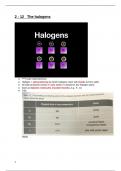
2 - 12 The halogens
● ***7 outer shell electrons
● Halogen = salt-producing (in which halogens react with metals to form salts)
● All salts produced contain X- ions (where X stands for any halogen atom)
● Exist as diatomic molecules (covalent bonds), e.g.: F2, Cl2
● (TB)
(SBA)
1
, ● ***Increasing melting and boiling points down the group (as Mr increases) [go from
gases to liquids to solids]
● ***Poor heat and electrical conductors
● ***Decreasing reactivity down the group
● ***Colour of elements get darker down the group
Safety......
● All halogens have coloured, extremely poisonous vapours, have to be handled in
fume cupboard
● Fluorine and chlorine - dangerously reactive
● Liquid bromine - very corrosive, need to be keep off skin
● Astatine - radioactive, formed during radioactive decay of other elements, e.g.:
uranium, thorium (also unstable, have half lives of seconds to fractions of a second)
Reaction of halogens
● Halogens always react with hydrogen, forming hydrogen halides (single covalent
bond), e.g.: H2 (g) + Br2 (g) → 2HBr (g)
● Hydrogen halides are all acidic, poisonous gases, also covalently bonded and
very soluble in water
○ Hydrogen halides dissolve in water, forming solutions of acids, e.g.: HCl (g)
[hydrogen chloride] → (dissolve in water) → HCl (aq) [hydrochloric acid]
● Halogens react with alkali metals, forming ionic salts, e.g.: 2Na (s) + Cl2 (g) →
2NaCl (s)
2
● ***7 outer shell electrons
● Halogen = salt-producing (in which halogens react with metals to form salts)
● All salts produced contain X- ions (where X stands for any halogen atom)
● Exist as diatomic molecules (covalent bonds), e.g.: F2, Cl2
● (TB)
(SBA)
1
, ● ***Increasing melting and boiling points down the group (as Mr increases) [go from
gases to liquids to solids]
● ***Poor heat and electrical conductors
● ***Decreasing reactivity down the group
● ***Colour of elements get darker down the group
Safety......
● All halogens have coloured, extremely poisonous vapours, have to be handled in
fume cupboard
● Fluorine and chlorine - dangerously reactive
● Liquid bromine - very corrosive, need to be keep off skin
● Astatine - radioactive, formed during radioactive decay of other elements, e.g.:
uranium, thorium (also unstable, have half lives of seconds to fractions of a second)
Reaction of halogens
● Halogens always react with hydrogen, forming hydrogen halides (single covalent
bond), e.g.: H2 (g) + Br2 (g) → 2HBr (g)
● Hydrogen halides are all acidic, poisonous gases, also covalently bonded and
very soluble in water
○ Hydrogen halides dissolve in water, forming solutions of acids, e.g.: HCl (g)
[hydrogen chloride] → (dissolve in water) → HCl (aq) [hydrochloric acid]
● Halogens react with alkali metals, forming ionic salts, e.g.: 2Na (s) + Cl2 (g) →
2NaCl (s)
2