1 - 8 Covalent bonding
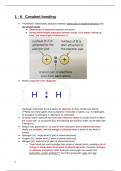
● ***Definition: electrostatic attraction between shared pair of negative electrons and
two positive nuclei
● Shared pair of electrons between two atoms
● Strong electrostatic attraction between nuclei (+) of atoms making up
bond, and shared pair of electrons (-)
● Shown using dot-cross diagrams
(Hydrogen molecules [H2] are said to be diatomic as they contain two atoms)
(***Most non-metal gases exist as diatomic molecules in nature, e.g.: H2 [hydrogen],
O2 [oxygen], N2 [nitrogen], F2 [fluorine], Cl2 [chlorine])
● All atoms within molecule have full outer electron shells (in GCSE level it is called
the “octet rule”, as except the first, the following two electron shells can be filled with
8 electrons)
● Reason why gases like H2, O2 and N2 form molecules: atoms without full outer
shells are unstable, and that energy is released when a bond (of any kind) is
formed
● Hydrogen (H2): single bond (1 pair of shared electrons)
● Oxygen (O2): double bond (2 pairs of shared electrons)
● Nitrogen (N2): triple bond (3 pairs of shared electrons)
○ Triple bonds are much stronger than single or double bonds, needing a lot of
energy to break down three pairs of shared electrons, therefore nitrogen
is relatively unreactive, while hydrogen and oxygen can easily form
hydroxides, oxides, hydrides*** and other groups like -ates and -ites.
1
, Simple molecular structures
● Strong covalent bonds between hydrogen and oxygen atoms in H2O molecules, but
weak intermolecular forces between H2O molecules
● When covalent compounds are heated, ONLY INTERMOLECULAR FORCES ARE
BROKEN DOWN, NOT THE COVALENT BONDS
● ***Melting and boiling points increase as relative molecular mass increases
Boiling points increase down this group, meaning that more energy is needed to
put in to break intermolecular forces as Mr increases, thus meaning that
intermolecular forces MUST HAVE become stronger as Mr increases.
● ***Have low melting and boiling points: not much energy is needed to break weak
intermolecular forces between molecules
● ***Do not (usually) conduct electricity: molecules do not have any overall electrical
charge (there are no delocalized ions), all electrons held tightly in atoms/covalent
bonds, so not able to move from molecule to molecule
● ***Insoluble in water: water is a polar (charged) solvent, while most covalent
compounds are non-polar (not charged) (ethanol [C2H5OH], ammonia [NH3] and
hydrochloric acid [HCl] are exceptions)
● ***Soluble in organic solvents (containing carbon): ↑ organic solvents are
also non-polar, same as most covalent compounds
Giant covalent structures
● Continues on and on in three dimensions
● NOT one, single molecule, as number of atoms joined up is variable and depends
on size of object
● ***Allotrope (同素異形體): different chemical forms of same element
(SBA) Each of two or more different physical forms in which an element can exist
2
● ***Definition: electrostatic attraction between shared pair of negative electrons and
two positive nuclei
● Shared pair of electrons between two atoms
● Strong electrostatic attraction between nuclei (+) of atoms making up
bond, and shared pair of electrons (-)
● Shown using dot-cross diagrams
(Hydrogen molecules [H2] are said to be diatomic as they contain two atoms)
(***Most non-metal gases exist as diatomic molecules in nature, e.g.: H2 [hydrogen],
O2 [oxygen], N2 [nitrogen], F2 [fluorine], Cl2 [chlorine])
● All atoms within molecule have full outer electron shells (in GCSE level it is called
the “octet rule”, as except the first, the following two electron shells can be filled with
8 electrons)
● Reason why gases like H2, O2 and N2 form molecules: atoms without full outer
shells are unstable, and that energy is released when a bond (of any kind) is
formed
● Hydrogen (H2): single bond (1 pair of shared electrons)
● Oxygen (O2): double bond (2 pairs of shared electrons)
● Nitrogen (N2): triple bond (3 pairs of shared electrons)
○ Triple bonds are much stronger than single or double bonds, needing a lot of
energy to break down three pairs of shared electrons, therefore nitrogen
is relatively unreactive, while hydrogen and oxygen can easily form
hydroxides, oxides, hydrides*** and other groups like -ates and -ites.
1
, Simple molecular structures
● Strong covalent bonds between hydrogen and oxygen atoms in H2O molecules, but
weak intermolecular forces between H2O molecules
● When covalent compounds are heated, ONLY INTERMOLECULAR FORCES ARE
BROKEN DOWN, NOT THE COVALENT BONDS
● ***Melting and boiling points increase as relative molecular mass increases
Boiling points increase down this group, meaning that more energy is needed to
put in to break intermolecular forces as Mr increases, thus meaning that
intermolecular forces MUST HAVE become stronger as Mr increases.
● ***Have low melting and boiling points: not much energy is needed to break weak
intermolecular forces between molecules
● ***Do not (usually) conduct electricity: molecules do not have any overall electrical
charge (there are no delocalized ions), all electrons held tightly in atoms/covalent
bonds, so not able to move from molecule to molecule
● ***Insoluble in water: water is a polar (charged) solvent, while most covalent
compounds are non-polar (not charged) (ethanol [C2H5OH], ammonia [NH3] and
hydrochloric acid [HCl] are exceptions)
● ***Soluble in organic solvents (containing carbon): ↑ organic solvents are
also non-polar, same as most covalent compounds
Giant covalent structures
● Continues on and on in three dimensions
● NOT one, single molecule, as number of atoms joined up is variable and depends
on size of object
● ***Allotrope (同素異形體): different chemical forms of same element
(SBA) Each of two or more different physical forms in which an element can exist
2