

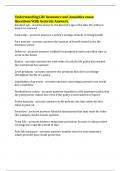
Understanding Life Insurance and Annuities exam
Questions With Accurate Answers.
Attained age - accurate answers-the insured's age at the time the policy is
issued or renewed
Cash value - accurate answers-a policy's savings element or living benefit
Face amount - accurate answers-the amount of benefit stated in the life
insurance policy
Deferred - accurate answers-withheld or postponed until a specified time or
event in the future
Endow - accurate answers-the cash value of a whole life policy has reached
the contractual face amount
Level premium - accurate answers-the premium that does not change
throughout the life of a policy
Liquidation of an estate - accurate answers-converting a person's net worth
into a cash flow
Nonforfeiture values - accurate answers-benefits in a life insurance policy that
the policyowner cannot lose even if the policy is surrendered or lapses
Policy maturity - accurate answers-in life policies, the time when the face
value is paid out
Securities - accurate answers-financial instruments that may trade for value
(for example, stocks, bonds, options)
Term Life - accurate answers-temporary protection because it only provides
coverage for a specific period of time
Pure life insurance - accurate answers-another term for term insurance,
which provides pure death protection
,Level Term - accurate answers-the most common type of temporary
protection purchased, where the death benefit does not change throughout
the life of the policy
Level premium term - accurate answers-provides a level death benefit and a
level premium during the policy term
Annually Renewable Term - accurate answers-the purest form of term
insurance where the death benefit remains level and the policy may be
guaranteed to be renewable each year
Increasing Term insurance - accurate answers-a type of term insurance that
will not be covered further in this course material as it is not required on the
state exam outline
Decreasing Term - accurate answers-a type of term coverage where the face
amount decreases over the policy term
Temporary protection - accurate answers-coverage that lasts for a specific
period of time
Permanent protection - accurate answers-coverage that lasts for the lifetime
of the insured
Death benefit - accurate answers-the amount paid to the beneficiary upon the
insured's death
Premium - accurate answers-the amount paid for the insurance coverage
Attained age at renewal - accurate answers-the insured's age at the time of
renewing the policy, which affects the premium
Maximum age for coverage - accurate answers-the age above which coverage
will not be offered or cannot be renewed
Cash value in whole life policy - accurate answers-the amount that
accumulates in a whole life policy, which can be accessed by the policyholder
, Decreasing Term Usage - accurate answers-Decreasing term is primarily used
when the amount of needed protection is time sensitive, or decreases over
time.
Decreasing Term Coverage - accurate answers-Decreasing term coverage is
commonly purchased to insure the payment of a mortgage or other debts if
the insured dies prematurely.
Decreasing Term Benefit - accurate answers-The amount of coverage thereby
decreases as the outstanding loan balance decreases each year.
Decreasing Term Policy Features - accurate answers-A decreasing term policy
is usually convertible; however, it is usually not renewable since the death
benefit is $0 at the end of the policy term.
Return of Premium (ROP) - accurate answers-Return of premium (ROP) life
insurance is an increasing term insurance policy that pays an additional death
benefit to the beneficiary equal to the amount of the premiums paid.
ROP Payment Conditions - accurate answers-The return of premium is paid if
the death occurs within a specified period of time or if the insured outlives the
policy term.
ROP Cost - accurate answers-ROP policies are structured to consider the low
risk factor of a term policy but at a significant increase in premium cost,
sometimes as much as 25% to 50% more.
Traditional Term Policies - accurate answers-Traditional term policies offer a
low-cost, simple-death benefit for a specified term but have no investment
component or cash value.
ROP Policy Expiration - accurate answers-When the term is over, the policy
expires, and the insured is without coverage.
ROP Policy Benefits - accurate answers-An ROP policy offers the pure
protection of a term policy, but if the insured remains healthy and is still alive
once the term limit expires, the insurance company guarantees a return of
premium.
Questions With Accurate Answers.
Attained age - accurate answers-the insured's age at the time the policy is
issued or renewed
Cash value - accurate answers-a policy's savings element or living benefit
Face amount - accurate answers-the amount of benefit stated in the life
insurance policy
Deferred - accurate answers-withheld or postponed until a specified time or
event in the future
Endow - accurate answers-the cash value of a whole life policy has reached
the contractual face amount
Level premium - accurate answers-the premium that does not change
throughout the life of a policy
Liquidation of an estate - accurate answers-converting a person's net worth
into a cash flow
Nonforfeiture values - accurate answers-benefits in a life insurance policy that
the policyowner cannot lose even if the policy is surrendered or lapses
Policy maturity - accurate answers-in life policies, the time when the face
value is paid out
Securities - accurate answers-financial instruments that may trade for value
(for example, stocks, bonds, options)
Term Life - accurate answers-temporary protection because it only provides
coverage for a specific period of time
Pure life insurance - accurate answers-another term for term insurance,
which provides pure death protection
,Level Term - accurate answers-the most common type of temporary
protection purchased, where the death benefit does not change throughout
the life of the policy
Level premium term - accurate answers-provides a level death benefit and a
level premium during the policy term
Annually Renewable Term - accurate answers-the purest form of term
insurance where the death benefit remains level and the policy may be
guaranteed to be renewable each year
Increasing Term insurance - accurate answers-a type of term insurance that
will not be covered further in this course material as it is not required on the
state exam outline
Decreasing Term - accurate answers-a type of term coverage where the face
amount decreases over the policy term
Temporary protection - accurate answers-coverage that lasts for a specific
period of time
Permanent protection - accurate answers-coverage that lasts for the lifetime
of the insured
Death benefit - accurate answers-the amount paid to the beneficiary upon the
insured's death
Premium - accurate answers-the amount paid for the insurance coverage
Attained age at renewal - accurate answers-the insured's age at the time of
renewing the policy, which affects the premium
Maximum age for coverage - accurate answers-the age above which coverage
will not be offered or cannot be renewed
Cash value in whole life policy - accurate answers-the amount that
accumulates in a whole life policy, which can be accessed by the policyholder
, Decreasing Term Usage - accurate answers-Decreasing term is primarily used
when the amount of needed protection is time sensitive, or decreases over
time.
Decreasing Term Coverage - accurate answers-Decreasing term coverage is
commonly purchased to insure the payment of a mortgage or other debts if
the insured dies prematurely.
Decreasing Term Benefit - accurate answers-The amount of coverage thereby
decreases as the outstanding loan balance decreases each year.
Decreasing Term Policy Features - accurate answers-A decreasing term policy
is usually convertible; however, it is usually not renewable since the death
benefit is $0 at the end of the policy term.
Return of Premium (ROP) - accurate answers-Return of premium (ROP) life
insurance is an increasing term insurance policy that pays an additional death
benefit to the beneficiary equal to the amount of the premiums paid.
ROP Payment Conditions - accurate answers-The return of premium is paid if
the death occurs within a specified period of time or if the insured outlives the
policy term.
ROP Cost - accurate answers-ROP policies are structured to consider the low
risk factor of a term policy but at a significant increase in premium cost,
sometimes as much as 25% to 50% more.
Traditional Term Policies - accurate answers-Traditional term policies offer a
low-cost, simple-death benefit for a specified term but have no investment
component or cash value.
ROP Policy Expiration - accurate answers-When the term is over, the policy
expires, and the insured is without coverage.
ROP Policy Benefits - accurate answers-An ROP policy offers the pure
protection of a term policy, but if the insured remains healthy and is still alive
once the term limit expires, the insurance company guarantees a return of
premium.


