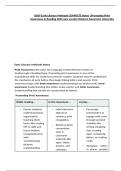
D669 Early Literacy Methods COMPLETE Notes |Promoting Print
Awareness in Reading 2025 new version Western Governors University
Early Literacy Methods Notes
Print Awareness falls under the Language Comprehension section of
Scarborough’s Reading Rope. Promoting print awareness is one of the
foundational skills for students to become readers. Students need to understand
the mechanics of print before they begin linking letters and sounds. Print
awareness helps with book awareness (understanding how books work), word
awareness (understanding that letters make words), and letter awareness
(understanding that sounds are represented by letters).
Promoting Print Awareness
While reading... In the classroom... At play...
• Ensure students • Label classroom • Encourage
understand book objects to preschoolers to
organization, reinforce print engage with print
teaching them recognition. through pretend
basics like reading activities like
• Reinforce print
left to right and writing shopping
conventions
top to bottom, lists, creating
seen in
recognizing print signs, composing
classroom
with letters, or making
materials like
accompanying cards.
signs, labels,
pictures,
posters, and • Recognize letters
understanding
calendars. in places outside
, page numbering, • Recognize letters of books.
and grasping the in places outside
• Play with letters
purpose of of books
of the alphabet
reading for
• Ensure classroom in centers or
meaning.
decor is full of during free play.
• Read aloud from print. Have things
books with large, available like
• Incorporate
easy-to-read print letter fridge
books, letters,
and stories magnets in a
songs, or rhymes
featuring play kitchen.
in different parts
predictable words.
of
Point to
words to connect
spoken and written
language.
• Use "big books"
to highlight
frequently
occurring words
like "a," "the,"
"is," "was," and • Include letters in
"you." art or sensory
activities, like
• Teach and practice the curriculum. building letters
print conventions
with clay or
such as left-to-right
finding letters in
directionality, word
a sensory bin.
boundaries,
capitalization, and
punctuation.
• Teach proper book
handling and
reinforce book
awareness.
When assessing students in print awareness, they are given a book and asked
,questions. Some of the things they may be asked are:
o Locate the front and back cover of the book.
o Identify the title of the book.
o Determine where to start reading.
o Determine the direction in which to read and where to go at the end
of a line.
o Point out a letter.
o Recognize capital and lowercase letters.
o Identify a word.
, o Recognize the first and last word of a sentence.
o Locate the first and last words on a page.
o Identify punctuation marks.
• print awareness: the understanding that printed text carries meaning,
including the recognition of words, letters, and the functions of various
elements in a book or written material
• letter awareness: the understanding that letters are representations of
sounds
• book awareness: the understanding of how books work, including
concepts such as reading from left to right, turning pages, and
recognizing the front and back covers
• word awareness: the recognition and understanding of individual words
as distinct units of language, including their sounds, meanings, and
spellings
• concepts about print: the understanding of how printed materials, such
as books and other written texts, function and are structured
Understanding how sounds are made is essential for teachers because it forms the
foundation of phonics instruction, a key component of early literacy development.
By understanding the articulation and phonetic properties of consonant sounds,
teachers can effectively guide students in decoding and encoding words, laying the
groundwork for reading and spelling skills. This knowledge also enables teachers to
diagnose and address difficulties in phonemic awareness, ensuring that students
receive targeted support to overcome literacy challenges.
Sounds are categorized by where the sound is made in your mouth and how your
mouth, teeth, tongue, and voice work together to make the sounds.
Sounds are also made with your voice, mouth, and breath together. How those
all work together are categorized into the following:
o Stops: Consonant sounds produced by momentarily stopping the
airflow in the vocal tract. Examples include /p/, /b/, /t/, /d/, /k/,
and /g/.
Awareness in Reading 2025 new version Western Governors University
Early Literacy Methods Notes
Print Awareness falls under the Language Comprehension section of
Scarborough’s Reading Rope. Promoting print awareness is one of the
foundational skills for students to become readers. Students need to understand
the mechanics of print before they begin linking letters and sounds. Print
awareness helps with book awareness (understanding how books work), word
awareness (understanding that letters make words), and letter awareness
(understanding that sounds are represented by letters).
Promoting Print Awareness
While reading... In the classroom... At play...
• Ensure students • Label classroom • Encourage
understand book objects to preschoolers to
organization, reinforce print engage with print
teaching them recognition. through pretend
basics like reading activities like
• Reinforce print
left to right and writing shopping
conventions
top to bottom, lists, creating
seen in
recognizing print signs, composing
classroom
with letters, or making
materials like
accompanying cards.
signs, labels,
pictures,
posters, and • Recognize letters
understanding
calendars. in places outside
, page numbering, • Recognize letters of books.
and grasping the in places outside
• Play with letters
purpose of of books
of the alphabet
reading for
• Ensure classroom in centers or
meaning.
decor is full of during free play.
• Read aloud from print. Have things
books with large, available like
• Incorporate
easy-to-read print letter fridge
books, letters,
and stories magnets in a
songs, or rhymes
featuring play kitchen.
in different parts
predictable words.
of
Point to
words to connect
spoken and written
language.
• Use "big books"
to highlight
frequently
occurring words
like "a," "the,"
"is," "was," and • Include letters in
"you." art or sensory
activities, like
• Teach and practice the curriculum. building letters
print conventions
with clay or
such as left-to-right
finding letters in
directionality, word
a sensory bin.
boundaries,
capitalization, and
punctuation.
• Teach proper book
handling and
reinforce book
awareness.
When assessing students in print awareness, they are given a book and asked
,questions. Some of the things they may be asked are:
o Locate the front and back cover of the book.
o Identify the title of the book.
o Determine where to start reading.
o Determine the direction in which to read and where to go at the end
of a line.
o Point out a letter.
o Recognize capital and lowercase letters.
o Identify a word.
, o Recognize the first and last word of a sentence.
o Locate the first and last words on a page.
o Identify punctuation marks.
• print awareness: the understanding that printed text carries meaning,
including the recognition of words, letters, and the functions of various
elements in a book or written material
• letter awareness: the understanding that letters are representations of
sounds
• book awareness: the understanding of how books work, including
concepts such as reading from left to right, turning pages, and
recognizing the front and back covers
• word awareness: the recognition and understanding of individual words
as distinct units of language, including their sounds, meanings, and
spellings
• concepts about print: the understanding of how printed materials, such
as books and other written texts, function and are structured
Understanding how sounds are made is essential for teachers because it forms the
foundation of phonics instruction, a key component of early literacy development.
By understanding the articulation and phonetic properties of consonant sounds,
teachers can effectively guide students in decoding and encoding words, laying the
groundwork for reading and spelling skills. This knowledge also enables teachers to
diagnose and address difficulties in phonemic awareness, ensuring that students
receive targeted support to overcome literacy challenges.
Sounds are categorized by where the sound is made in your mouth and how your
mouth, teeth, tongue, and voice work together to make the sounds.
Sounds are also made with your voice, mouth, and breath together. How those
all work together are categorized into the following:
o Stops: Consonant sounds produced by momentarily stopping the
airflow in the vocal tract. Examples include /p/, /b/, /t/, /d/, /k/,
and /g/.