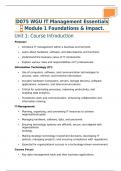
D075 WGU IT Management Essentials
- Module 1 Foundations & Impact.
Unit 1: Course Introduction
Purpose:
Introduce IT management within a business environment.
Learn about hardware, software, and data features and functions.
Understand the business value of IT components.
Explore various roles and responsibilities of IT professionals.
Information Technology (IT):
Use of computers, software, and communication technologies to
process, store, retrieve, and transmit information.
Includes hardware (computers, servers, storage devices), software
applications, networks, and telecommunications.
Critical for automating processes, improving productivity, and
enabling data analytics.
Transforms work and communication, enhancing collaboration and
information sharing.
IT Management:
Planning, organizing, and overseeing IT resources to achieve
organizational goals.
Managing hardware, software, data, and personnel.
Ensuring technology systems are efficient, secure, and aligned with
organizational
strategy.
Making strategic technology investment decisions, developing IT
policies, managing projects, and ensuring compliance with regulations.
Essential for organizational success in a technology-driven environment.
Course Focus:
Key data management tools and their business applications.
, Data management processes and their benefits.
Applying spreadsheet functions in data management.
Relationship between IT functions and business operations.
Supporting business innovation through IT.
Impact of the Internet of Things, social media, mobile apps, and
software on business communication and collaboration.
Excel Application:
Includes assignments using Excel.
Review Excel Assignments and Installing the Add-In for preparation.
Accounting and Information Technology
Purpose:
Understand the integration of IT in accounting.
Learn basic IT concepts relevant to accounting.
Accounting Overview:
Correlating information and recording financial transactions.
Summarizing, analyzing, and reporting transactions for management
and oversight agencies.
Impact of IT on Accounting:
Radical changes due to IT innovations.
Electronic processing of transactions, including paper checks.
Automation of previously manual accounting processes.
Course Focus:
Develop an understanding of basic IT concepts.
Identify when financial recording tools malfunction.
Recognize and address errors.
, Make informed decisions about system upgrades.
Professional Relevance:
IT innovations increase efficiency but require caution.
Errors in data fields can cause significant process failures.
Understanding IT helps diagnose and solve critical problems.
Expanded Responsibilities:
Protecting sensitive consumer financial information.
Tracking and recording organizational expenses and expenditures.
Managing IT-related costs and expenditures.
Value of IT Knowledge:
Helps understand the rationale behind IT costs and expenditures.
Identifies problems and discrepancies.
Enhances capability as a valuable accounting professional.
Healthcare and Information Technology Management
Purpose:
Understand the importance of IT in healthcare.
Learn IT management basics to contribute to patient health and data
safety.
Wi-Fi Connectivity in Healthcare:
Loss of connection can make patient data inaccessible.
Medical professionals may miss crucial updates on patient vitals.
Emergency communication can be hindered.
Course Focus:
Basics of IT management in healthcare.
Contributing to patient health, data safety, and other healthcare aspects.
Adoption of IT in Healthcare:
Rapid adoption of IT practices and products.
, Daily use of systems like Epic and Cerner, which are large databases.
Data Collection and Privacy:
Healthcare leads in data collection and privacy.
HIPAA provides robust privacy protections for over two decades.
Understanding these protections and IT support is crucial.
Professional Relevance:
Daily use of IT skills developed in the course.
Use of regional and national databases, billing systems, data mining,
wireless communication, paperless prescriptions, standardized
codes, and diagnosis support systems.
Critical role in updating systems as per federal guidelines.
Value of IT Knowledge:
Prepares you to be a strong contributor to healthcare management.
Enhances ability to partner with business, IT, and health professionals.
Significant impact on patient care.
Human Resources and Information Technology Management
Purpose:
Understand the critical role of HR in organizational success.
Learn about the strategic management of HR functions.
HR Functions:
Recruitment and selection.
Performance management.
Ensuring a compliant, safe, and ethical work environment.
Overseeing payroll and benefit administration.
Navigating employee relations issues.
- Module 1 Foundations & Impact.
Unit 1: Course Introduction
Purpose:
Introduce IT management within a business environment.
Learn about hardware, software, and data features and functions.
Understand the business value of IT components.
Explore various roles and responsibilities of IT professionals.
Information Technology (IT):
Use of computers, software, and communication technologies to
process, store, retrieve, and transmit information.
Includes hardware (computers, servers, storage devices), software
applications, networks, and telecommunications.
Critical for automating processes, improving productivity, and
enabling data analytics.
Transforms work and communication, enhancing collaboration and
information sharing.
IT Management:
Planning, organizing, and overseeing IT resources to achieve
organizational goals.
Managing hardware, software, data, and personnel.
Ensuring technology systems are efficient, secure, and aligned with
organizational
strategy.
Making strategic technology investment decisions, developing IT
policies, managing projects, and ensuring compliance with regulations.
Essential for organizational success in a technology-driven environment.
Course Focus:
Key data management tools and their business applications.
, Data management processes and their benefits.
Applying spreadsheet functions in data management.
Relationship between IT functions and business operations.
Supporting business innovation through IT.
Impact of the Internet of Things, social media, mobile apps, and
software on business communication and collaboration.
Excel Application:
Includes assignments using Excel.
Review Excel Assignments and Installing the Add-In for preparation.
Accounting and Information Technology
Purpose:
Understand the integration of IT in accounting.
Learn basic IT concepts relevant to accounting.
Accounting Overview:
Correlating information and recording financial transactions.
Summarizing, analyzing, and reporting transactions for management
and oversight agencies.
Impact of IT on Accounting:
Radical changes due to IT innovations.
Electronic processing of transactions, including paper checks.
Automation of previously manual accounting processes.
Course Focus:
Develop an understanding of basic IT concepts.
Identify when financial recording tools malfunction.
Recognize and address errors.
, Make informed decisions about system upgrades.
Professional Relevance:
IT innovations increase efficiency but require caution.
Errors in data fields can cause significant process failures.
Understanding IT helps diagnose and solve critical problems.
Expanded Responsibilities:
Protecting sensitive consumer financial information.
Tracking and recording organizational expenses and expenditures.
Managing IT-related costs and expenditures.
Value of IT Knowledge:
Helps understand the rationale behind IT costs and expenditures.
Identifies problems and discrepancies.
Enhances capability as a valuable accounting professional.
Healthcare and Information Technology Management
Purpose:
Understand the importance of IT in healthcare.
Learn IT management basics to contribute to patient health and data
safety.
Wi-Fi Connectivity in Healthcare:
Loss of connection can make patient data inaccessible.
Medical professionals may miss crucial updates on patient vitals.
Emergency communication can be hindered.
Course Focus:
Basics of IT management in healthcare.
Contributing to patient health, data safety, and other healthcare aspects.
Adoption of IT in Healthcare:
Rapid adoption of IT practices and products.
, Daily use of systems like Epic and Cerner, which are large databases.
Data Collection and Privacy:
Healthcare leads in data collection and privacy.
HIPAA provides robust privacy protections for over two decades.
Understanding these protections and IT support is crucial.
Professional Relevance:
Daily use of IT skills developed in the course.
Use of regional and national databases, billing systems, data mining,
wireless communication, paperless prescriptions, standardized
codes, and diagnosis support systems.
Critical role in updating systems as per federal guidelines.
Value of IT Knowledge:
Prepares you to be a strong contributor to healthcare management.
Enhances ability to partner with business, IT, and health professionals.
Significant impact on patient care.
Human Resources and Information Technology Management
Purpose:
Understand the critical role of HR in organizational success.
Learn about the strategic management of HR functions.
HR Functions:
Recruitment and selection.
Performance management.
Ensuring a compliant, safe, and ethical work environment.
Overseeing payroll and benefit administration.
Navigating employee relations issues.