
The muscular system
It’s used to enable movement. The framework of the human body us formed
by the skeleton. Bones of the skeleton are connected in various ways.
Muscles are attached to the bones. Bones, muscles and joints enable
movement.
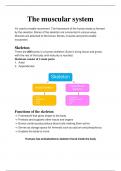
Skeleton
There are 206 bones in a human skeleton. Bone is living tissue and grows
with the rest of the body until maturity is reached.
Skeletons consist of 2 main parts:
1. Axial
2. Appendicular
Functions of the skeleton
® Framework that gives shape to the body
® Protects and supports other tissue and organs
® Bones continuously produce blood cells making them active
® Serves as storage space for minerals such as calcium and phosphorus
® Enables the body to move
Humans has endoskeletons; skeleton found inside the body
, Muscles
All muscles are attached to the skeleton. Muscles are made of tissue that
consists of fibres
Functions of muscles
® Ability to contract and relax
® Movement
® Ability to propel
Three types of muscles
1. Skeletal muscle
2. Smooth muscle
3. Cardiac muscle
Antagonistic muscles
® Muscles that work together in pairs
® Muscles can contract or relax- cannot push or stretch itself
® Biceps contact (flex) the elbow bends. At the same time the triceps relax
® Triceps contract, it stretches the elbow and straightens the arm. At the
same time the biceps relax
Muscles that work together are called antagonistic muscles
® Voluntary: be controlled
® Involuntary: done automatically through nerve stimulation
It’s used to enable movement. The framework of the human body us formed
by the skeleton. Bones of the skeleton are connected in various ways.
Muscles are attached to the bones. Bones, muscles and joints enable
movement.
Skeleton
There are 206 bones in a human skeleton. Bone is living tissue and grows
with the rest of the body until maturity is reached.
Skeletons consist of 2 main parts:
1. Axial
2. Appendicular
Functions of the skeleton
® Framework that gives shape to the body
® Protects and supports other tissue and organs
® Bones continuously produce blood cells making them active
® Serves as storage space for minerals such as calcium and phosphorus
® Enables the body to move
Humans has endoskeletons; skeleton found inside the body
, Muscles
All muscles are attached to the skeleton. Muscles are made of tissue that
consists of fibres
Functions of muscles
® Ability to contract and relax
® Movement
® Ability to propel
Three types of muscles
1. Skeletal muscle
2. Smooth muscle
3. Cardiac muscle
Antagonistic muscles
® Muscles that work together in pairs
® Muscles can contract or relax- cannot push or stretch itself
® Biceps contact (flex) the elbow bends. At the same time the triceps relax
® Triceps contract, it stretches the elbow and straightens the arm. At the
same time the biceps relax
Muscles that work together are called antagonistic muscles
® Voluntary: be controlled
® Involuntary: done automatically through nerve stimulation


