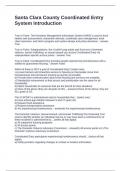
Santa Clara County Coordinated Entry
System Introduction
True or False: The Homeless Management Information System (HMIS) is used to track
intakes and assessments, streamline referrals, coordinate case management, track
client outcomes, and inform program and system design and policy decisions. - answer
True
True or False: Subpopulations, like Youth/Young adults and Survivors of domestic
violence, human trafficking, or sexual assault can access Coordinated Entry via
subpopulation-specific access points. - answer True
True or False: Coordinated Entry provides people experiencing homelessness with a
waitlist for guaranteed housing. - answer False
Which of these is NOT a goal of Coordinated Entry? (select one):
a) Lower barriers and streamline access to housing so that people move from
homelessness into permanent housing as quickly as possible.
b) Provide clear communication about what housing and services are available.
c) Standardize assessment so that access and prioritization are the same for all
households.
d) Match households to resources that are the best fit for their situations.
e) None of the above (they are all goals of CE). - answere) None of the above, they are
ALL goals of CE.
The VI-SPDAT is administered only for households that... (select one):
a) Have school-age children between 5 and 17 years old.
b) Request food assistance.
c) Request transportation assistance.
d) Are experiencing homelessness. - answerd) Are experiencing homelessness.
The Domestic Violence, Sexual Assault, and Human Trafficking Pre-Screening Tool
used to identify whether an individual may be or may have been a victim/survivor of
these incidents is administered by... (select all that apply):
a) All supportive housing programs.
b) All access points.
c) The Domestic Violence Advocacy Consortium. - answerb) All access points & c) The
Domestic Violence Advocacy Consortium
Coordinated Entry participants experiencing homelessness should... (select all that
apply):
a) Notify providers regarding changes in contact or location information.
System Introduction
True or False: The Homeless Management Information System (HMIS) is used to track
intakes and assessments, streamline referrals, coordinate case management, track
client outcomes, and inform program and system design and policy decisions. - answer
True
True or False: Subpopulations, like Youth/Young adults and Survivors of domestic
violence, human trafficking, or sexual assault can access Coordinated Entry via
subpopulation-specific access points. - answer True
True or False: Coordinated Entry provides people experiencing homelessness with a
waitlist for guaranteed housing. - answer False
Which of these is NOT a goal of Coordinated Entry? (select one):
a) Lower barriers and streamline access to housing so that people move from
homelessness into permanent housing as quickly as possible.
b) Provide clear communication about what housing and services are available.
c) Standardize assessment so that access and prioritization are the same for all
households.
d) Match households to resources that are the best fit for their situations.
e) None of the above (they are all goals of CE). - answere) None of the above, they are
ALL goals of CE.
The VI-SPDAT is administered only for households that... (select one):
a) Have school-age children between 5 and 17 years old.
b) Request food assistance.
c) Request transportation assistance.
d) Are experiencing homelessness. - answerd) Are experiencing homelessness.
The Domestic Violence, Sexual Assault, and Human Trafficking Pre-Screening Tool
used to identify whether an individual may be or may have been a victim/survivor of
these incidents is administered by... (select all that apply):
a) All supportive housing programs.
b) All access points.
c) The Domestic Violence Advocacy Consortium. - answerb) All access points & c) The
Domestic Violence Advocacy Consortium
Coordinated Entry participants experiencing homelessness should... (select all that
apply):
a) Notify providers regarding changes in contact or location information.