

Written by students who passed Immediately available after payment Read online or as PDF Wrong document? Swap it for free 4.6 TrustPilot
logo-home
Document preview thumbnail
Preview 1 out of 3 pages
Exam (elaborations)

Introduction to Veterinary Science, Chapter 1Certification Exam Examples Questions And Answers Solved.

Document preview thumbnail
Preview 1 out of 3 pages

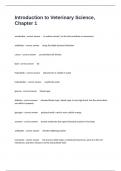
anesthetize - correct answer to sedate animals ( so the lack sensitivity or awareness) antibiotics - correct answer drugs that fight bacterial infections cancer - correct answer uncontrolled cell division lipid - correct answer fat hydrophilic - correct answer attracted to or soluble in water hydrophobic - correct answer repeled by water glucose - correct answer blood sugar diabetes - correct answer elevated blood sugar. blood sugar at very high levels, but the animal does not utilize it properly. glycogen - correct answer polysaccharide, used to store cellular energy. enzymes - correct answer protein molecules that speed chemical reaction in the body antibodies - correct answer infection-fighting proteins exocytosis - correct answer the process which takes a membrane-bound sac, joins it to the cell membrane, and then releases it to the extracellular fluid. metabolism - correct answer all reactions conducted in the cells anabolism - correct answer cellular reaction that breaks larger molecules into smaller ones homeostasis - correct answer maintenance of the extracellular fluid diffusion - correct answer process that allows molecules to move across a membrane in an effort to equal concentration osmosis - correct answer process that allows a solvent to move across a membrane in an effort to equalize concentration but will not allow large molecules of the solutes to pass solutes - correct answer molecules dissolved in the water active transport - correct answer process that allows the pumping of a substance into an area of higher concentration endocytosis - correct answer process that allows the cell membrane to wrap around a particle and then section it into the cytoplasm as a vacuole benign - correct answer description of tumor that is localized and will not spread to other areas of the body malignant - correct answer description of a tumor that will invade other parts of the body pathologists - correct answer scientist who interpret and diagnose changes in cells and tissues the smaller the molecule the more easily diffusion occurs - correct answer SER - correct answer smooth endoplasmic reticulum - correct answer has no ribosomes attached (ex. liver cells) metabolism - correct answer all cellular reactions extracellular fluid surrounds all living cells and is derived from - correct answer blood diabetes - correct answer too much blood sugar how many different types of amino acids are used to make proteins - correct answer 22 plasma membrane - correct answer cell membrane chromatin (DNA) - correct answer is found in the nucleus of the cell do mammals have an even or odd number of chromosomes - correct answer an even number of chromosomes do enzymes function identically in all species - correct answer no 5 mechanisms of cellular exchange - correct answer 1. diffusion, 2. osmosis 3. active transport , ytosis, 5, exocytosis 4 stages of mitosis - correct answer 1. interphase, ase, hase, 4. anaphase, hase how do cancer cells differ from normal cells - correct answer 1. too many cells involved in cell division, 2. invade surrounding tissue, 3. have a large nucleus with many nucleiin 4. chromatin is clumped and visible, 5. dividing cells have an abnormal spindle

Content preview

Introduction to Veterinary Science,
Chapter 1

anesthetize - correct answer to sedate animals ( so the lack sensitivity or awareness)


antibiotics - correct answer drugs that fight bacterial infections


cancer - correct answer uncontrolled cell division


lipid - correct answer fat


hydrophilic - correct answer attracted to or soluble in water


hydrophobic - correct answer repeled by water


glucose - correct answer blood sugar


diabetes - correct answer elevated blood sugar. blood sugar at very high levels, but the animal does
not utilize it properly.


glycogen - correct answer polysaccharide, used to store cellular energy.


enzymes - correct answer protein molecules that speed chemical reaction in the body


antibodies - correct answer infection-fighting proteins


exocytosis - correct answer the process which takes a membrane-bound sac, joins it to the cell
membrane, and then releases it to the extracellular fluid.


Document information

Uploaded on
June 18, 2025
Number of pages
3
Written in
2024/2025
Type
Exam (elaborations)
Contains
Questions & answers
$15.49

Wrong document? Swap it for free Within 14 days of purchase and before downloading, you can choose a different document. You can simply spend the amount again.
Written by students who passed
Immediately available after payment
Read online or as PDF

Seller avatar
Reputation scores are based on the amount of documents a seller has sold for a fee and the reviews they have received for those documents. There are three levels: Bronze, Silver and Gold. The better the reputation, the more your can rely on the quality of the sellers work.
Rechga
5.0
(10)
Sold
20
Followers
2
Items
2424
Last sold
1 month ago


Why students choose Stuvia

Created by fellow students, verified by reviews

Quality you can trust: written by students who passed their tests and reviewed by others who've used these notes.

Didn't get what you expected? Choose another document

No worries! You can instantly pick a different document that better fits what you're looking for.

Pay as you like, start learning right away

No subscription, no commitments. Pay the way you're used to via credit card and download your PDF document instantly.

Student with book image

“Bought, downloaded, and aced it. It really can be that simple.”

Alisha Student

Working on your references?

Create accurate citations in APA, MLA and Harvard with our free citation generator.

Working on your references?

Frequently asked questions
